
-


Follow Us

 On Facebook
 On Flipboard
 On Twitter
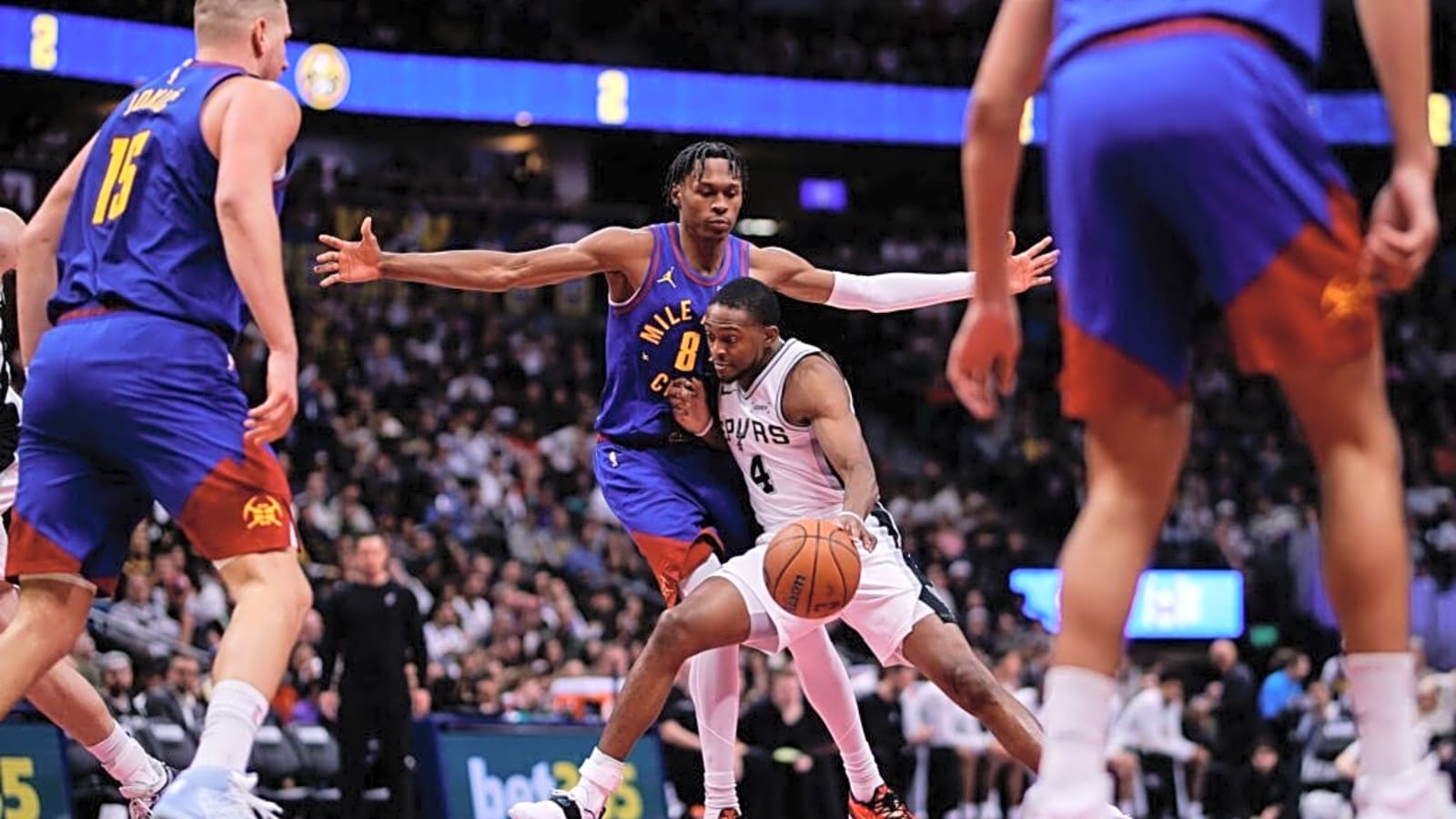
When the Spurs knocked the Nuggets out of the NBA Cup without Victor Wembanyama, it felt like San Antonio’s announcement to the league that, for the first time in the Wembanyama era, they’re not just playoff-bound but also fully capable of making some real noise in the postseason. And with that, a new question emerges: Could the Spurs’ development actually have transformed them into a legitimate threat to the Nuggets?
Can these Spurs be a Threat to the Nuggets?
San Antonio’s Journey From Tim Duncan To Victor Wembanyama
Their journey from the Tim Duncan era to this current iteration has been long and arduous. Of course, it helps to draft a generational talent, but he entered the league burdened with sky-high, almost unfair expectations. Yet somehow, he’s been able to meet nearly all of them. He’s already established himself as the NBA’s premier shot-blocker, while consistently producing highlights that feel almost inhuman. However, those superhuman plays have not translated into the team success you’d expect. One reason is that the Spurs’ roster was deeply flawed compared to what used to be the gold-standard system under Popovich. Additionally, part of the Wembanyama experience in the first couple of years was frequent live-ball turnovers, questionable shot selection, and injuries.
Gregg Popovich will undoubtedly go down as one of the league’s greatest ever coaches. However, it became increasingly clear that his age was starting to affect him, diminishing the quality of his coaching during his final years in San Antonio. The trademark discipline that defined the Spurs’ style of play for decades had completely vanished. The offense lost its beautiful, high-IQ ball movement, and the defense let its former cohesion fade into a shadow of what it once was.
For all the hype surrounding Wembanyama, he still had noticeable flaws on both ends of the court. Popovich—no longer carrying the same old-school edge—often allowed him to play through some truly rough stretches without the accountability he once famously imposed on his players in the past. It was a dynamic that risked cementing bad habits. However, he managed to outgrow all on his own.
How Smart Team-Building Transformed the Spurs
Year one of the Wembanyama era laid bare the personnel and coaching problems that had built up during the slow decline following the Duncan, Tony Parker, and Manu Ginobili years. The team’s internal evaluation of its own talent was questionable at best, with players like Jeremy Sochan and Keldon Johnson pushed into roles that stretched far beyond their capabilities.
What the Spurs needed was a significant roster upgrade—whether through internal development, strong drafting, or smart free-agent moves. Remarkably, the front office delivered in all three areas.
On the drafting front, Stephon Castle showed real promise as a rookie and has since grown into a high-level two-way guard. Dylan Harper already looks like one of the league’s most dynamic downhill threats and plays with a poise far beyond his years. The addition of De’Aaron Fox has been transformative, finally giving Wembanyama the stabilizing star point guard he lacked during the early years of his NBA journey. Meanwhile, veteran additions like Harrison Barnes and Luke Kornet have provided much-needed depth, defensive cohesion, and basketball maturity.
And finally, just as crucial has been the internal development of players who’ve been with the organization for years. Johnson and Sochan not only embraced bench roles without complaint—they’ve thrived in them, proving far more effective than when they were starters. Meanwhile, Julian Champagnie has blossomed into an excellent starting 3-and-D wing. If Devin Vassell can stay healthy, he possesses the talent to become an elite scoring option. These developments and smart decisions have transformed the Spurs into one of the better teams in the Western Conference.
The Nuggets Matchup

Despite all this—and despite that disappointing NBA Cup loss—Denver shouldn’t fear San Antonio, at least not yet. The Nuggets will still enter a potential series with these young Spurs as the favorites. Not only because they’re more experienced, but also because they can exploit several favorable matchups.
Defensively, the versatile pairing of Aaron Gordon and Christian Braun matches up well against the Wembanyama-Fox pick-and-roll. That allows Denver to hide Nikola Jokic by having him guard a less threatening offensive player. With his offensive growth this season, Peyton Watson can now play meaningful playoff minutes without opponents exploiting his limited shooting. One of the few bright spots in the NBA Cup loss was Watson’s ability to bother and chase Fox around screens effectively. His length and athleticism would also make him an intriguing matchup against Wembanyama, allowing the Nuggets to switch seamlessly whenever Gordon, Braun, or Watson are involved in the action.
Just as important is the fact that some Spurs players, despite their incredible talent, remain quite raw. Castle, for instance, still struggles with his three-point shooting. That potentially gives Denver a viable hiding spot for their superstar. Furthermore, a Castle-Fox backcourt also lacks perimeter shooting reliability. That allows the Nuggets the freedom to utilize different defensive schemes like their zone defense, for example.
Lessons the Nuggets Should Take From Their NBA Cup Defeat To San Antonio
Yet none of this means the Nuggets can simply shrug off the loss as meaningless. San Antonio exposed several issues that would resurface in a potential playoff matchup.
First and foremost, Denver’s pick-and-roll coverage was absolutely shocking. Of course, as mentioned before, without their defensive core in Braun and Aaron Gordon, both Valanciunas and Jokic looked helpless. When the Nuggets kept their bigs low, they allowed easy alley-oops to Kornet. That problem would only worsen with a superior lob threat like Wembanyama on the floor. However, when the bigs stepped up to the ball handler, Fox consistently turned the corner on them. He created clean looks either for himself or his teammates. Even with Braun and Gordon back in the lineup, the problem with the bigs will still remain in traditional pick-and-roll coverage. San Antonio’s quick guards relentlessly exploited both Jokic and Valanciunas, and there is no reason this would change in the future.
One possible solution is to use bench lineups without Valanciunas and play a more mobile frontcourt with Gordon and Watson. However, that would only be a minor fix, since Jokic will be on the floor most of the time.
Equally troubling is how hard it became for Denver to involve Jokic offensively when teams put undersized defenders on him. This has been a recurring problem for Jokic and the Nuggets. They still struggle against defenses that front him with a smaller body while placing a bigger rim protector behind him. That exact strategy was used effectively by the Thunder with Alex Caruso in last year’s postseason.
The Verdict
Ultimately, as long as Jokic asserts himself as the best player on the floor, the Nuggets shouldn’t panic. For all of Wembanyama’s defensive brilliance, he can still be outmuscled in the post and on the glass. Both areas are where Jokic can absolutely dominate him. With his combination of strength and skill, the three-time MVP can overwhelm Wembanyama and put him in foul trouble frequently.
That said, Denver should keep a close eye on San Antonio. The Spurs’ long-term trajectory is undeniably compelling, and they’re evolving into another legitimate threat in the Western Conference. That rise speeds up even more if the Spurs swing another blockbuster move, especially one for Giannis Antetokounmpo. Should that happen, the Nuggets have every reason to be scared.
The Western Conference features numerous elite teams. Teams like the Thunder, Lakers, and these fast-developing Spurs continue to get better. That reality makes Denver’s obligation to win now even more urgent.
More must-reads:
- LeBron James' agent says Lakers aren't true contenders
- Terry Rozier pleads not guilty to federal gambling charges
- The 'AL and NL MVPs since 2000' quiz
Breaking News
Trending News





Customize Your Newsletter
 +
+




Get the latest news and rumors, customized to your favorite sports and teams. Emailed daily. Always free!
PRIVACY POLICY EDITORIAL POLICY CONTACT US
ABOUT YARDBARKER TERMS OF SERVICE


Use of this website (including any and all parts and
components) constitutes your acceptance of these
Terms of Service and Privacy Policy.
This site is for entertainment purposes only.
There is no gambling offered on this site.
Gambling Problem? Call 1-800-Gambler.
