
-

-


Follow Us
-

 On Facebook
 On Flipboard

Somewhere inside the Raiders’ facility, the franchise’s future stopped belonging to one family. Mark Davis, the man who inherited a football dynasty from his father Al, sat across from a seven-time Super Bowl champion and a private equity titan and agreed to something no Davis had ever done before. He shared the wheel. Not symbolically. Not as a courtesy to investors writing checks. The controlling owner of a franchise valued at $9.9 billion in its latest minority transaction opened the door to a power structure the NFL has never quite seen.
The Davis Way Dies Quietly
Al Davis ran the Raiders like a sovereign nation. One voice. One vision. No committees. Mark inherited that model when his father died in 2011, and for years he held it together through sheer stubbornness. But stubbornness doesn’t generate $9.9 billion valuations. The NFL’s new private equity rules changed the math entirely, letting institutional money flow into franchises for the first time. Davis didn’t just adapt. He invited Silver Lake and Tom Brady into the building before most owners finished reading the memo.
Brady’s Five Percent Buys a Throne

NFL owners unanimously approved Brady’s roughly 5% personal stake in October 2024, with his broader group acquiring about 10.5% alongside Tom Wagner and Richard Seymour. Five percent. In most boardrooms, that buys you a chair and a quarterly report. In Las Vegas, it bought Brady something closer to a command center. The assumption was that celebrity owners sit courtside and smile. Brady had a different interpretation. And Davis, the man who could have kept him decorative, chose instead to lean on him heavily for football decisions.
The De Facto Boss

The Athletic reported it plainly: Davis has treated Brady “as the de facto boss when it comes to football matters.” Not a consultant. Not a sounding board, despite Brady’s own diplomatic phrasing. The de facto boss. A minority owner with a 5% stake calling the shots on football operations. Brady himself told Raiders.com he is “just a limited partner” and that “Mark’s the boss,” describing himself as “a great sounding board.” But the reporting tells a sharper story. Davis defers. Brady weighs in heavily. The franchise valued at $9.9 billion runs through a man who owns a sliver of it.
Silver Lake’s Silent Leverage
While Brady grabbed headlines, the real financial machinery moved quieter. A Silver Lake-led group is acquiring a 25% stake from existing minority investors — not from Davis — at a $9.9 billion valuation, and Durban’s group will own nearly 40% once the deal closes. Silver Lake co-chief executive Egon Durban already holds the right of first refusal to purchase controlling interest if Davis ever sells. Read that again. Controlling interest. The same firm tied to TKO and Endeavor/WME could eventually own the Raiders outright. Davis remains the controlling owner today, but the architecture around him looks less like a family business and more like a leveraged succession in progress.
The Valuation Gap Nobody Mentions

Forbes valued the Raiders at $7.7 billion in 2025, and Sportico currently pegs them at $7.9 billion. The Silver Lake transaction priced them at $9.9 billion — though Bloomberg reports Durban’s blended rate across his stakes is believed to be under $8 billion. That’s still a roughly $2 billion premium over independent analyst valuations. ESPN has reported a significant portion of the Raiders’ rising value can probably be attributed to Brady’s presence alone. His name on the ownership rolls didn’t just add prestige. It helped inflate the headline price tag by billions. Tom Brady turned his celebrity into a valuation lever, and Davis cashed the check.
The Template Other Owners Fear

Every NFL owner watched this deal close and did the same math. Celebrity minority owner plus private equity muscle equals valuations that leap past Forbes and Sportico estimates. The Raiders built a template. If it works, expect retired superstars and hedge fund managers circling every franchise with a willing seller. The precedent Davis set goes beyond Las Vegas. He proved that splitting power can multiply value. The old model of one-man rule kept franchises stable. The new model makes them richer, faster, with consequences nobody has tested yet.
A Franchise Built on Allegiant Sand

Once you see the structure, you can’t unsee it. Davis controls the vote. Brady carries outsized influence over football. Silver Lake controls the financial trajectory. Three power centers inside one franchise, each with different incentives. Brady wants wins. Durban wants returns. Davis wants legacy. That alignment works beautifully when the team is ascending. The moment it fractures, when a quarterback decision conflicts with a balance sheet priority, there’s no precedent for who wins. The Raiders aren’t just testing a new ownership model. They’re stress-testing it live.
The Escalation Nobody Sees Coming
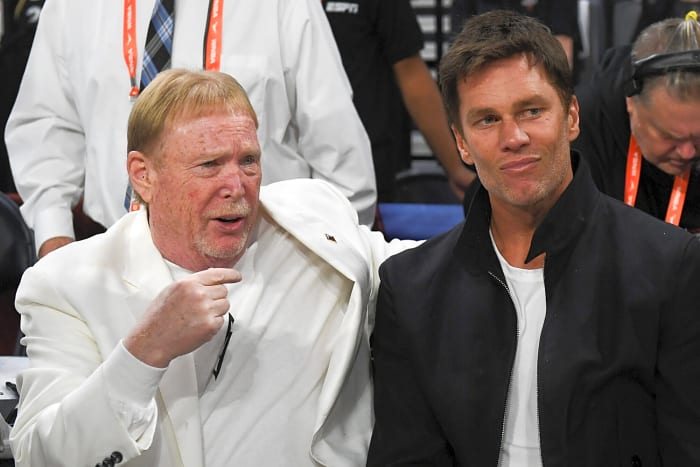
Durban’s option to acquire controlling interest isn’t hypothetical. It’s contractual, approved by NFL owners in March 2026. Davis has publicly said he is not selling his majority stake yet, but the succession plan is in place. Within the coming years, the Raiders could transition from Davis family control to private equity control, with Brady serving as the football-facing figure of a Wall Street portfolio. The franchise that Al Davis built on rebellion and independence could become a subsidiary. Other owners who follow Davis’s playbook may find themselves in the same position: minority shareholders in buildings that used to carry their names.
Who Really Owns the Raiders Now

Davis still signs the checks. Brady still calls himself a sounding board. Silver Lake still calls it a minority investment. Everyone’s telling a polite version of the same story. But the $9.9 billion valuation tells the real one: the Raiders are now a financial instrument as much as a football team, and the people shaping its future hold spreadsheets, not playbooks. The franchise — projected at roughly $10 billion or more whenever a controlling sale eventually completes — will belong to whoever controls the capital. Right now, that answer is changing faster than anyone in Las Vegas will admit. Would you trust Tom Brady to run your favorite franchise’s football operations on a 5% stake — or is Mark Davis handing over too much for too little? Sound off in the comments.
More must-reads:
- NFL insider shares why Ravens' Lamar Jackson will 'most likely' be traded soon
- Rams give Matthew Stafford contract extension just after drafting his replacement
- The 'NFL's active 1K-rushers' quiz
Breaking News
Trending News



Customize Your Newsletter
 +
+




Get the latest news and rumors, customized to your favorite sports and teams. Emailed daily. Always free!
PRIVACY POLICY COOKIE POLICY CONTACT US
ABOUT YARDBARKER TERMS OF SERVICE


By using this site, you agree to our Terms of Service and Privacy Policy.
This site is for entertainment purposes only.
There is no gambling offered on this site.
Gambling Problem? Call 1-800-Gambler.
