
-


Follow Us

 On Facebook
 On Flipboard
 On Twitter
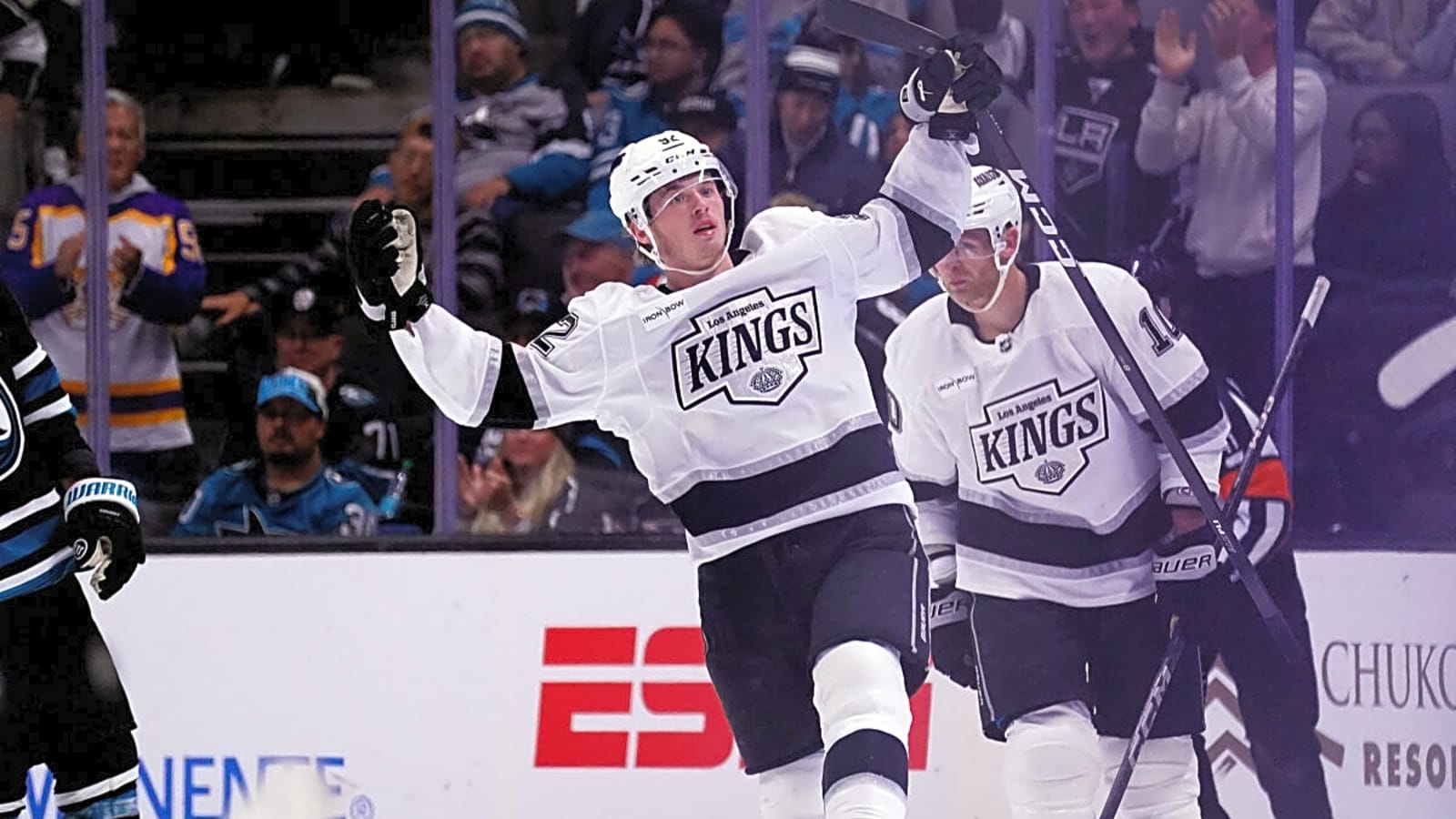
What transformed into one of the most dangerous aspects of the Los Angeles Kings’ offense after last season’s trade deadline, and even propelled them to a two-game series lead over the Edmonton Oilers in Round 1 of the Stanley Cup Playoffs, has fallen completely off the rails.
The five-forward power play unit was first introduced after the acquisition of Andrei Kuzmenko. There have been different variations at different points, but for the most part, the first unit has consisted of Adrian Kempe, Anze Kopitar, Quinton Byfield, Kevin Fiala, and Kuzmenko. With a unit as skilled as this one, it’s shocking how ineffective it’s been.
Power Play In Shambles
Through the first 25 games played this season, the Kings have the fifth-worst power-play percentage league-wide, operating at a mere 14.1 percent (they have also had the seventh most power-play opportunities). For a power play that has that much skill and talent on it, the success rate is nowhere near where it should be. It doesn’t get any better when you take a look at who leads the NHL in shorthanded goals against. That’s right, the Kings are currently tied for the most shorthanded goals against with four.
“The power play has struggled in general,” Kings coach Jim Hiller said. “The group of five of them clearly aren’t getting it done as constructed. We have talked about it a few times…It’s something we are thinking about, and it doesn’t look good. It’s cost us games, so when it gets to that point, you might have to make some changes.”
This was expressed just moments after the Kings fell to the Boston Bruins 2-1 in overtime, less than two weeks ago, in a game that saw them squander all five power-play opportunities.
Despite the awareness from Hiller, no changes were made to the power play. The Kings elected to keep everything the same against the Ottawa Senators, a team with a bottom-three penalty kill in the league. It was Brandt Clarke, quarterbacking the second unit, who scored the Kings’ first power-play goal after 12 consecutive missed opportunities. A positive for an individual continuing to make his case for a crack at PP1, but another reminder of how unproductive the five-forward PP1 is.
The Kings had just one power play the following game against the Anaheim Ducks, in which they didn’t score, but what happened the game after that is what ended up being the final straw. The Kings hosted the Vancouver Canucks on Saturday, who came into the game with the league’s worst penalty kill, operating at a measly 70.5%. The Kings had four cracks at the man advantage against Vancouver and had nothing to show for it. If you can’t find the back of the net on four opportunities against the team with the worst penalty kill, then that’s a pretty good indication that something has to change.
Let’s put this even more into perspective. Over the past 13 games, the Kings have had 45 power-play opportunities, about 3.46 per game. Over that span, they have scored just five times (an abysmal power-play percentage of 0.11%). Not only that, but during that same span, they allowed three shorthanded goals against. So they can’t score and are also having trouble keeping the puck out of their net, all while having a man advantage. How much more evidence is needed for a change to be made?
Why is it so bad? There are multiple factors, but some are more evident than others. First and foremost, the structure of that first unit. Kempe, arguably the team’s most dangerous goal scorer (either him or Fiala), is manning the point. It’s not the ideal spot for a sniper, but what has made it worse is his decision-making when playing at that position. Low-danger shots are a lot of what we have seen from Kempe at the point, and most of them feel like wasted opportunities.
Kuzmenko’s first instinct is always to move the puck, even when he’s in a prime position to shoot. He has a lethal shot, but it just doesn’t seem like he wants to use it. As a five-man unit, there’s a lack of movement and fluidity as well. There’s nothing dangerous about how the Kings’ power play operates, and it’s not only a big reason why they aren’t scoring, but also why the opposition can kill it off easily and generate chances of their own. The back-and-forth perimeter passing that leads to a shot from the point just doesn’t work.
“I think you will probably see some broader changes once Drew ends up coming back into the lineup,” Hiller said following the overtime win against the Canucks.
Initially, Hiller made it seem as if changes weren’t going to happen right away, despite the continued lack of production, and that this group was okay with staying the course until Doughty returned. Perhaps a little more time spent thinking about the current state of the power play is all Hiller needed to pull the trigger and change it up now, as opposed to waiting for Doughty to return.
Maybe there’s a complete overhaul in the works for when the veteran defenseman is ready to return, and other possible formations are being discussed. Regardless of Doughty’s timeline (which is still up in the air) or other future possibilities, one thing is clear: something had to change now. It doesn’t make sense to continue on this way. Not when the lack of production is actively killing them in games. It’s no longer plausible for the Kings to continue with the five-forward unit. It was great while it worked, but it’s gotten to a point where it has become detrimental, and it seems as if Hiller and the rest of the coaching staff agree.
During Monday’s practice, Clarke was seen taking reps on the first unit. Logically, even with Doughty healthy, Clarke is the guy you want playing the point on the first power-play unit. Not only has he earned the opportunity, but it’s what he was made for. Brian Dumoulin was also seen practicing with the second unit, indicating the long-awaited end to the five-forward unit.
There were other small changes as well from what was seen at practice, and Hiller later confirmed that all the changes would be implemented against the Washington Capitals.
“We have talked about this for a while, I think more than anything, the energy had to change,” Hiller said. “We kept going back to the well, and it just had to change.”
Here are what the new units look like heading into tonight’s game.
PP1: Anze Kopitar, Adrian Kempe, Kevin Fiala, Andrei Kuzmenko, Brandt Clarke
PP2: Quinton Byfield, Corey Perry, Joel Armia, Alex Laferriere, Brian Dumoulin
Hopefully, with the personnel change comes a different approach to generating chances on the power play as well. The switch allows Clarke to finally get a chance in a spot he should have had earlier, while also moving Kempe away from the point. Two big positives and two changes that should lead to an improvement. Clarke will provide an element on the blue line that was missing, and having a defenseman on both units will be more beneficial to combating any potential shorthanded chances against.
At the end of the day, it can’t get any worse. A change was needed, and only time will tell if the Kings can turn it around on the man advantage and start using all that talent to their advantage.
More must-reads:
- Five NHL teams that are out of the playoffs now but will make the postseason
- Patriots' Christian Elliss sends message to Giants' Jaxson Dart after crunching hit
- The '1,500-receiving-yard NFL seasons' quiz
Breaking News
Trending News








Customize Your Newsletter
 +
+




Get the latest news and rumors, customized to your favorite sports and teams. Emailed daily. Always free!
PRIVACY POLICY EDITORIAL POLICY CONTACT US
ABOUT YARDBARKER TERMS OF SERVICE


Use of this website (including any and all parts and
components) constitutes your acceptance of these
Terms of Service and Privacy Policy.
This site is for entertainment purposes only.
There is no gambling offered on this site.
Gambling Problem? Call 1-800-Gambler.
