
-

-


Follow Us
-

 On Facebook
 On Flipboard
 On Twitter
I’ve enjoyed some really good atmospheres over the years. Arkansas, Tennessee, and Coastal Carolina have all delivered with rowdy crowds. However, ECU might top the list for me. It’s not too often that a mid-major group can wow me, but their fanbase is built on extreme passion. I’ve always felt that they would turn Omaha purple upon setting foot at Charles Schwab.
Now, put that up against a Tar Heel fanbase that consistently packs the Bosh and might be the most faithful group in the ACC. You get chaos.
For a long time, I’ve wanted to cross this series off the bucket list. Both programs have a long history of producing talent, and over the years, I’ve found myself elsewhere. With how talented both rosters were this spring, it was an easy decision to make it happen.
After exchanging blowouts on Friday and Saturday, Sunday’s contest was a duel that Mother Nature wanted to interrupt. As a result of the rain, the rubber match of the series wound up in a tie, creating a balanced outcome that even Thanos could admire. Despite the oddity that was this series, there was plenty of talent on full display, so let’s dive into who stood out.
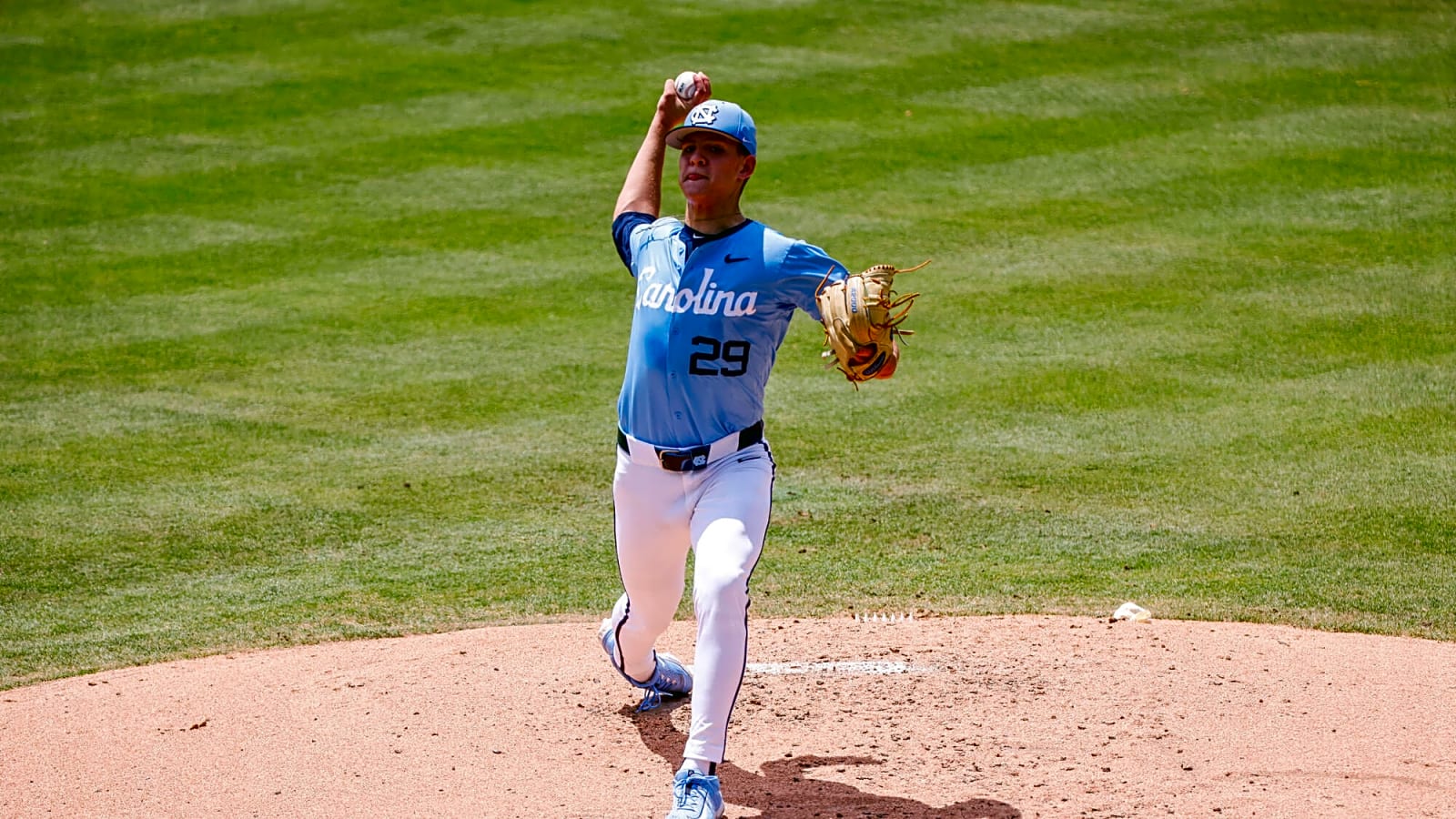
RHP Jason DeCaro, North Carolina
Final Line: 8 IP, 5 H, 0 R, 1 BB, 7 K (66 Strikes/101 Pitches)
I won’t mince words, this was the best outing I’ve seen from DeCaro since making it to campus.
In the postgame media scrum, DeCaro had mentioned how he didn’t feel settled in until the fifth inning, though with how efficient he was to that point, it was tough to tell. In fact, his fifth inning of work was his most laborious. DeCaro averaged just under 12.5 pitches per inning in his shutout of the Pirates, a testament to how good he was on Friday.
.@DiamondHeels RHP Jason DeCaro was phenomenal tonight, throwing a CGSHO at ECU.
— Tyler Jennings (@TylerJennings24) February 21, 2026
FB – 90-94, 2,500+
SL – 81-84, tight breaker
CB – 75-78, landed for strikes, 3K+ spin
CH – 81-83, AA with fade
Exceptional sequencing throughout the night = high floor. Untapped upside is there. pic.twitter.com/5JWLgQo2u5
The most noteworthy change that DeCaro has made to his delivery is raising his arm slot, with his new release height hovering just south of the six-and-a-half-foot mark.
This change has allowed DeCaro to trade some tail for carry on his low-90s fastball, as he averaged more carry (~19.6″) than run (~15.8″) on the offering. While he did struggle to locate armside early on, DeCaro did a great job of setting up his secondary offerings with the pitch as the outing went on.
The best secondary in his repertoire was his low-80s change-up, which was exceptional on Friday. A unique high-spin offering (2,500+ RPMs), DeCaro generated seven whiffs on eight swings with the pitch, equating to an 88% whiff rate. The pitch flashed plus with great fading life, commanding it below the zone to lefties.
His low-80s slider has gotten firmer, displaying medium sweep with slight depth. He’d use it to steal strikes consistently, while flipping in his mid-70s curveball to generate called third strikes. Both pitches displayed loud spin metrics, with each pitch tickling the 3,000 RPM barrier. He did an exceptional job of sequencing his arsenal and kept hitters guessing on what was to come.
He’s an easy Day 1 arm in this draft class, and given the traits and polish, he feels like a lock to go within the first two rounds in some fashion. He may need a bit more of a specific development fit to unlock another echelon to his game, but this is a no-doubt starter profile in pro ball.
2B Gavin Gallaher, North Carolina
Final Line: 4-12, 6 RBI, 1 2B, 1 HR, 1 K
North Carolina’s postseason hero had some of the most mature at-bats of the weekend from either side.
Gallaher’s swing is a thing of beauty. It’s well-connected, visually appealing, and boasts good leverage. There’s a bit of bat speed through the zone, plus he can backspin the ball well, which helped him pull a middle-middle splitter from Gavin Van Kempen over the Blue Monster on Saturday for a game-tying three-run blast.
While his exit velocities will never be jaw-dropping (the homer left the bat at 97 MPH), he’s someone who will use his strengths to find success. In the case of Gallaher, he has a long history of pulling the baseball in the air at a high clip, especially to the left-center gap.
I loved Gavin Gallaher quite a bit last year after a breakout performance, and he looks the part tonight.
— Tyler Jennings (@TylerJennings24) February 21, 2026
Nearly took Ethan Norby deep to the opposite field gap, but settled for a double at 101 MPH. Well-connected, smooth swing.
#65 on the @JustBB_Media College T100. pic.twitter.com/aFy0JqMe2i
However, Gallaher is more than just a pull-side merchant. He’s got punch to the opposite-field gap, which was on display with the swing above, which nearly left the yard at 101 MPH. He’s not afraid to spread the ball around the park to show off the hit tool.
If there’s one thing that did stand out about his plate discipline, it was his affinity for hunting heaters.
He’s long been a good fastball hitter, posting a contact rate of 82% against velocity the past two years, though this weekend, Gallaher was swinging early and often at heat. He’d watch a pitch or two before throwing the barrel at heaters down the heart of the plate. He has the contact skills to fight pitches on the black off to stay alive in two-strike counts.
As a defender, Gallaher looks to be in more control at his new home at second base. It’s nothing flashy, but it’s a serviceable defender with good instincts and isn’t rushing himself to make plays. It does look better than his adventures at third base. He’s not a burner on the basepaths, even with a long follow-through on his swing that hampers his ability to get out of the box well.
Overall, Gallaher should hear his name called within the top five rounds, as his gap-to-gap approach and pull-side authority will give him a future in pro ball.
RHP Ryan Lynch, North Carolina
Final Line: 5 IP, 6 H, 3 ER, 1 BB, 5 K (49 Strikes/76 Pitches)
Despite Mother Nature raining on his parade, Lynch’s first two innings of work were electric on Sunday before he began to scuffle with command.
Boasting a workhorse build with plenty of strength, Lynch is a “metric darling” of sorts. His outlandishly low release height, which hovers around the five-foot mark, is tremendous for his size, as he sinks into his back leg very well and generates good extension. This gives him a flatter approach angle to the plate, though he’s used his heavy heater to attack inside to hitters.
We're in a rain delay in Chapel Hill, so here's some film of the starters.
— Tyler Jennings (@TylerJennings24) February 22, 2026
Ryan Lynch was electric to start, but scuffled with command later in outing. FB was 93-97 with heavy run/bore (20" of HM), pairing it with a sweeper at 82-84 (-19" HM). Flashed CH late. Solid clay here. pic.twitter.com/ufDtdlS6vD
Given the low release height, Lynch generates a ton of run and sink out of the hand, averaging nineteen inches of horizontal movement on the day.
There were times later in the outing when he struggled to command both sides of the plate, though he showed a willingness to bore the pitch in on the hands of righties and generate uncomfortable swings. He showed an ability to generate quality carry (12-14″ IVB), which is an excellent mark given the slot he throws from.
He spent most of the outing sitting in the mid-90s and reached back for 97 MPH twice. Another interesting aspect of Lynch’s heater is its high spin, as he reached 2,700 RPMs and sat just under 2,600 RPMs.
Lynch will continue to attack the horizontal axis of the strike zone with his low-80s sweeper, which averaged close to twelve inches of sweep and got up to nineteen early on. He primarily used it late in the count after setting it up with his heater, though he began to lose feel when the rain became heavier. He went to a mid-80s change-up later in the outing, killing spin and featuring running action, though it’s a work in progress.
Given his size, strike-throwing, and two plus pitches, Lynch has a future as a starter at the next level. He’ll need to expand the arsenal, though he’s shown the ability to carve through lineups with his fastball/slider combination. Like DeCaro, he should hear his name called on Day 1.
OF Braden Burress, East Carolina
Final Line: 7-11, 3 R, 1 BB, 2 K
One thing stood out to me about Burress’ game this weekend: he’s a legitimate sparkplug that’s perfect in the leadoff spot.
Burress finished the weekend with seven total hits, and while they were only singles, the hit tool is the standout asset in his profile. He prioritizes putting the ball in play, where he’s able to put his above-average to plus speed on display and terrorize infielders.
That said, he’s a bit on the passive side, swinging ~35% of the time and rarely chasing pitches out of the zone. He can get behind in counts as a result, but if he sees a fastball in the zone, he will not miss it. He’s one of the best pure hitters this side of the Mississippi.
Given his smaller stature, Burress won’t slug the baseball often, featuring well-below-average power at best. He’ll spread the ball around the infield, though when he elects to sting the baseball, he’ll generate upper-90s exit velocities on a line. It’s the weakest part of his profile, and admittedly, he’ll need to show more impact moving forward.
Defensively, Burress is relegated to second base as a result of Grady Lenahan manning center, though he got reps in left field on Friday. He’s a solid defender at both positions, though I was more impressed with his reads and arm strength in the outfield.
He gets solid jumps off the bat and covers plenty of ground with his speed, giving some the idea that he can man center at some capacity. In the dirt, he has some bounce and high-level instincts, as well, though the arm strength did lack slightly.
While he isn’t eligible until next summer, Burress has already made quality impressions in front of scouts and should generate some value at the next level, though he’s got to grow into more impact to achieve that. That said, he’s the perfect leadoff hitter for a club looking for a spark to kick things off. For a walk-on player, this is a great story.
RHP Gavin Van Kempen, East Carolina
Final Line: 4.1 IP, 3 H, 3 ER, 2 BB, 5 K (51 Strikes/81 Pitches)
East Carolina saw what Trey Yesavage did for them for three years, so they decided to find guys with nearly identical release heights. Van Kempen certainly fits that bill.
A transfer from West Virginia with prior starting experience, Van Kempen’s release height sits over seven feet tall, and he toys with the vertical axis of the strike zone regularly. In a world where outlier release traits are sought after, Van Kempen jumps right off the page. Despite his height, he controls his body rather well, utilizing a compact skip down the bump before releasing the baseball.
Van Kempen held low-90s velocity throughout the start, reaching 94 MPH at his peak early in the outing. He relied on the heater regularly the first time through the order, using it primarily to set up his secondary offerings. Considering the release height, he does get considerable backspin and carry on the heater, though he showed some tail late through the zone. He got three whiffs on the pitch, all in the upper third of the strike zone.
His secondaries play well from the angle created by his release. His mid-80s splitter kills plenty of spin and dives to the dirt, possessing great feel to throw to both sides of the plate. He has confidence in throwing it to both lefties and righties alike, though in this outing, he did run into some command woes later in the outing. Most notably, he left one middle-middle to Gavin Gallaher, which he proceeded to deposit over the Blue Monster.
He has two breaking balls in his arsenal, a firm mid-80s cutter and a bigger low-80s curveball. The curveball was the better of the two offerings, featuring sharp bite and shorter break from the release. It’s a true downer breaker with minimal hump out of the hand, commanding it well, and utilizing it to steal strikes. The cutter gave him a bit of a horizontal option, primarily hammering the outside corners with the pitch to righties.
Overall, Van Kempen mixed his pitches well and has some viability at the next level. He’s a senior and should give a team some savings in the middle rounds, especially if he’s able to hold form throughout the year.
RHP Sean Jenkins, East Carolina
Final Line: 4.2 IP, 1 H, 0 ER, 0 BB, 7 K (39 Strikes/56 Pitches)
A bulky sophomore arm, Jenkins has been outstanding out of the bullpen for the Pirates. However, his magnum opus of the young season was on Saturday, where he allowed just one baserunner across 4.2 scoreless frames.
After throwing more of a sweeping breaking ball last year, Jenkins has turned his slider into an upper-80s monster, flashing legitimate two-plane break with serious snap. He relied on it heavily against UNC, throwing it nearly 80% of the time and locating it perfectly to his gloveside. To quote a scout at the game, the pitch dives to the dirt like a “torpedo,” and hitters could not touch it. It touched 90 MPH with spin rates routinely in the 2,500-2,600 RPM range.
ECU's Sean Jenkins was electric out of the bullpen today, going 4.2 scoreless with 7 K's and only one baserunner after taking over.
— Tyler Jennings (@TylerJennings24) February 21, 2026
Leaned heavily upon his upper-80s bullet SL that touched 90, pairing it with a heavy mid-90s sinker and mid-80s split.
17:2 K:BB already in '26. pic.twitter.com/XX4wMYnXLj
Jenkins would flash a heavy sinker in the mid-90s, which is another noteworthy development. After sitting around 92 MPH as a true freshman, he has ramped up his velocity, reaching 97 MPH. He’ll toy with a low-spin splitter that he can locate away from lefties, though it is a work in progress.
The fact of the matter is this: Jenkins has found significant success in his new role and is on his way to a breakout campaign, the next in a long line of Pirate pitchers to do so as a sophomore. He already has a 17:2 K:BB ratio just two weeks into the season, an insane ratio to boast this early.
He should see starts down the line for ECU, especially as a junior. The ceiling is high, plus he projects to be a model-friendly arm when he’s eligible next summer, thanks to a reclassification in high school.
OF Grady Lenahan, East Carolina
Final Line: 4-10, 1 2B, 1 3B, 1 HR, 6 RBI, 2 K
Ranked as one of the top freshmen in the entire country, it’s easy to see why we snuck Lenahan onto the back end of our Top 315 rankings in 2025. He was a single shy of the cycle in a huge coming-out game on Saturday, where he recorded a team-high 6 RBI.
An athletic, projectable centerfielder, Lenahan is an interesting cat at the dish. He has two distinct stances at the plate: one upright, the other crouched and wide. He keeps his hands just above his forehead and drifts into a launch position during his load, which allows them to stay tight to his body and compact through the zone.
Lenahan has a history of pulling the ball with authority, as shown in Friday’s and Saturday’s games. He smoked a line drive at 107 MPH against Jason DeCaro and peppered the Blue Monster in Durham with a home run and a triple, though those balls carried more due to the leverage and backspin Lenahan creates with his swing. All of his damage came on pitches on the outer third, where he could get his arms extended.
Not a bad time to get your 1st career HR, I'd say.
— Tyler Jennings (@TylerJennings24) February 21, 2026
Grady Lenahan leans on a hanging SL and gets enough on it to carry it over the Blue Monster for a go-ahead three-run HR. 101 EV/371 feet. This kid is going to be really, really good.
Also, the crowd's pop was electric. pic.twitter.com/ZFGadnhBA7
If there is one thing to critique with his game, it’s his aggression at the dish. Lenahan is jumpy at the dish and swings the bat at a high clip, though more mature swing decisions should come with time. He should grow into a bat that utilizes the gaps routinely to show off his plus speed, and the affinity for the pull side wall is the cherry on top.
With the plus speed, Lenahan covers plenty of ground in center, and he made a couple of tough plays in the gaps to steal hits away from UNC. He played the position as a prepster at Pro5 Academy, and it’s clear he has an excellent feel for the position, with range and instincts. He should stick at the position long term, assuming he doesn’t outgrow his athleticism.
Lenahan will not be eligible again until 2028, but the early reviews speak highly of his ability on the baseball field.
Next Stop: Amegy College Baseball Series in Arlington, Texas
More must-reads:
- Brooks Koepka speaks about his legacy in typically nonchalant fashion
- Penguins reveal Sidney Crosby's fate after suffering injury during Olympics
- The 'Last 1K-rushing-yard season by team' quiz
Breaking News
Trending News






Customize Your Newsletter
 +
+




Get the latest news and rumors, customized to your favorite sports and teams. Emailed daily. Always free!
PRIVACY POLICY COOKIE POLICY CONTACT US
ABOUT YARDBARKER TERMS OF SERVICE


By using this site, you agree to our Terms of Service and Privacy Policy.
This site is for entertainment purposes only.
There is no gambling offered on this site.
Gambling Problem? Call 1-800-Gambler.
