
-

-


Follow Us
-

 On Facebook
 On Flipboard



The end of It: Welcome to Derry’s sixth episode cues up what is sure to be one of the show’s most harrowing events. It is an event that we know will be difficult to watch. We’re talking about the Black Spot fire, a hate crime perpetrated against Derry’s Black community that killed some forty people. Director Andy Muschietti referenced it in the films and it’s also in Stephen King’s original 1986 novel. We don’t get too much about the Black Spot fire either in the novel or in the films, beyond a reference. However, we get enough to form an idea about what is yet to come in the HBO series’ final episodes.
The timeline in Stephen King’s book is completely different from the film and TV version, of course, as much as it might stick to the general events. In King’s novel, the Losers Club faced Pennywise in 1958, with the previous cycle starting in 1929, ending in 1930. The It films, along with Welcome to Derry, switched things up timeline-wise, with the Loser’s Club forming in 1989, with the previous cycle in this universe’s Derry taking place in 1962. This means they moved the Black Spot fire from the end of 1930 to 1962 for the HBO series.
Much like we see in the series, in the book, the Black Spot was a popular hangout for Black soldiers stationed at the nearby Derry Air Force Base. In the time of the fire in the novel, 1930, the U.S. Military was still strictly segregated. So, the Black officers couldn’t mingle socially with their fellow white soldiers on base, even if they wanted to. At least not on sanctioned military facilities. So they had no choice but to make a safe space for themselves separately, even though their more open-minded white officers sometimes joined them.
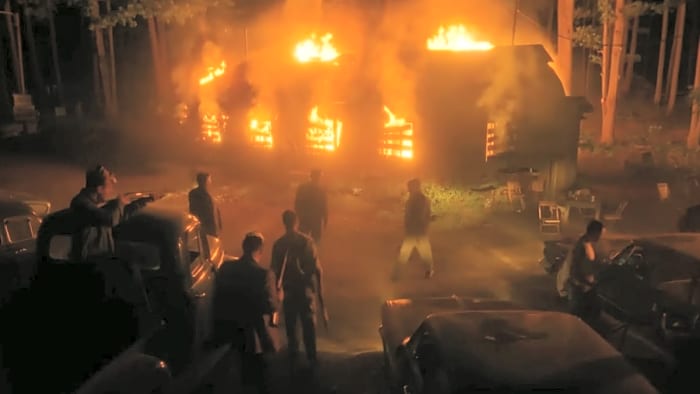
In the 1930s, racial violence was rampant across America, thanks to a resurgence of the Ku Klux Klan. Although heavily operating in the South, the Klan was hardly limited to that area. Something like the Black Spot fire of 1930 would have been all too common. According to King’s lore, a racist, masked group called the Maine Legion of White Decency trapped the patrons inside, setting the building ablaze. Dick Halloran, described as a cook at the Black Spot, barely escaped with his life. He would go on to become a cook at the Overlook Hotel decades later in The Shining. The series Welcome to Derry changes Hallorann from a cook to a member of the military who starts the club on the site of the old facility. The fire’s survivors saw a giant black bird, holding red balloons during the fire. A clear manifestation of Pennywise.
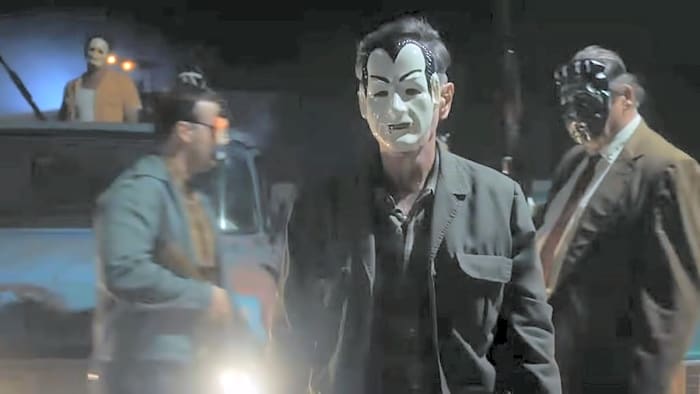
In 1962, the Civil Rights movement was in full swing in America and the KKK entered its third major wave of orchestrated hate crimes, with the second being the one from the 1930s. So the switch from 1930 to 1962 fits actual real-world history in this case. From 1961 to 1968, there were several infamous incidents of KKK hate crimes. Among the most infamous is the bombing of the 16th Street Baptist Church in Birmingham, Alabama. So, Welcome to Derry is being very historically accurate here. The events of the show really don’t have to stray far from reality for its horrors. Even though places like Maine were more desegregated at the time, in a small town like Derry, a desegregated nightclub would likely have been taboo.
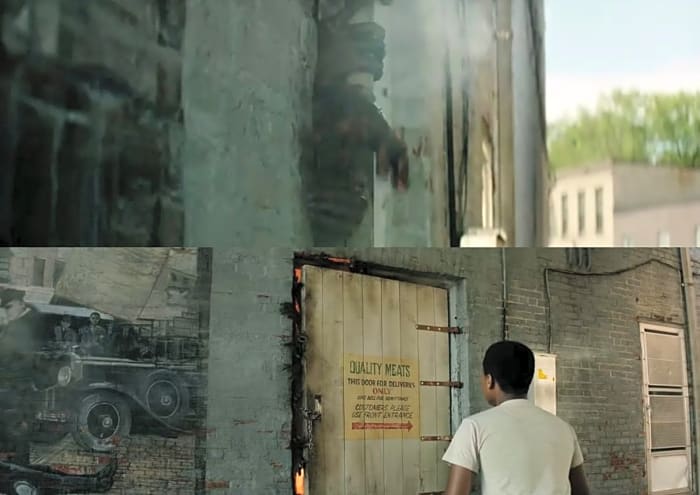
There are some changes from not only the King’s original novel, but also the film, which the series retains continuity with. In the first film, young Mike Hanlon (Chosen Jacobs) has a Pennywise-induced vision of burning people desperately trying to escape a raging fire from the meatpacking building downtown. This is the same one where he does deliveries for his grandfather, Leroy Hanlon. A later newspaper clipping in It: Chapter Two suggests this place was the site of the Black Spot in 1962. But Welcome to Derry tells us it was in a decommissioned Air Force storage unit on the outskirts of town.
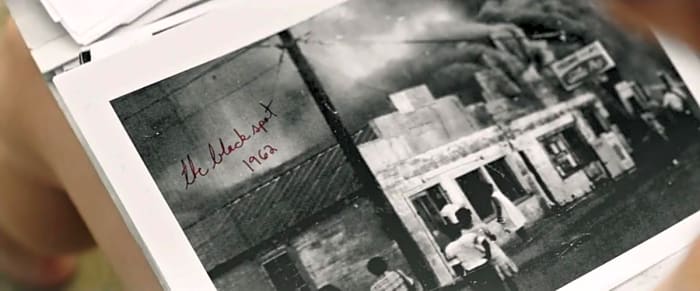
We could just handwave this away as a continuity error. However, It the novel showed how Pennywise could alter people’s perceptions. Maybe Pennywise wanted Mike to think the Black Spot fire was there, since he often frequented that location. Also, the picture isn’t clear whether the Black Spot is the actual building we see. The smoke coming from the distance could be the Black Spot, not the building in the foreground. So, it’s easy enough to explain away if one wants to.
We know that in the continuity of the series, Will Hanlon (Blake Cameron James) will eventually die sometime in the late ‘70s or early ‘80s, after becoming the father of Mike. The novel says Will Hanlon dies in a house fire. Young Mike will then be raised by his grandfather Leroy, played as an older man in the first It. Leroy seems much more bitter and mean than the younger Leroy in the Welcome to Derry, played by Jovan Adepo. But by this point, he will have survived Pennywise and the loss of a son. That explains quite a lot about his attitude as a senior citizen. With only three episodes left of Welcome to Derry, we imagine many more answers are forthcoming about how it all connects.
It: Welcome to Derry drops new episodes every Sunday on HBO Max.
More must-reads:
Breaking News
Trending in Entertainment


Customize Your Newsletter
 +
+




Get the latest news and rumors, customized to your favorite sports and teams. Emailed daily. Always free!
PRIVACY POLICY COOKIE POLICY CONTACT US
ABOUT YARDBARKER TERMS OF SERVICE


By using this site, you agree to our Terms of Service and Privacy Policy.
This site is for entertainment purposes only.
There is no gambling offered on this site.
Gambling Problem? Call 1-800-Gambler.
