
-

-


Follow Us
-

 On Facebook
 On Flipboard

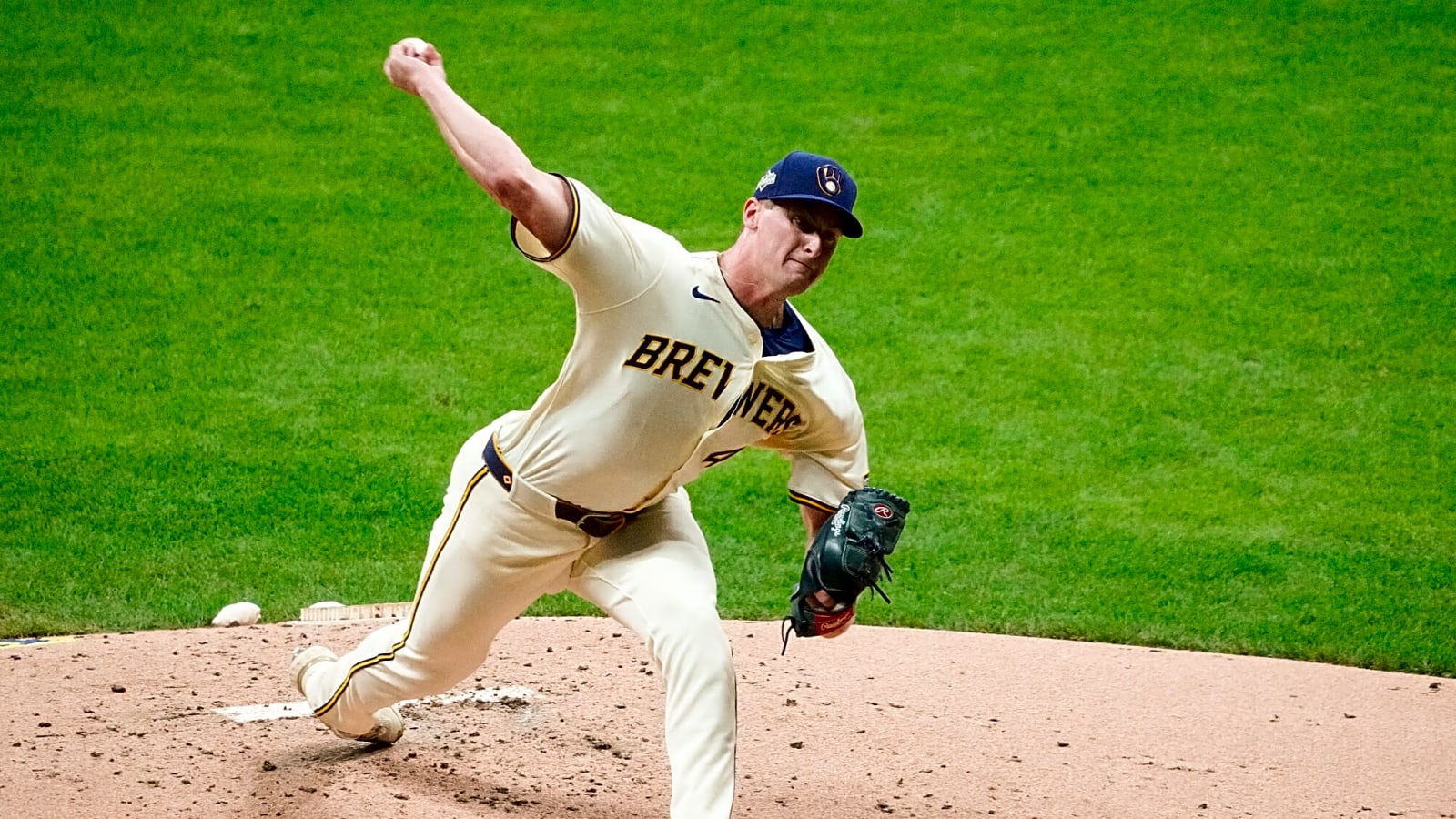
Finally, we get to talk about most people’s favorite positional sleepers: starting pitchers. The always-challenging task of balancing upside with injury risk that often times can make or break your fantasy season.
In many ways, building your rotation is a numbers game. You are going to deal with injuries, and working quickly on the waiver wire is almost always your best bet. However, it’s not the only way to find hidden gems. Those same players you scramble to add on the waiver wire are available in the later rounds, giving you a chance to capitalize before they become a hot commodity.
Today, I am going to highlight some of my favorite starting pitching sleepers. These are arms that hold an ADP of 250 or greater, according to National Fantasy Championship ADP rankings. This range is absolutely crucial for deeper leagues and covers worthwhile names for those of you in a 10 person league.
Let’s dive in.
Trust the Brewers with Quinn Priester — No. 290 NFBC ADP
Quinn Priester has had a pretty wild start to his career.
A top prospect in the Pirates organization, Priester started to fade before being traded to the Red Sox. He was then later moved to the Brewers, where he broke out in 2025. Across 24 starts, Priester posted a 3.32 ERA, 4.01 FIP, 7.55 K/9, and 2.86 BB/9.
Priester does not have the type of strikeout stuff that attracts early-round sections, but he comes with four pitches that he locates and mixes well to keep batters off balance. Sure, he’ll allow some hard contact, but his sinker-heavy approach usually results in this contact being on the ground, shown in his 55.7% ground-ball rate. That’s elite.
In this range, you usually can chase high-strikeout, high-walk pitchers with upside, or you can lean into more stable profiles. Priester is the latter, but I trust the Brewers organization to get the most out of him.
We saw real improvement last season, and I would not be surprised if he took another step in 2025. At the very least, I see a relatively high-floor arm that can fill the back of your rotation.
Can Reese Olson Stay Healthy? — No. 333 NFBC ADP
Each of the last two seasons have been cut short due to injury for Reese Olson. Across three seasons, Olson has only started 53 games but has pitched to a 3.60 ERA and 3.55 FIP in that time. The question is not about talent, but instead about staying healthy.
Olson is the type of pitcher who I view as a consistent starter. He has a high ground-ball rate, respectable strikeout rate, and usually plus command. We see these type of pitchers fairly often in this range, but I do think Olson comes with more upside due to his 30% chase rate and 29.7% whiff rate. I think more strikeouts are possible.
What I like most about Olson is his profile and track record, as it leads to avoiding blowup starts. He keeps the ball low in the zone, avoiding fly balls and limiting home runs. It’s rare to see a lineup string together extra-base hits against him, and his sinker helps produce double plays.
If he can stay healthy, watch out.
Brady Singer: A Steady, Underrated Pick — No. 372 NFBC ADP
You know what, Brady Singer is not all that different from Olson. A strikeout rate around 8.5 K/9, a walk rate around 3.00 BB/9, and a high ground-ball rate, but he does come with a higher ERA and FIP. While I think Olson has more to dream on, Singer is the safer pick.
Singer joined the Reds last season and pitched to a 4.03 ERA and 3.98 FIP across 32 starts. Although he now called Great American Ball Park his home, his 10% HR/FB rate was the best of his career. What you get with Singer is consistency. Rarely injured and a predictable stat line isn’t sexy, but it does carry value.
I like Singer in this range because knowing what you are going to get helps balance the risk you take elsewhere. Not every pitcher is going to light up with little red bubbles on savant, but I’d happily take a guy who should be right around a 4.00 ERA to round out my rotation.
Strikeout Upside with Mike Burrows — No. 426 NFBC ADP
The Pirates had too many high-end arms, which made Mike Burrows expendable — a move they could grow to regret. Burrows has not had a full season of work but did start 19 games in Pittsburgh last season, pitching to the tune of a 3.94 ERA and 4.00 FIP.
Burrows comes with a profile that we all know too well: Strikeout stuff with spotty command. However, his command in 2025, both in the majors and minors, was much improved compared to years prior.
He offers a changeup that produced a 43% whiff rate and neutralizes lefties, but he needs work on his fastball command to avoid getting hit hard.
Burrows’ changeup is already great. I think he can figure out either his curveball or slider, giving him a breaking ball to work with. The big question comes down to his fastball. The velocity and movement are there, but if he continues to struggle with location, perhaps we see more of his sinker.
He’s an upside pick with a fresh start.
David Peterson is Boring, and That’s Okay — No. 477 NFBC ADP
You will not hear anyone clearing their schedule to tune in for a David Peterson start, but it’s hard to deny the production we have seen over the past two seasons. Peterson doesn’t offer the same strikeout upside he did earlier in his career, but he has improved his command.
What I like most about Peterson is his elite ground-ball rate of 54.7%. I’m less worried about a somewhat-high 3.47 BB/9 because his profile usually does not result in batters stringing together hits.
I should also mention Peterson managed to fix his biggest issue: home runs. In fact, over the past two seasons, he’s cut his home runs per fly ball in half.
There’s a theme with all of these arms: they’re ground-ball pitchers and are steady options that give you a high floor. Peterson falls into that category, which is the exact type of pitcher I like to add in this range.
You might want to chase upside in the later rounds, but don’t overlook the proven vets who can provide just as much value.
More must-reads:
- Mets will roll with all-rookie outfield after latest call-up
- Braves star catcher Drake Baldwin lands on 10-day IL in significant blow
- The 'Active 40-HR MLB seasons' quiz
Breaking News
Trending News



Customize Your Newsletter
 +
+




Get the latest news and rumors, customized to your favorite sports and teams. Emailed daily. Always free!
PRIVACY POLICY COOKIE POLICY CONTACT US
ABOUT YARDBARKER TERMS OF SERVICE


By using this site, you agree to our Terms of Service and Privacy Policy.
This site is for entertainment purposes only.
There is no gambling offered on this site.
Gambling Problem? Call 1-800-Gambler.
