
-

-


Follow Us
-

 On Facebook
 On Flipboard


The Cincinnati Reds finish the season 75-87, leading us to, once again, think about anything other than actual baseball in October. A 20-11 record through April caught fans’ attention before the Reds went under .500 in four of the last five months. Injuries, underperformance, a lack of depth, not enough this, not enough that led to a repeat season of what we have seen so many times over the past 30 years.
What made this season sting more than others? To me, it was accepting that what the Reds have been building for the past five years is not good enough. All of the prospects that we focused on throughout the rebuild are here, established, and what do the Reds really have?
Hoping player X will become something different or player Y will take the leap forward has ended. At this point, we know what these players are. It’s not all bad, though. There are a couple of legit stars on this team, but not enough others contributing.
No matter how a season ends, there are always takeaways. Things to learn and new data points that give us new information. Today, I wanted to highlight the top five things that we learned from the Cincinnati Reds season.
Elly De La Cruz Is What We Thought He Could Be
When Elly De La Cruz was coming up as a prospect, his tools alone made everybody think of the best-case outcome. “Elly could hit 45 home runs and steal 60 bags while playing elite defense at short.” While those expectations were not completely unfathomable, they weren’t exactly reasonable. A more realistic outcome is what we saw this season and at points throughout his career.
At 24 years old, Elly slashed .283/.365/.515 with 30 home runs, 30 stolen bases, and a 139 wRC+. He had a career-best in home runs, walk rate, average, on-base percentage, slugging percentage, and wRC+, along with his second-best season according to fWAR. A bona fide star who really seemed to unlock his power later in the season.
De La Cruz made massive strides against left-handed pitching, slashing .325/.394/.596 with 10 home runs and eliminating one area of his game that was a weakness. Although the lackadaisical errors in the field were still there, he did cut down to 18 errors this year, compared to 26 last year and 28 the year prior. I typically don’t use errors when talking about a player’s defense, but with Elly and how he got those errors previously, I thought it was important to point out.
By all means, Elly De La Cruz proved that he is the star that the Reds thought he could be and desperately need. Strikeouts be damned. I couldn’t care less as long as he’s putting together seasons like we saw this year.
The Rotation Needs Serious Help
Its rotation was supposed to be the strength of this team. In 2025, the rotation led them to a postseason berth and, on paper, gave them a legitimate chance against anyone, well, besides the Dodgers. Fast forward a year, and the outlook for the rotation is completely different.
Hunter Greene is once again injured and will not impact this team in any way next season. Nick Lodolo‘s uncertainty with injury and performance has continued to a point where he’s unreliable. Intrabats’ advanced metrics caught up to him, proving that he’s more of a back-end arm than anything else. Thank God for Chase Burns.
The Reds not trading Brady Singer and instead discussing bringing him back for a large amount of money is baffling to me. He’s a perfectly fine pitcher, but not a guy you just have to have. Rhett Lowder didn’t exactly show enough to give us confidence that he can be an answer.
The Reds’ rotation has Burns, Abbott, Lowder, and then what? They are going to have to find pitching from outside of the organization because there’s just simply not enough coming through the minors. I’m sure this is a topic we will revisit throughout the offseason.
Chase Burns Is a True Ace
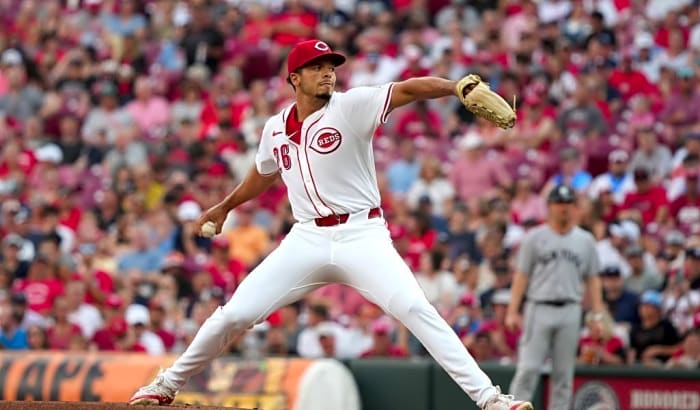
Greene missing time due to injury has unfortunately become a staple in any given Reds season. Luckily, the Reds have Chase Burns, who can step up and fill his spot atop the rotation. The 23-year-old gave the Reds a chance to win every single time he took the mound.
Across 29 starts, Burns posted a 2.83 ERA, 3.24 FIP, 10.79 K/9, and 3.27 BB/9. Carrying a 32% whiff rate and 30% strikeout rate for a pitcher who essentially only throws two pitches is remarkable. It goes to show just how disgusting his fastball-slider combination is. The best part? We’ve yet to see Burns truly reach his ceiling.
If the Reds are going to have any shot at making the playoffs in 2027, they are going to need Chase Burns to be at his best. I don’t think what we’ve seen is a fluke or something that batters will catch up to and completely change how he looks as a pitcher. I think Burns is just simply that good.
Questions Remain at Second and in the Outfield
My biggest concerns for the Reds coming into the season were at second base and in the outfield. The outfield has been a concern for a number of years, as the Reds have not invested in anything other than one-year contracts, change-of-scenery candidates, or relying on prospects from within the organization.
T.J. Friedl was one of the worst players in the entire sport and somehow managed to appear in 91 games. Noelvi Marte continued to make the same mistakes, chasing the exact same pitch with no adjustment, leading to him once again returning to the minors. Neither of these players is an answer moving forward.
JJ Bleday‘s season started on an absolute heater before cooling off to a .627 OPS in the second half, leading to more questions about his ability to be an everyday player. Hector Rodriguez had flashes, and I’d like to see more before giving up, but a .229/.270/.410 slash doesn’t scream sure thing.
Then you have second base. It’s time to put the “…in 2023” precursor to rest for Matt McLain. After posting an 80 wRC+ last season, McLain was somehow worse at 67 this year. Nineteen home runs, 15 stolen bases, and good defense are true, but he doesn’t offer enough consistency to be a regular. You already have too many players who can’t hit on this team to have the luxury of a good defender at second base.
Edwin Arroyo was seen as a possible replacement. The former top prospect looked like he made some changes to his swing early in the year in Triple-A but could not replicate the success in the majors. He does not impact the ball enough to keep pitchers away from challenging him in the zone, leading to a low walk rate and little damage when he does make contact.
The Reds cannot afford to go into 2027 rolling out the same cast of characters in the outfield and at second base. It is time to make some changes. However, how likely is that?
Nothing Has, or Will, Change
Every offseason, we love to discuss what the Reds should do in order to improve next year. I hate to sound so negative, but that’s usually the greatest time for fans to have hope with this franchise. Everything we have seen typically would lead to the firing of a general manager, changes in the front office, coaching staff, and roster. I don’t think we’re getting it.
The Reds organization did not waste any time coming out and saying that hitting coach Chris Valaika will be returning to his role. They also made it sound like the front office would be held in place, which is the worst-case scenario in my mind.
The only change we are seeing is coming from the pitching department. Derek Johnson had to leave the team mid-year due to a “personal matter,” which has now forced the Reds to make a change. Now we sit back and wait for the announcement of some promotion from within.
Of course, this all boils down to ownership. I don’t have to tell you how bad the Reds’ ownership has been because you’ve lived through it. A repeat year after year of either failed trades, bad signings, or spoiled prospects has led the Reds to float around .500 without much progress forward. And considering not much is changing, I expect the same in 2027.
More must-reads:
- Four errors prove costly for Yankees in Game 2 of ALDS
- Craig Breslow gives honest answer about what Red Sox's wild-card loss to Yankees really means
- The 'Most HRs by an MLB first baseman' quiz
Breaking News
Trending News


Customize Your Newsletter
 +
+




Get the latest news and rumors, customized to your favorite sports and teams. Emailed daily. Always free!
PRIVACY POLICY COOKIE POLICY CONTACT US
ABOUT YARDBARKER TERMS OF SERVICE


By using this site, you agree to our Terms of Service and Privacy Policy.
This site is for entertainment purposes only.
There is no gambling offered on this site.
Gambling Problem? Call 1-800-Gambler.
