
-

-


Follow Us
-

 On Facebook
 On Flipboard


The first two seasons of Paul Skenes’ career with the Pittsburgh Pirates were nothing shy of historic, as he made waves in nearly every way possible.
Having a legitimate argument for the best start to a pitching career in MLB history, Skenes started two consecutive All-Star Games, won the NL Rookie of the Year Award, unanimously took home the 2025 NL Cy Young Award, placed top-six in NL MVP voting, and set many franchise records along the way.
Knowing this, the expectations for year three were nothing shy of astronomical. For someone who’s already put together this impressive of a resume before turning 24 years old, the sky is the limit for his ceiling. With Skenes putting together a handful of his best starts in the early part of this season, it seemed like he’d surpass our expectations once again.
However, since May 17, Skenes has run into some trouble, as he’s currently in the midst of the worst stretch of his career. Of course, slumps are more than normal, but for Skenes, this feels quite shocking because of the dominance we’ve become accustomed to.
Since that start in mid-May, Skenes has an ERA over 5.30, with his worst start being a seven-earned-run performance against the Phillies on July 1.
Skenes’ issues have run deeper than purely poor performance on the mound, as he’s also seen his fastball velocity drop, which has naturally become a massive talking point around the baseball industry. With the 24-year-old rarely hitting triple digits as frequently as he once did, concern is brewing more than ever.
The cause of his struggles is actually more complicated than it may seem. While there are several potential reasons for Skenes’ rough patch, there isn’t one red flag that stands out above the rest, but rather a sequence of things that could be to blame.
Let’s dive into Skenes’ recent struggles and try to discover what could truly be to blame for his poor performance on the mound.
Establishing the Cause for Concern
Before proposing why I believe Skenes is currently struggling to recapture his dominant form on the mound, we first must look a little more closely at the individual causes for concern surrounding his game. These run deeper than just poor performance, as seemingly countless theories have been proposed as reasons to worry.
After examining each of these individual causes for concern, we can then properly examine what I believe to be the reason for each of these sudden changes.
A Dip in Velocity
As I briefly touched on in the introduction, one of the main causes for concern with Skenes’ struggles this season has been his dip in fastball velocity. This has arguably been the most talked-about piece of this puzzle, as the industry can’t help but wonder what happened to the triple digits we used to see him reach so often.
According to Baseball Savant, Paul Skenes has yet to touch triple digits this season, a feat he accomplished 13 times during the entirety of the 2025 season. Taking things one step further, Skenes hit the 100 mph mark exactly 100 times the previous season, raising even more eyebrows about this sudden drop in velocity.
In fact, Skenes has yet to surpass the 99.5 mph mark in 2026, with the only pitch he’s thrown at this velocity occurring way back on April 13, Skenes’ fourth start of the season.
His average four-seam velocity has fallen by 1.2 mph, moving from 98.2 mph in 2025 to 97.0 mph in 2026. He’s even recorded a four-seam fastball thrown at 92.4 mph this season, which is super concerning considering that up until 2026, he had never thrown a single fastball clocked under 93.8 mph at the big league level.
A Change in Spin Rate and Fastball Shape
Not only has Skenes’ fastball velocity been a cause for concern during this stretch, but his spin rate and changes in fastball shape have been another notable piece of this puzzle.
Following his start on July 1, when he gave up seven earned runs to the Phillies, Codify put out a great post on X showcasing his heater’s average spin rate in each of his starts this season since April. During Skenes’ start on April 1, his four-seamer averaged 2,318 rpm, and by July 1, this number had dropped to 1,987 rpm.
Not only is this a concern purely for the reason that a change in shape could have on a pitcher’s effectiveness, but oftentimes, a decline in fastball spin rate can be an indicator of a potential injury. Multiple times in recent baseball history, pitchers have seen a heavy spike in fastball spin rate right before significant arm or elbow injuries occur, which has naturally led to some questions regarding the health of Skenes’ arm.
The declining spin rate in itself isn’t exactly an issue, per se, but when expanding this to Skenes’ fastball shape, the issue starts to become clearer. Coming out of the draft, some scouts and analysts labeled Skenes’ fastball as significantly below average because of its lack of vertical break and overall shape.
While this is true in a vacuum, these individuals often failed to account for the added effectiveness his fastball gained thanks to his release point, arm angle, and exceptional velocity. With these factors included, Skenes actually possessed an outlier fastball, not a negative one as previously labeled.
While this is the case, if you remove any of these added factors, Skenes’ fastball inches closer and closer to the “poor” label it was initially given out of the draft. With Skenes losing his velocity and his arm angle rising three degrees, he’s lost a lot of the deception that made up for the areas in which his fastball was lacking.
As it currently stands, Skenes’ fastball has produced 12.7 inches of induced vertical break and 12.1 inches of horizontal break, which is much more of a “dead-zone” shape than we’ve seen before, especially when you add in the declining velocity and changes in arm angle. With the current state of his fastball shape, there’s a definite cause for concern.
Weaker Command
As if Skenes’ declining velocity, worsening shape, and decreasing spin rate weren’t already enough causes for concern, his command has wavered quite a bit in 2026 as well. Skenes’ command is one of the traits that makes him an elite arm, and seeing this worsen is something to take note of.
Beginning with his four-seamer, Skenes has seen his zone rate decrease just shy of 14%, which is a massive decline in this area. He’s throwing his four-seamer for strikes less than ever as well (68.7% strike rate), which is another indicator of his dipping command.
Expanding to more than just his four-seamer, Skenes is throwing fewer strikes with his changeup, sweeper, and curveball, which is definitely something to keep tabs on. Not only have these marks taken a step backwards from 2025, but all three of these pitches’ strike rates are career lows.
Skenes’ Mechanical Issues
Now that we’ve taken a closer look at each of the original concerns surrounding Paul Skenes’ 2026 season, we can take a look at what I believe to be the cause of these declining attributes: Skenes’ mechanics. After seeing Rob Friedman explore the potential impact of Skenes’ earlier hand break on his velocity, I wanted to dig a little deeper and fully evaluate his entire throwing motion.
The following frames are from two four-seam fastballs Skenes has thrown over the last two years. On the left is a 99.6 mph heater Skenes threw to Jake McCarthy on July 27, 2025, and on the right is a 95.3 mph heater Skenes threw to Bryce Harper on May 17, 2026. With a little over 4.0 mph separating these two pitches, there’s a lot we can gather from taking a closer look.
Beginning with the highest point in Skenes’ leg lift, we can immediately begin to see some mechanical inefficiencies that extend throughout his entire motion.
When taking a look at this still frame, the first thing that stands out is the difference in Skenes’ leg position. On the left, Skenes raises his leg up and backwards, which allows him to coil into his hip and get into a lower half, almost like how a hitter correctly begins their load.
On the right, this is not the case. While he still lifts his leg up and slightly back, the angle is much different, and he’s far less engaged in his lower half as a result. This difference alone can produce a huge difference in velocity, as speed is built from the ground up, the same way hitters build power from their lower halves.
On top of this, Skenes’ hand positioning is slightly off in 2026, and he’s in a far less athletic position overall in his current state. These are the building blocks for the mechanical issues that plague his entire delivery, as we’ll see in the coming frames.
Moving onto the beginning of Skenes’ drop into his back leg, these differences continue.

In this side-by-side, we’re taking a look at the first moment when Skenes sinks into his back side before he begins striding towards the plate.
On the left, Skenes is dropping in a way that allows him to engage his lower half and coil into his hip, rather than just lowering himself at this stage of the delivery. His hands are also much higher, allowing him to avoid separating too early.
On the right, Skenes is dropping himself in a way that lowers him to the ground without exactly coiling into his back hip or engaging his lower half any more than he already has. Not only is this true, but he’s dropping a lot lower at this stage than he did in 2025, which could explain where he’s losing some more of the potential energy he’s built up.
On top of this, Skenes’ hands are a lot lower, almost like he’s already preparing to separate his hands in this stage of the windup. As Rob Friedman pointed out, earlier hand separation doesn’t allow for the proper tension needed to build up velocity.
Moving to the next stage in Skenes’ delivery, we’ll see some more inefficiencies begin to stand out and introduce themselves.

In this side-by-side comparison, the first thing that stands out to me is the clear distinction in the impact of when Skenes is separating his hands through his motion.
In 2025, Skenes had just begun to separate his hands at this stage in the windup, and you can see how much more tension he has as a result. He’s more coiled into his back up, still turned slightly towards second base, which allows him to build up the potential energy needed to near triple digits.
Of course, a lot of this potential energy still comes from how Skenes is engaged in his lower half, which is the second main difference we can see here. In 2025, he’s a lot more engaged in his legs, as opposed to 2026, where he’s less engaged and more upright in this position.
In short, there’s a difference between engaging your lower half, coiling into your hip, and allowing for later hand separation than just turning towards second base, which appears to be what he’s currently doing.
Onto the next frame, we’ll get a look at the first step of Skenes’ stride towards home plate.

Here, for starters, take a look at Skenes’ throwing hand. Due to the delayed hand separation, Skenes’ right arm is later, which allows for more tension to be built up, which then produces the high-90s heater he throws in this clip. It’s still downwards behind his leg, a key difference in this side-by-side.
In 2026, Skenes’ right arm is so much more ahead that it looks like he’s in the next stage of his throwing motion, even though these two frames are synced up. It’s a lot higher, no longer behind his leg, and beginning to move up towards his head. This is also evident by where his glove is positioned, as the only way he could get to this place is with earlier hand separation.
There’s a lot less torque being produced here, which explains the dip in velocity.
On top of this, we can once again see the difference in how he’s engaged with his lower half. On the left, Skenes’ back leg is still angled, with his knee bent. In 2026, his leg is much straighter, as he’s having trouble staying as engaged with his lower half.
Continuing, we’ll see these recurring themes keep sticking out.

In this side-by-side, we’ve now advanced closer to Skenes’ actual delivery, as he’s beginning to raise his hands near his shoulders. Once again, we see similar tendencies as before, with his throwing arm higher and further along in 2026, creating less tension than it did previously.
While this is visible here, the difference in Skenes’ lower half is what’s most glaringly clear in this image. In 2025, despite being just milliseconds away from having his front foot land, he still has some bend in his back leg, showing how much more engaged he is with his lower half. In 2026, this leg is almost fully straight, as he’s no longer holding his hip coil.
Next, we’ll continue to approach his actual delivery, with some new key differences presenting themselves.

While the difference in the quality of engagement with his lower half and the tension created from his earlier hand break are visible yet again, I want to focus on something different here: Skenes is opening up sooner and beginning his delivery earlier, which prevents the potential energy he’s built up from exploding and producing electric velocity.
Even though it may be blurry, take a look at the “Pittsburgh” lettering across Skenes’ chest. On the right, in 2026, almost all of this lettering is visible, which shows how much sooner he’s turning to deliver the pitch, otherwise known as “opening up.” This can also cause command issues in addition to velocity, as once again, he’s not utilizing the potential energy he built up to generate the tension needed to produce velocity.
This same idea is noticeable in Skenes’ hip, as his back hip is completely visible here, which shows just how much more open and ready to deliver he is at this stage in the motion.
The concept of “opening up” is something that becomes even more visible in the next still frame, alongside the other ideas we’ve explored to this point.
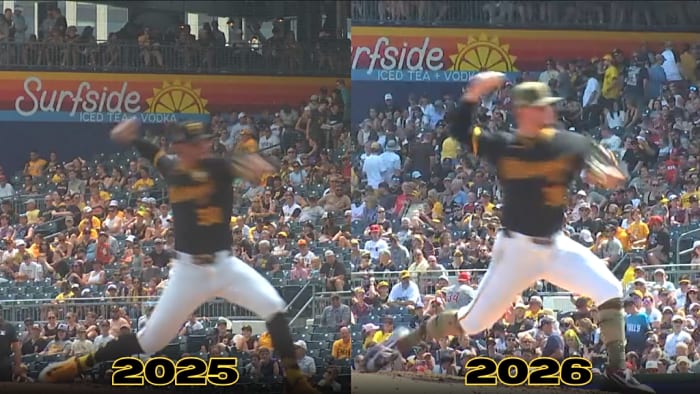
In this side-by-side, Skenes is very close to being ready to deliver his pitches, and this is arguably one of the most important stages in his delivery.
Firstly, I’d like to again point out how much more “open” Skenes is in 2026. The entirety of the “Pittsburgh” lettering across his chest is visible, his hip is almost fully facing home plate, and his arm is beginning to come around his body.
Essentially, Skenes is ready to fire, and he’s fully lost the tension that he built up and that he should still have at this point. He’s almost ahead of himself in this stage of the delivery, as he’s missing the factors needed to produce elite velocity.
If you compare this to 2025, you cannot yet fully see the “Pittsburgh” lettering across his chest. His arm still has a little ways to go before it’s ready to fire, his hip is still “closed,” and he’s still fully engaged in his lower half. Even if these things are subtle, this is the difference between elite velocity and above-average velocity.
One last new factor is visible here as well, which is that in 2026, Skenes has already tucked his glove into his body, while in 2025, he has not yet fully completed this move.
The “glove-tuck” typically goes hand-in-hand with the delivery of the pitch, helping to explode the tension that’s been built up at this point. The fact that this has already happened in 2026 is a huge difference, as he cannot fully “explode” through his release.
Lastly, we’ll take a look at the stage right before Skenes begins to deliver the pitch, and these differences are still as present as they’ve been throughout the earlier side-by-sides.

Firstly, take a look at Skenes’ throwing arm and where it’s positioned. In 2026, it’s a lot higher, with less tension built up, as it seems more relaxed in this position. This is a byproduct of the loss of tension Skenes should still have built up.
In 2025, his arm is still lower, almost dragging behind him, which is due to the tension he still has built up, as it’s getting ready to “explode” forward. His upper half is also less open at this stage in 2025, he’s more engaged in his lower half, and he’s overall in a better position to fire from this spot in his motion.
Once again, we can connect all of these inefficiencies we’ve discussed through each of these frames back to the initial causes for concern. Without tension built up through engaging his lower half, breaking his hands later, and more, he’s not able to properly explode, which can explain the velocity dip, different fastball shape, and poorer command.
Also, even though it’s a small difference, Skenes’ hand positioning in the later frames could explain the difference in arm angle. With Skenes opening up sooner, having less tension built up in his arm, and more, it makes sense that he’d naturally deliver more over the top, since nothing is keeping his arm back and preventing him from delivering the baseball.
The Next Steps Forward
After diving deep into the cause for concern with Skenes’ struggles so far in 2026 and the mechanical inefficiencies he’s currently experiencing, we’re left with one final question: What are the next steps forward for the former Cy Young Award winner?
First and foremost, Skenes needs to correct his mechanics, getting closer to his 2025 delivery as opposed to the 2026 delivery that’s full of mechanical inefficiencies. All of the struggles we touched on in the causes for concern section can be explained by the issues with his mechanics.
In short, once these weaknesses are hammered out, a lot of these struggles should be cleaned up, including his velocity, command, fastball shape, and more.
This may be a trial-and-error process, and it’s important to remember that this is completely okay. It’s normal for stars to struggle, experience their old habits creep back in, and go through ruts like this. If anything, the near-perfection we had seen out of Skenes was more abnormal, and this will be important to remember through this process.
I truly believe that once Skenes is back throwing more closely to how he did in 2025, he’s going to return to his dominant ways once again. It’s not a matter of if he’ll get back on track, but rather when, as Skenes is truly too incredible for these struggles to plague him for long.
More must-reads:
- The Mets have found a leadoff man in A.J. Ewing
- Red Sox rotation is stuck between a rock and hard place after Ranger Suárez injury
- The 'Most MLB All-Star Games' quiz
Breaking News
Trending News







Customize Your Newsletter
 +
+




Get the latest news and rumors, customized to your favorite sports and teams. Emailed daily. Always free!
PRIVACY POLICY COOKIE POLICY CONTACT US
ABOUT YARDBARKER TERMS OF SERVICE


By using this site, you agree to our Terms of Service and Privacy Policy.
This site is for entertainment purposes only.
There is no gambling offered on this site.
Gambling Problem? Call 1-800-Gambler.
