
-

-


Follow Us
-

 On Facebook
 On Flipboard
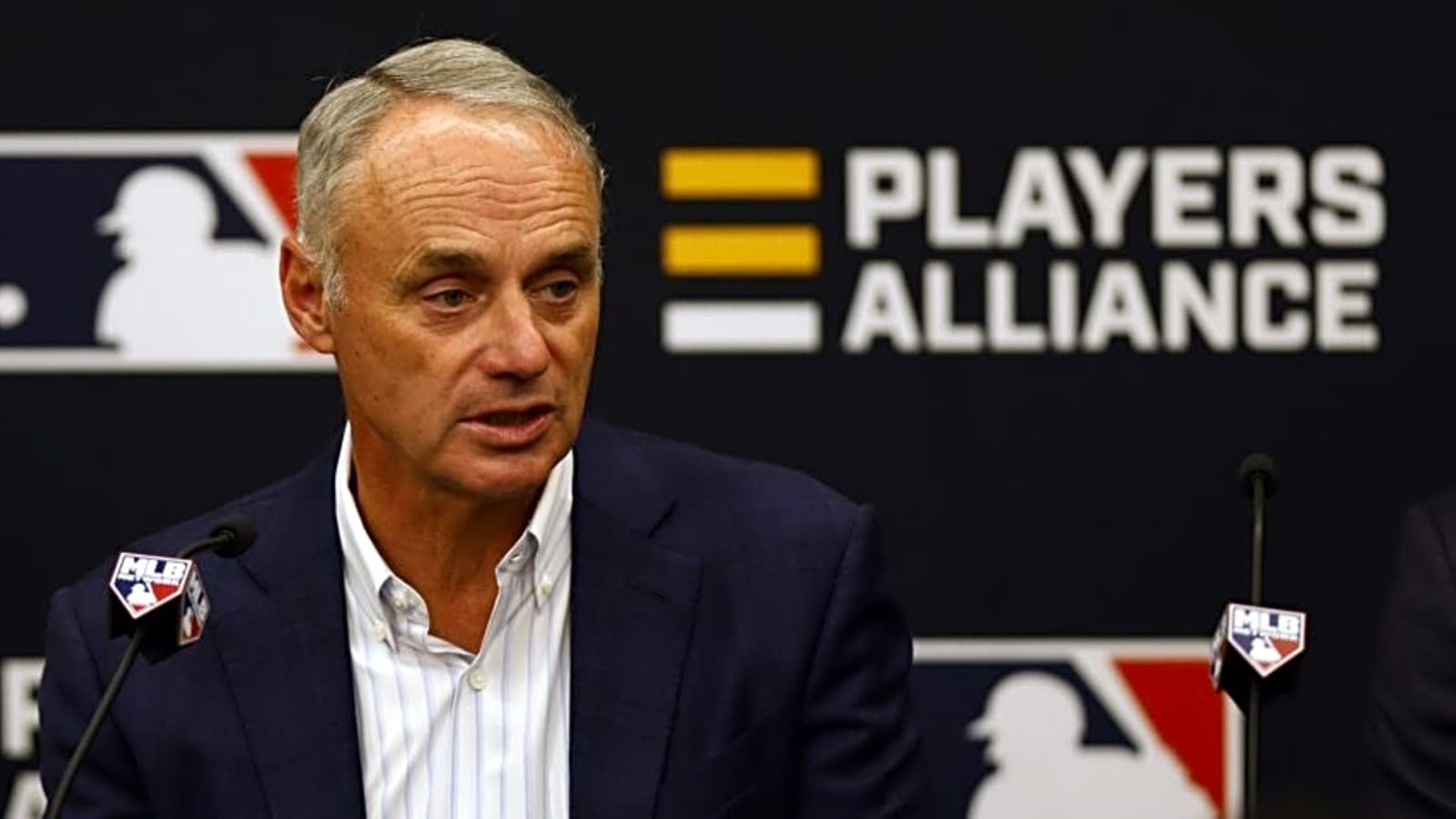
“If you want to speak about that, you can get the f— out of our clubhouse.”
The words reverberated throughout a tense July meeting between MLB commissioner Rob Manfred and the Philadelphia Phillies. Bryce Harper, standing “nose to nose” with Manfred, had heard enough.
Manfred typically holds meetings with MLB teams across the league each year, but this one was markedly different. This year, Manfred seemed to be attempting to get ahead of the looming expiration of the 2022 collective bargaining agreement (CBA).
The subject that frustrated Harper so deeply was the potential implementation of a salary cap in MLB. Manfred did not address this proposition head-on, but Harper read between the lines of what was being discussed.
Harper’s teammate, Nick Castellanos, elaborated on the incident to ESPN after the fact. “Rob seems to be in a pretty desperate place on how important it is to get this salary cap because he’s floating the word ‘lockout’ two years in advance of our collective bargaining agreement [expiration].”
In this statement, Castellanos touches on an important point. CBA negotiations were not the sole focus of this meeting. Still, their imminence is enough cause for concern when it comes to the relationship between MLB ownership and the players.
The 2022 CBA negotiations were not smooth sailing either. Disagreements between MLB and the MLB Players Association culminated in a lockout that nearly resulted in the first cancellation of regular season games due to labor disputes since 1995.
Both sides were able to reach an agreement in time to prevent a shortened 2022 season. Still, it is clear that tensions have not yet eased. With this CBA set to expire Dec. 1 of 2026, tensions are likely to boil over once again throughout the next year.
Point of Contention
As mentioned, the most prominent discourse regarding the upcoming CBA negotiations surrounds the potential of a salary cap in MLB.
The MLBPA, as made abundantly clear by Harper’s statements, is strongly opposed to a salary cap. Meanwhile, team owners have fervently advocated for the implementation of a cap for decades.
Amongst fans, the divide is far more nuanced. Plenty of fans recognize the disparity in payroll structure between small- and large-market teams. To that point, many feel that a salary cap would help balance MLB payrolls and promote parity amongst teams. Most proponents of a salary cap also advocate for a corresponding salary floor.
On top of this, MLB remains the only major North American sports league without a salary cap. The NFL, NBA, and NHL all have a salary cap in place, making MLB the odd man out in this debate.
However, those who are against the idea would argue that a salary cap is punitive to the players and, functionally, would do little to address the payroll gap. These fans would posit that the real issue involves owners refusing to invest in their teams. A salary cap would provide them with cover to avoid taking accountability on this front.
Furthermore, MLB already utilizes a competitive balance tax (CBT) system, which effectively serves as a soft spending cap for teams. Because of this, a cap would be most beneficial to the teams that wish to keep league spending lower overall.
Arguments for both sides seem to recognize one core truth: The spending gap between the largest and smallest payrolls in MLB must be addressed somehow.
The significance of the salary cap debate and the implications of the upcoming CBA negotiations are immense. As such, I feel that it is incredibly important to have a thorough, informed understanding of the topic(s) at hand.
The Case for a Salary Cap
Before diving headfirst into the salary cap debate, we should first develop a clear understanding of the arguments presented by both players and owners.
For owners, the argument is multifaceted and centered around cost certainty and market discrepancy. With the upper range of contracts rising sharply in recent years, teams in smaller markets like Cleveland or Milwaukee find it difficult to compete for top talent.
This is due to a few factors. For one, large markets provide the benefit of increased revenue, allowing for greater payroll investment. Additionally, destinations like New York and Los Angeles are highly coveted places to live. This poses a massive advantage in free agency negotiations.
For small-market teams who may not share these advantages, it can make courting free agents much more difficult. As such, these teams are more reliant on drafting and development. And, even with a great farm system, they have the added challenge of retaining talent long-term.
The owners feel that instituting a salary cap would prevent large-market teams from boxing out the competition. It could cultivate a fairer playing field during the free agency process and help teams retain homegrown talent. Additionally, it would likely provide the owners with greater cost certainty, driving up franchise valuations.
Considering that MLB would also be joining the NFL, NBA, and NHL in enacting this policy, the owners do not view the salary cap as a radical idea. Rather, they view the cap as a logical next step. Implemented with a salary floor, they reason that it would be a stabilizing force for MLB payrolls.
The Case Against a Salary Cap
Most players disagree with the arguments put forward by the owners.
The MLBPA recognizes the same problems presented by the current payroll situation. However, as the players stand to lose the most from a salary cap, their opposition is easily understandable.
In this way, the salary cap could be viewed as punitive to star players or teams looking to go all-in. It would deny players the ability to pursue their full market value while also slowing future salary growth. Payroll constraints could also drive down contract length, as bad contracts would become more consequential over time.
Additionally, many players will argue that a hard cap would do little to substantively address league parity. Sure, teams would be prevented from spending in excess. But there would still be a lack of an enforcement mechanism to ensure teams with lower payrolls operate in good faith.
MLB already has the luxury tax system as a soft cap. Thus, many players wonder why the focus remains on top spenders rather than those at the bottom of payroll rankings. Besides, these teams already receive a sizable chunk of the luxury tax revenue pool in the name of addressing this very disparity.
Factor in the league’s revenue-sharing system, and these teams should have far more ability to spend than they contend. These teams also have a financial incentive to advocate for a salary cap. Therefore, the legitimacy of their stated goals is somewhat questionable.
Setting the Stage
On Nov. 1 of 2025, the Los Angeles Dodgers won the World Series for a second year in a row. They did so with the largest payroll in baseball and seem primed to continue on their path of success in the years to come.
As a result, the salary cap discourse has sparked up yet again. Many fans have declared that this win was the final straw and that the only way to protect the integrity of baseball is to institute a cap. However, there are a number of issues with this logic.
For one, this argument contextualizes the issue of a salary cap within a vacuum. It assumes that baseball is broken without a salary cap, and that instituting one is a necessary step on the linear path to fixing it. In my opinion, this argument is disingenuous at worst, and surface-level at best.
MLB already has a soft cap in the form of the CBT. Teams still exceed it, but those who point this out miss the fact that revenue from this tax is distributed amongst teams who do not. Not to mention, MLB also boasts a revenue-sharing system that most small-market teams benefit from immensely.
Gate and television contract revenue is largely pooled, and a substantial amount of it is distributed amongst small-market teams. When combined with the revenue pool generated from the CBT, small-market teams have quite a bit more money to work with than their owners would like to admit.
These systems exist to promote parity in MLB. And, while many would have you believe otherwise, some evidence suggests MLB already has a rather evenly-matched competitive landscape.
Level Playing Field
For the amount of time spent discussing the “parity problem” within baseball, there is little evidence to support the issue. Sure, the Dodgers have won the World Series for two consecutive years. Even still, that example is anecdotal and fails to paint a complete picture.
Take the other major North American sports leagues, for example. The NFL, NBA, and NHL all have a salary cap of some form or another. Despite this, MLB boasts the most widespread team success among these leagues.
There are only four MLB teams that have not won a championship since 1978. By contrast, there are 14 NFL teams, 12 NHL teams, and 14 NBA teams that have not won a title in that time. Based on this, it would seem to me that MLB has had far more fluctuation in title contention.
Taking this argument a step further, only the Seattle Mariners have not appeared in a World Series since 1978. And yet, there are seven NFL teams, six NHL teams, and nine NBA teams without championship appearances over the same span.
In the NFL specifically, one of either the Kansas City Chiefs or the Philadelphia Eagles has appeared in the Super Bowl in six of the past eight years. This includes two Super Bowls that featured both teams. Before them, the New England Patriots appeared in nine Super Bowls between 2001 and 2018.
None of this is to say that MLB’s system is not in need of change. However, it does indicate that MLB has far more parity than proponents of a salary cap would give credit for. Based on the analysis of parity across other professional leagues, it is also likely that a salary cap would not fix this supposed problem.
Financial Overview
So, if competitive parity is not the primary issue at hand in MLB, then what is? Certainly, there is still an argument relating to the financial discrepancy between large- and small-market teams.
There is no question that markets like New York and Los Angeles offer greater financial flexibility than markets like Cleveland or Miami. Between greater revenue margins and more team-specific factors like television contracts, clubs like the Dodgers still have an obvious advantage.
Still, the truth is not so simple. By taking a look at the discrepancies between reported revenue and payroll (including CBT costs), several interesting trends emerge.
For example, the Dodgers and Yankees pulled in the most revenue in 2024, clocking in at $752 million and $728 million, respectively. In return, the Dodgers and Yankees committed $549 million and $362 million to their payrolls in 2025. This means they committed 73.01% and 49.73% of their 2024 revenue to payroll the next year.
Let’s compare these figures to those of the Miami Marlins and Chicago White Sox. In 2024, the Marlins and White Sox brought in $277 million and $317 million, respectively. Yet, they committed just $87 million and $86 million to their payroll entering 2025. These commitments represent 31.41% and 27.13% of their 2024 revenues.
Another team worth noting is the Chicago Cubs, who brought in $584 million in revenue – third most across MLB in 2024. Despite this, the Cubs entered the 2025 season with the 13th highest payroll at $213 million, representing just 36.47% of their 2024 revenue.
For a team valued at $5.69 billion, the fourth-highest valuation in MLB, their payroll commitments represented the fifth lowest proportion of 2024 revenue. While the gap between the highest and lowest payrolls is significant, the notion that discrepancies like this are not just as significant, if not more so, is absurd.
Follow the Money
Looking further into these financial trends, the lowest revenue total among MLB teams in 2024 was $257 million for the Oakland Athletics. This figure is substantially lower than the totals for the Dodgers or Yankees, but remains sizable nonetheless.
Factoring in their $111 million payroll entering 2025, the Athletics maintained a $146 million discrepancy between 2024 revenue and 2025 payroll. Somehow, Forbes reported in March of 2025 that the Athletics operated at a $23 million loss coming into 2025.
The Rockies, Diamondbacks, White Sox, Blue Jays, Rangers, Astros, Braves, Mets, Giants, and Yankees also reported losses. This means that over a third of MLB teams reported an operating loss, despite MLB teams averaging a $201 million difference between 2024 revenue and 2025 payroll costs.
I find it difficult to believe that MLB teams lose money at this scale. Don’t get me wrong – there are a number of factors not represented in this math. Between debt servicing, television deals, real estate, and other associated costs, it is not out of the question.
However, it is important to note that all MLB teams except for the Atlanta Braves are privately owned. Therefore, most MLB teams are not required to open their books or publish their financial records publicly. While this alone is cause for some skepticism towards losses, MLB valuations greatly exacerbate this concern.
Between 2024 and 2025, MLB team valuations grew 5.65% on average, per Sportico. While the Giants and Twins did not see an increase in value, no MLB team reportedly decreased in value. Going back to 2021, MLB team valuations have risen 24.68% on average, indicating substantial growth.
Even more interesting, these figures become higher if you average the growth of only the 11 teams that reported operating at a loss. Teams that reportedly lost money averaged 6.06% growth from 2024 to 2025, and 29.55% growth from 2021 to 2025.
None of this is confirmatory of any foul play or misrepresentation, though it is enough to raise an eyebrow. Without any public accounting, there is no real way to know for sure. Yet, given the way revenue sharing is set up and the actions taken by ownership both in modern MLB and across its history, I believe it is fair to hold skepticism as to the intentions of some teams’ ownership.
Sharing Is Caring
Currently, MLB distributes pooled revenue between teams through two primary mechanisms.
The first, more well-known system is the CBT, or luxury tax. Originally designed as a compromise between MLB and the MLBPA in the 1996 CBA, the luxury tax currently operates via a threshold system and functions as a soft salary cap.
In 2026, every dollar spent on payroll beyond a $244 million threshold will be taxed at a 20% rate. There are also three surcharge thresholds, valued at $264 million, $284 million, and $304 million. These surcharges incur a 12%, 42.5%/45%, or 60% additional tax rate.
The base tax rate also increases to 30% after two consecutive years over the cap, and 50% for subsequent years. Any team beyond the second surcharge also has its top draft pick moved back 10 spots (unless they have a top-six pick; in that case, their second-highest selection is moved back instead).
Money collected from the luxury tax is pooled, with $3.5 million funding player benefits. Half of what remains funds MLBPA retirement accounts, and the other half is distributed to teams that have grown their local revenue over multiple years.
The other revenue-sharing system involves the distribution of gate and television contract revenue. As of 2022, teams pool 48% of their local net revenue, and funds are then allocated equally amongst 17 teams. The remaining 13 teams are excluded based on market size, but pay in regardless.
This system provides direct subsidies from the largest market teams to the smallest. Per the 2022 CBA, funding is explicitly intended “to promote the growth of the Game and the industry on an individual Club and on an aggregate basis.” Though, teams have still found a way to circumvent this intention.
The System Works as Designed
Every team that receives revenue sharing is expected to report on how that income is used by Aug. 15 each year. The CBA explicitly states that the funding is directly intended to promote “improvement to on-the-field performance.”
As such, the funds are not permitted to be used for acquisition debt, paying entities or personnel not related to on-field performance, or distribution to ownership unrelated to tax obligations. If a team fails to uphold this, the commissioner is able to levy penalties against them.
However, the burden of proof to highlight this kind of misconduct lies with the MLBPA. Since the commissioner is more beholden to the owners than the players, what incentive is there to follow through if they report a grievance?
In March 2025, it was reported that the Marlins had found a loophole to the stipulation that 150% of revenue-sharing funds must be spent on payroll. For context, they received $70 million this year despite maintaining an $86 million payroll.
The Marlins posit that they upheld the “spirit of the law” by fortifying other parts of the organization, like facilities and weight training rooms. Conveniently, these aspects raise the real estate value for ownership but do not inherently equate to on-the-field gains.
Grievances filed by the MLBPA rarely result in notable action and often take lots of time to dispute. At the time of writing this, the Marlins themselves still hold pending grievances related to their 2017 and 2018 trading spree.
Even further, the MLBPA had filed grievances against MLB and a number of individual teams during return-to-play negotiations amid the COVID-19 pandemic. They alleged that MLB had engaged in bad faith and that the Rays, Athletics, Pirates, and Marlins had been misappropriating revenue-sharing funds.
As part of ending the 2022 lockout, MLB demanded that the MLBPA drop its grievance cases against them. Despite the MLBPA contending for nearly a decade that teams that receive revenue-sharing funds do not use them properly, virtually nothing has come from it.
Spend It To Make It
Owners of all dispositions have a financial stake in their teams. This is not in dispute, nor should it be. However, what should be widely disputed is the idea that all (or even most) owners are as truthful or fiscally responsible as they claim.
You cannot separate the owners’ financial incentives for wanting a salary cap from the arguments that they cannot spend with their current resources. This is nonsensical because, even with a salary floor, teams would lack a proper incentive to deepen their investments.
Owners who invest heavily in their teams often do so for their own intrinsic reasons. Whether it be a sense of collective responsibility or lifelong fandom, they are largely motivated by personal ambition rather than financial incentives. That said, there are plenty of examples of how paying into the system can lead to a greater payout.
Take the Dodgers, for example. While they are now regarded as a superteam with infinite pockets, this was not always the case. Under the ownership of Frank McCourt from 2004 to 2012, the Dodgers had a very different reputation.
McCourt was a notoriously awful owner. His time as the Dodgers’ owner was marred by controversy and ended explosively. In the midst of McCourt’s very public and messy divorce proceedings, it was revealed that he had misused team funds to supplement his lavish lifestyle.
Additionally, the Dodgers were heavily in debt and on the verge of bankruptcy. Ultimately, MLB stepped in and took control of the team, leading to the Dodgers’ sale to Guggenheim Baseball Management in 2012.
Since then, the Dodgers have become the model franchise in MLB. This is in large part due to continuous spending by their new ownership. They have won three championships with five World Series appearances. Better yet, the Dodgers have made the postseason in all 13 years of Guggenheim’s ownership, winning the NL West division title in all but one year.
The ownership group purchased the Dodgers for around $2 billion after the team seemed all but destined for bankruptcy. In a little over a decade, they have turned this investment into a $7.73 billion valuation and shaped the Dodgers into the pride and envy of MLB teams.
Shifting the Discourse
No serious fan will argue that the Dodgers’ valuation is attainable by any other team. Between their expansive history and the financial benefits provided by their signing of Shohei Ohtani, the Dodgers have unique advantages. It is also more than fair to point out that the Dodgers benefit from high revenue and an enormously lucrative television deal.
However, the idea that a salary cap will somehow “fix” this problem is ludicrous. There is a vast array of different factors that complicate the league’s inequity, but above all else, that should be the takeaway.
This issue is an important one. Maintaining parity and allowing for all fanbases to enjoy postseason success should be a top priority for MLB. So, why do we allow so much of this discourse to center around the teams who do what it takes to achieve this for themselves?
Why is it that many fans aim their frustrations towards big spenders like the Dodgers or Mets, when their team’s owner may be just as responsible for the disparity – if not more responsible? Instead of focusing on owners who go all-out for their franchises, we should highlight those who refuse to do so.
MLB owners want you to blame the Dodgers. They are desperate to claw back cost control from the players and would love nothing more than to see their franchise valuations skyrocket at the expense of the players’ paychecks. Directing attention away from this clear and entrenched financial interest only serves to further their efforts.
If we want to have a serious conversation about a salary cap proposal, we need to do more than just cast aspersions and pass blame around. Instead, we should be asking where the actual problems lie and how to solve them in a way that is beneficial to all parties – not just the owners.
Closing Arguments
Baseball is more than just a game. For so many, baseball is an avenue for building community and generational connection. To treat ownership of a baseball team purely as an investment strategy peels away the human element of the game.
The essence of baseball is found in the children who rejoice after catching a home run ball. It is found in the stadium personnel and staff who help bring the magic of baseball to their cities, and the athletes who dedicate their lives to the pursuit of greatness.
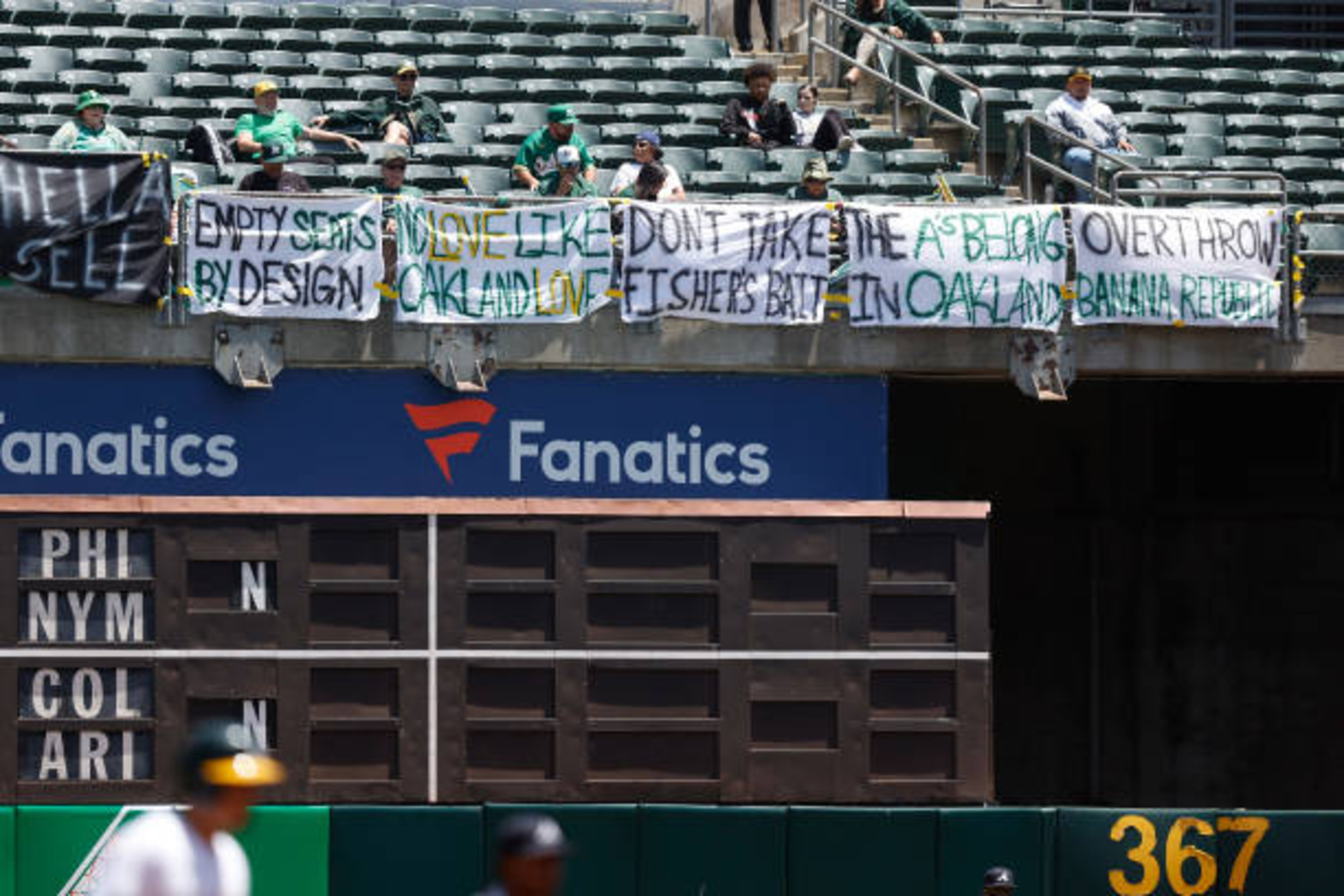
Fans in places like Oakland have lost their ability to partake in these communal experiences. Others across North America have seen their baseball experience degraded steadily over time. This has been the direct result of ownership prioritizing its own benefits, rather than the communities to which the owners are obligated.
In prioritizing cost-cutting measures and profit margins, these lives and experiences are reduced to a collection of ones and zeros. Baseball ownership is not simply an inherently stable investment strategy. It is a public service, and should be treated as such.
For the fans and cities that fuel this sport, the profitability of ownership is secondary, if not an afterthought. Not to mention, team valuations grow every year for clubs across MLB. This holds true whether they rank first in payroll or 30th.
MLB owners favor a salary cap. MLB players stand largely in opposition to this. If the owners want a cap, but the people directly responsible for the implementation of the game we love do not, then which option do you think is most reasonable?
Baseball has seen tremendous growth and momentum these past few years. To jeopardize this growth over what amounts to a cash-grab and asset stability for a few wealthy folks, all while punishing players and failing to directly address core issues, is inane and unjust.
Moving Forward
The central purpose of this piece is to critically examine the salary cap debate and refute the necessity of a cap. However, I feel it would be unfair to merely criticize without proposing solutions.
First and foremost, MLB needs some version of a salary floor. This change could come alongside steeper luxury tax rates as well. That way, teams are prevented from continuously blowing past the soft cap without being artificially restricted outright.
Along that line, there should be greater financial accountability and transparency for ownership. The lack of enforcement of MLB’s stipulations around revenue sharing has created a broken system whereby teams can record exorbitant profits without guaranteed future investments.
No team or owner should be able to collect luxury tax or revenue-sharing subsidies without being held accountable. To this point, MLB should be far more proactive in its policing of ownership. They already established precedent for doing so when it came to McCourt’s mishandling of the Dodgers.
MLB owners essentially function as a board of directors for professional baseball. In any company, members of the board are beholden to the best interests of the company as a whole. In extreme cases, owners who refuse to act in such a manner should not retain the privilege of leadership any longer.
This would not be a punishment, but rather an early paycheck. You would be hard-pressed to find a single owner who would not collect a massive return on their initial investment by selling their team. All they would lose is their ability to collect a check at the expense of their players, staff, and most importantly, the fans.
Owning a baseball team should be considered a prestigious honor, rather than a reward for having a few billion dollars in the bank. The game should be owned by true fans, not just self-proclaimed ones.
To that effect, this could potentially be solved by a push for partial fan ownership. The Braves are publicly traded already, so the precedent exists. The Green Bay Packers are another example, as fans own 100% of the team. The results speak for themselves, as the Packers have the most NFL championships, with 13 in total.
How Can You Not Be Romantic About Baseball?
None of the aforementioned solutions would fix the game of baseball. There will always be disparity, poor ownership, and other issues. The game has never been perfect, but it has gotten better over time.
The goal of these proposals, and this piece by and large, is not punitive. It is not to condemn teams who perform poorly, or owners who put their best foot forward and fail. It is purely to combat a generational trend of moneyed interest controlling baseball’s institutions and rotting them from the inside out.
Many remember the final game played in Oakland. Watching fans come together to celebrate one final game at the Coliseum brought me a great deal of joy, but also a deep sadness.
I love the game of baseball. Its undercurrent is present throughout my entire life. I chose to write about this because I desperately wish to see the game continue to grow and prosper. Baseball deserves far better than to be crippled by a few wealthy folks who could not care less about the well-being of those they ostensibly represent.
A salary cap would not “ruin baseball” either. But, it would hurt the sport quite a bit. Players would be prevented from pursuing the true extent of their value. Teams would likely still suffer from the same issues. The marketability of cities like New York and Los Angeles would allow their teams to remain the most remunerative. Despite the addition of payroll limitations, smaller teams would likely still spend less.
To my knowledge, MLB representatives have yet to put forward a compelling explanation for why a salary cap would work. Much less, I have yet to hear how it would benefit baseball, its players, and MLB fans as much as the pocketbooks of those who lord over them. Until they do, fans need not pay them any mind.
Maybe a salary cap could increase minimum contracts by tying them to league revenue. It might even help promote league parity. Still, it seems to me that it would mostly allow the worst of MLB to continue denigrating the experiences of baseball players and fans with added impunity. If Rob Manfred were honest with himself, he would admit as much is true.
But until that day, I maintain that the best path forward lies in prioritizing the continuation of baseball’s growth and the improvement of experiences for those who find home within it.
2024 team revenues calculated by Forbes. Team valuations calculated by Sportico. Reported operating income or losses courtesy of Forbes. CBA information and historical payroll data courtesy of Cot’s Baseball Contracts and Baseball Prospectus. All views are my own and do not necessarily represent the views of Just Baseball.
More must-reads:
- Juan Soto, Carlos Mendoza excited to see old friends when Mets face Yankees
- Report: Dodgers' Edwin Diaz is being linked to illegal cockfighting
- The 'Active 40-HR MLB seasons' quiz
Breaking News
Trending News





Customize Your Newsletter
 +
+




Get the latest news and rumors, customized to your favorite sports and teams. Emailed daily. Always free!
PRIVACY POLICY COOKIE POLICY CONTACT US
ABOUT YARDBARKER TERMS OF SERVICE


By using this site, you agree to our Terms of Service and Privacy Policy.
This site is for entertainment purposes only.
There is no gambling offered on this site.
Gambling Problem? Call 1-800-Gambler.
