-

-


Follow Us
-

 On Facebook
 On Flipboard


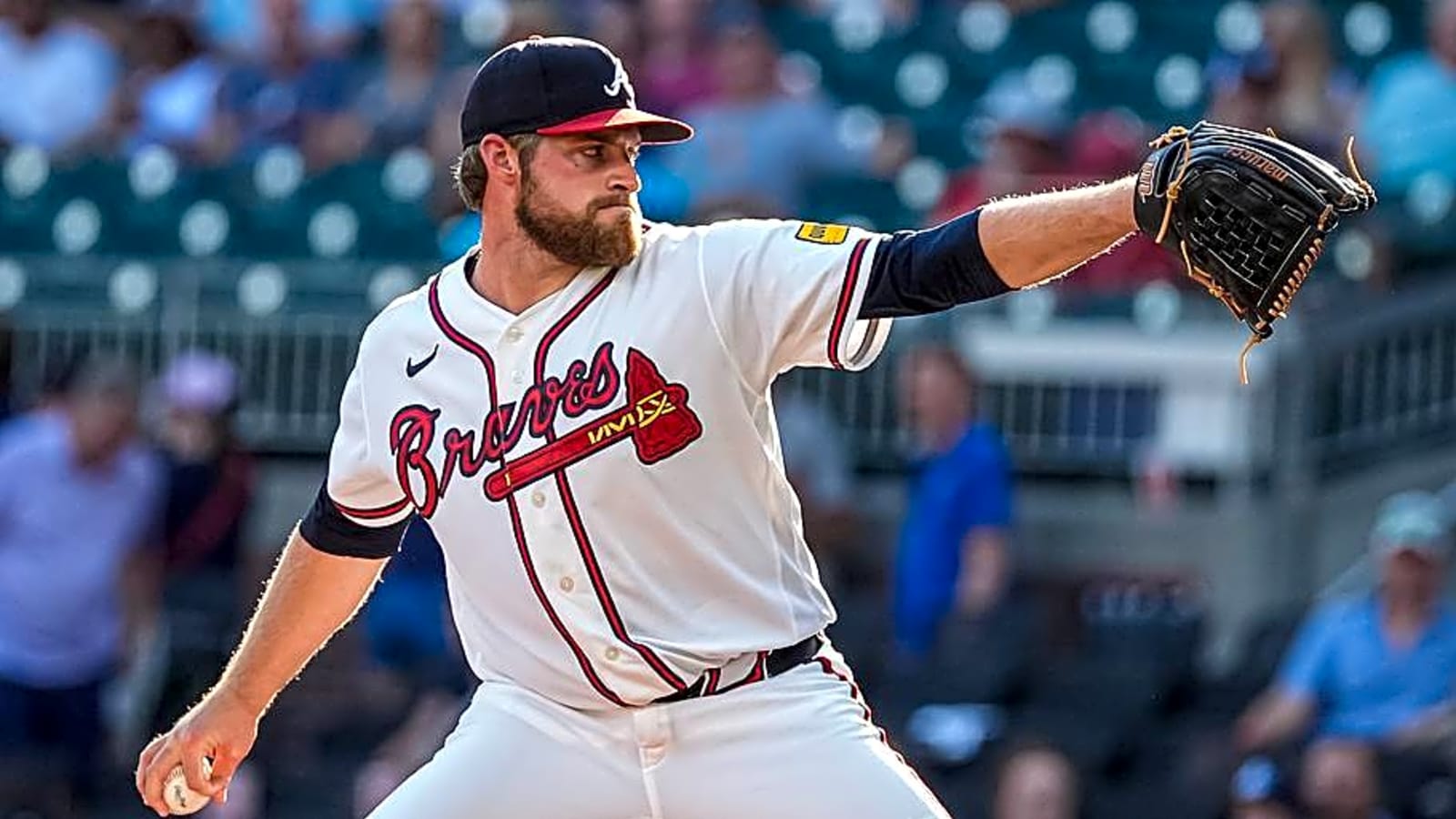
The Atlanta Braves made it official on Friday. Bryce Elder will be back in 2027. Atlanta tendered him a contract at the Nov. 20 deadline, along with Dylan Lee, Joey Wentz and Mitchell Parker, while non-tendering James Karinchak and Michael Grove. Elder is arbitration-eligible, and one projection put him at a $3.65 million salary.
That's a pretty modest price for a starter who just finished a respectable season. His final 2026 line was a 4.11 ERA and a 1.27 WHIP, with 121 strikeouts and 49 walks over 149 innings in 26 starts. But that ERA hides a lot. It's really two very different halves of a season, and the question for the Braves is which version of Elder shows up in 2027.
To understand that, you have to start with where the changes came from. After the 2024 season, which was a rough one for him, John Smoltz arranged for Elder to visit Greg Maddux at the four-time Cy Young Award winner's home. They focused on pitching in the mornings and spent the afternoons golfing, which, honestly, sounds like a pretty good way to learn. Maddux actually suggested the cutter when the two began talking. To protect his best pitch, Elder throws his slider off his middle finger and the cutter off his index finger.
Elder paired that improved slider and the cutter with a changeup, a sinker and four-seamer to keep hitters off balance. He also features a rarely used curveball. (less than one percent of the time, according to Baseball Savant). That's a six-pitch mix, and it's a big leap from the pitcher who posted a 5.59 ERA across 2024 and 2025. It also wasn't a sudden reinvention. The cutter wasn't new in 2026, and I think it's more accurate to call this a gradual evolution that finally clicked.
And when it clicked, it really clicked. The run started in late 2025, when Elder posted a 2.30 ERA over 18 starts between Aug. 24, 2025 and May 22. Through his first 11 starts in 2026, he had a 1.97 ERA over 68⅔ innings. The supporting numbers backed it up too. Opponents' barrel rate fell to 1.7%, and his strikeout rate climbed to 25.3%. For a while, he looked like one of the better pitchers in the league.
Then the bottom fell out. In June, he gave up six runs in four innings against the Mets and eight runs in a single inning against the Brewers. Elder’s dismal month concluded with allowing 24 earned runs in 26 2.3 innings, an 8.10 ERA and an opponents’ batting average of .313. His overall season ERA rose from 1.97 on May 22 to 4.01 on June 27. Manager Walt Weiss attributed it to arm fatigue, though he also said he had no long-term concerns.
The knee turned out to be part of the story as well. Elder first felt discomfort after a July 9 start in Pittsburgh, and the Braves skipped his turn once in July and again in August to ease his workload. In his last start on August 31 against the Giants, he was still battling it. On September 8, he had surgery in Dallas to remove bone fragments from his right knee, which put him on the injured list. I can't say how much the knee played into the summer slump, and Weiss said at the time it wasn't enough to make him miss a start. But it's hard to ignore.
That brings us to the real question: results versus underlying numbers. The full-season numbers are less encouraging than the ERA. He finished with a strikeout rate around 19% and a 4.62 FIP, higher than his 4.11 ERA. FanGraphs' early projection for 2027 has him at a 4.59 ERA. So the pitch mix may have given him a higher ceiling, but his true level for a full season looks like a back-end starter.
And that's fine. That's a useful role, especially for the Braves right now. Chris Sale, Grant Holmes and Elder provide a starting foundation, but beyond them there are questions about health, readiness and workload. With Spencer Strider and Spencer Schwellenbach still carrying some uncertainty, a cheap, durable starter who can serve as a sixth arm or compete for a rotation spot has real value.
How much, though, depends on what else Atlanta does. If the Braves add one starter this winter, Elder is probably in the rotation. If they add two, he could be depth. Either way, I think they made the right call keeping him.
For spring, I'll be watching three things: his velocity, his cutter usage and, of course, his knee. If the first two hold up and the third is healthy, the early version of Elder might not be gone for good.
More must-reads:
- Former All-Star Kris Bubic gets fresh start with American League contender
- Orioles land ALCS MVP Freddy Peralta with five-year contract
- The 'Multiple Cy Young Awards' quiz
Breaking News
Trending News
Customize Your Newsletter
 +




Get the latest news and rumors, customized to your favorite sports and teams. Emailed daily. Always free!
PRIVACY POLICY COOKIE POLICY CONTACT US
ABOUT YARDBARKER TERMS OF SERVICE


By using this site, you agree to our Terms of Service and Privacy Policy.
This site is for entertainment purposes only.
There is no gambling offered on this site.
Gambling Problem? Call 1-800-Gambler.