
-


Follow Us

 On Facebook
 On Flipboard
 On Twitter

The Chicago Cubs Have frustrated many fans with their slow, methodical approach to offseason talent acquisition. Actually, some may use terms other than “slow and methodical,” like “tepid and aggravatingly conservative.”
So far, the Cubs’ entire offseason push consists of signing relievers Phil Maton and Hoby Milner, re-signing Caleb Thielbar, and picking up MLB castoff/NPB reclamation project, first baseman Tyler Austin.
Chicago Cubs being left behind?
Meanwhile, as the Cubs dawdle and cut coupons, just about every top free agent closer has been snatched up. Sluggers Kyle Schwarber and Pete Alonso have been signed. Starting pitchers Dylan Cease signed with the Blue Jays and Michael King re-signed with the Padres.
Time is moving fast and, as talent gets scooped up by other, more daring teams, one can’t help but feel that the Cubs will once again be a team standing on the sidelines looking for bargain buys because they just couldn’t/wouldn’t invest outside their comfort zone.
But what if the team’s off-putting conservative approach was actually more purposeful strategy than collective team quirk?
When it comes to their bullpen, at least, that totally looks to be the case.
Is “cheap” a team strategy?
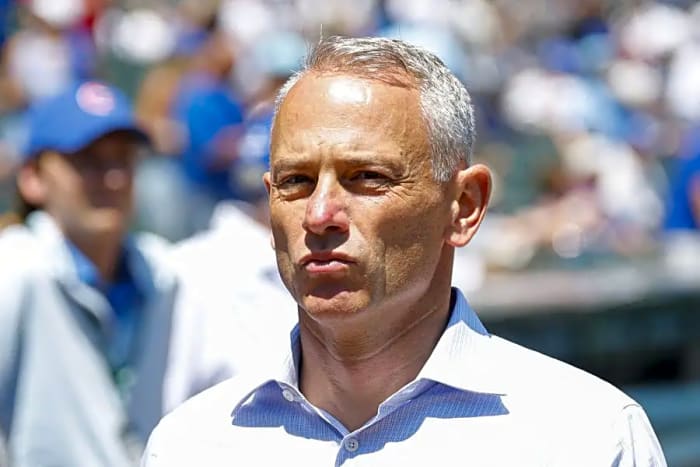
Speaking to Patrick Mooney of The Athletic, Cubs president of baseball operations Jed Hoyer talked about his strategy when it comes to putting together a bullpen, one which doesn’t really include investing in big-money pickups.
“Every team has to make their own decisions on how they allocate resources,” Hoyer said. “Other teams may choose to put really big blocks in the bullpen. That’s up to them. How I see it is: I would rather use those big chunks of money to go get (something else), whether it’s starting pitching or position players.”
One can debate whether this is a sound practice or not. However, it’s not a particularly pleasant thing for fans to hear as a playoff-capable Cubs team walks into the deep end of the offseason with roster holes to fill and rumors of acquisitions buzzing all around.
In Hoyer’s defense, he HAS been able to patch together some solid bullpens on a relative shoestring budget. Last season, for instance, was a bit of a marvel in terms of how much the team got from a crew mostly comprised of castoffs, call-ups, and reclamation projects.
The ups and downs of frugality

The Cubs’ ability to rekindle careers has definitely also given them a leg up in signing more pitchers looking to rebound from rough career patches.
“We’ve done a good job bringing the best out of guys, so I think that certainly is noticed,” Hoyer pointed out. “We’re not alone in that, but I think that when we do Zooms, and we talk to different pitchers, they’re aware of that.”
Manager Craig Counsell seems to endorse Hoyer’s strength-in-volume approach to building the relief corps. Counsell’s ability to mix-and-match arms with team necessities helped turn the bullpen from an early mess to a solid crew. That couldn’t have been done without Hoyer’s constant stocking of potentially viable arms.
“We ended up pitching pretty well,” Counsell told The Athletic. “Maybe it wasn’t the guys that we expected to do it. It just shows (you) get a bunch of good arms and kind of see what happens, and have enough abilities to pivot when you have to during the season.”
On the flip side, however, elite bullpens win championships and the Cubs’ model of shorting bullpen investment almost guarantees that the team won’t ever have an elite bullpen.
At some level, Hoyer himself acknowledges this reality. Last season, he made an unsuccessful bid at big-ticket closer Tanner Scott and this year he swung and missed on Devin Williams and, to a lesser degree, Emilio Pagan and Ryan Helsley.
When push comes to shove, though, the Cubs seem set on falling back to their conservative ways, ostensibly setting aside bullpen money for higher purposes (like starting pitching and position players). But, as everyone has seen, that money often doesn’t get spent on those higher purposes, either.
So, for now, it’s wait-and-see time for Cubs fans. Will another offseason go by without a major free agent acquisition, in deference to gambles wrapped around budget buys?
More must-reads:
- Padres' Michael King re-signing helps alleviate significant losses
- Angels' possible plan for Mike Trout isn't the answer
- The 'AL and NL MVPs since 2000' quiz
Breaking News
Trending News





Customize Your Newsletter
 +
+




Get the latest news and rumors, customized to your favorite sports and teams. Emailed daily. Always free!
PRIVACY POLICY EDITORIAL POLICY CONTACT US
ABOUT YARDBARKER TERMS OF SERVICE


Use of this website (including any and all parts and
components) constitutes your acceptance of these
Terms of Service and Privacy Policy.
This site is for entertainment purposes only.
There is no gambling offered on this site.
Gambling Problem? Call 1-800-Gambler.
