-

-


Follow Us
-

 On Facebook
 On Flipboard


Since Kevin O’Sullivan took the helm in Gainesville, the Florida Gators have been a model of consistency in the SEC. From 2010 to 2026, the club has reached Omaha nine times, culminating in a College World Series title in 2017.
In that same timeframe, O’Sullivan has coached 14 first-rounders, including budding stars like Wyatt Langford and Jac Caglianone. That number is expected to grow in 2027, though it could come with history in multiple facets.
No player in program history has gone first overall, and furthermore, no Canadian has been taken that high in draft history. This could all change with stud infielder Brendan Lawson, the consensus top player in this year’s class.
Born in Toronto, Canada, Lawson chose baseball at a young age and has been a familiar name in scouting circles for some time. He played for the Canadian Junior National Team before heading to P27 Academy, a sports school Corey Warner founded in 2018 in South Carolina.
The school had seen draft talent come through its doors, with Logan Wagner and Alfonsin Rosario being the most notable draftees. Lawson had the pedigree and tools to be a Day 1 selection, but a sinus infection plagued his senior season.
After subsequent surgery and a brief stint in the MLB Draft League, Lawson was taken in the 19th round by the St. Louis Cardinals, but he opted to take his talents to Florida, which has paid massive dividends to date.
However, how has the toolset evolved since getting to campus, and what should we expect as we get ready to flip the calendar to 2027? That’s what our first Evaluation Station installment of the cycle will cover.
For those who have read our content since the beginning, the Evaluation Station piece on Ethan Petry was a kickstarter when we launched, and the goal for this series remains the same: to bring light to our evaluation process, understand our scouting pillars, and pinpoint areas to improve upon for prospects.
With Lawson being at the top of our list, it makes perfect sense to start with him. With a collegiate class that currently lacks enough up-the-middle bats, what sets him apart from the pack?
The answer is simple: very few bats can rival Lawson’s hit/power combination. It’s an above-average hit tool with double-plus power potential. His development on campus points to a potentially quick-moving infielder with loud upside at the major-league level, something teams have looked for at the top of recent drafts.
However, this transformation didn’t happen overnight. Lawson has made a myriad of changes to his play to achieve the results, and his 2026 campaign cemented his status among the sport’s elites. With an OPS north of 1.200 and nineteen home runs, the impact is obvious, but what changes did he make to get here? Let’s dive in and paint the picture.
The Bat Itself
The biggest changes to Lawson’s game have come in his swing, which will catch your attention at first glance. It’s unorthodox, but it works.
Lawson likes to keep his hands above his head, similar to what Nolan Schanuel has employed throughout his career. As a high schooler, he liked to operate with a wider base, nearly encompassing the entire length of the box. Here’s a look at his open-side mechanics from 2023 WWBA Worlds, courtesy of Perfect Game:
‘24 SS Brendan Lawson (ON CAN) smokes this one on a line to PS. Really strong hds, considerable pwr upside. #GoGators commit #WWBAWorlds @pg_int1 pic.twitter.com/CuFZ3vyTOM
— Perfect Game Scout (@PG_Scouting) October 4, 2023
While Lawson kept the width to his lower half during his freshman campaign at Florida, he gradually became more upright over time, and at the start of the 2026 season, he moved fully to an upright, narrow stance at the back of the box.
His operation is triggered by a controlled toe-tap, and he stacks his backside nicely, coiling his back hip incredibly well. What comes next is a picturesque example of effortless violence, with his barrel flying through the zone with significant leverage at impact.
High speed look at a 2B from SS Brendan Lawson (@GatorsBB)… https://t.co/4DCvSir4fc pic.twitter.com/CXuySfJgUI
— PG College Baseball (@PGCollegeBall) May 29, 2026
Given the physicality in Lawson’s frame, it’s no shock that there’s considerable power upside in the stick. He’s always been a strong kid, but his power production was limited by his approach, lacing the ball to every part of the field as a freshman. That changed in 2026, as Lawson found himself pulling the ball at an elevated clip, and the results speak for themselves:
- HR total jumps to 19, SLG% jumps from .522 to .699
- Posted a 90th Percentile EV of 111.2 MPH (99th percentile) and a MaxEV of 116 MPH
- PullAir% jumps from 15% to 27.1%; PullFB% jumps from 9.5% to 19.5%
- Posted a Barrel% of 35.5%, HardHit% of 64.5% (99th percentile on HH%)
- GB% fell from 46% to 34%, FB% rose from 30% to 36%
The swing change itself plays a huge role in his power surge, as his ability to generate leverage and ground force has improved drastically. It’s easy double-plus power that is frequently showing up in game settings, and he’s doing it in the SEC. It’s freakishly good, and if this fall is any indication, there’s no sign of him slowing down.
To further prove his power grade, I’ve included Jimmy Janicki and Tague Davis in this conversation, as they share double-plus power with Lawson.
Lawson’s 90th-percentile EV clears both Janicki and Davis, who posted figures of 110.8 MPH and 110.0 MPH, respectively. Janicki boasts a higher max EV at 118 MPH, though Lawson is not far behind. Surprisingly, Davis’ maximum sat at 115.1 MPH. The raw juice is certainly there, and Lawson’s ability to lift and pull the ball aids his power production.
However, his power isn’t the only tool behind a stark offensive jump; his swing decisions and contact skills have changed dramatically. As a freshman, Lawson endured his lumps against secondary offerings and chased pitches out of the zone at a hefty clip (27%). With a 75% contact rate, there was clear room for improvement, and he exceeded expectations in 2026.
That 27% chase clip fell to a measly 16.3%, as Lawson found his footing, becoming more selective and tightening up his approach at the plate. He stopped chasing pitches off the outer third of the plate, and his walk rate ballooned as a result, jumping from 12.7% to 20.1%.
At the same time, his strikeout rate fell from 20.7% to 17.4%, a respectable mark for a sophomore. His contact rate jumped to 81%, and his in-zone mark was even better, whiffing on just 11% of pitches inside the zone. It’s an impressive jump for someone with his raw power.
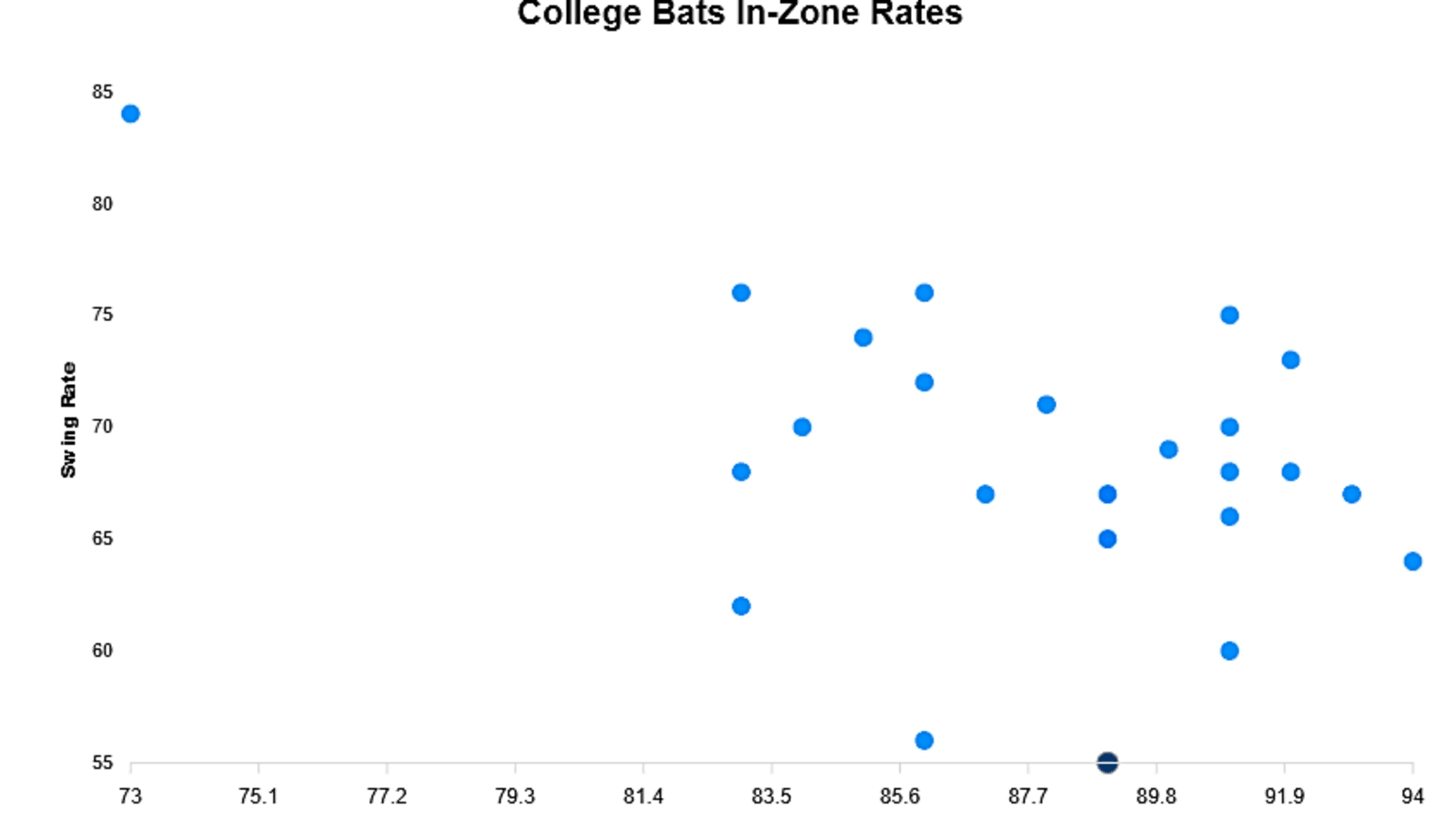
Of course, there is one caveat here, and that’s the passivity in the zone. This is Lawson’s biggest blemish on the offensive front, and while college arms have tended to pitch around him so far, the arms he’ll face as he climbs the ladder will not. Of the college bats on our Top 50 college board, Lawson posted the lowest swing rate in the zone at 55%.
Here’s a scatterplot of how he stacks up against the rest of the board, with his dot shaded dark blue. For a reference point, here are the averages for in-zone contact and swing rates of players on this graph:
- In-Zone Contact: 87.88%
- In-Zone Swing: 68.27%
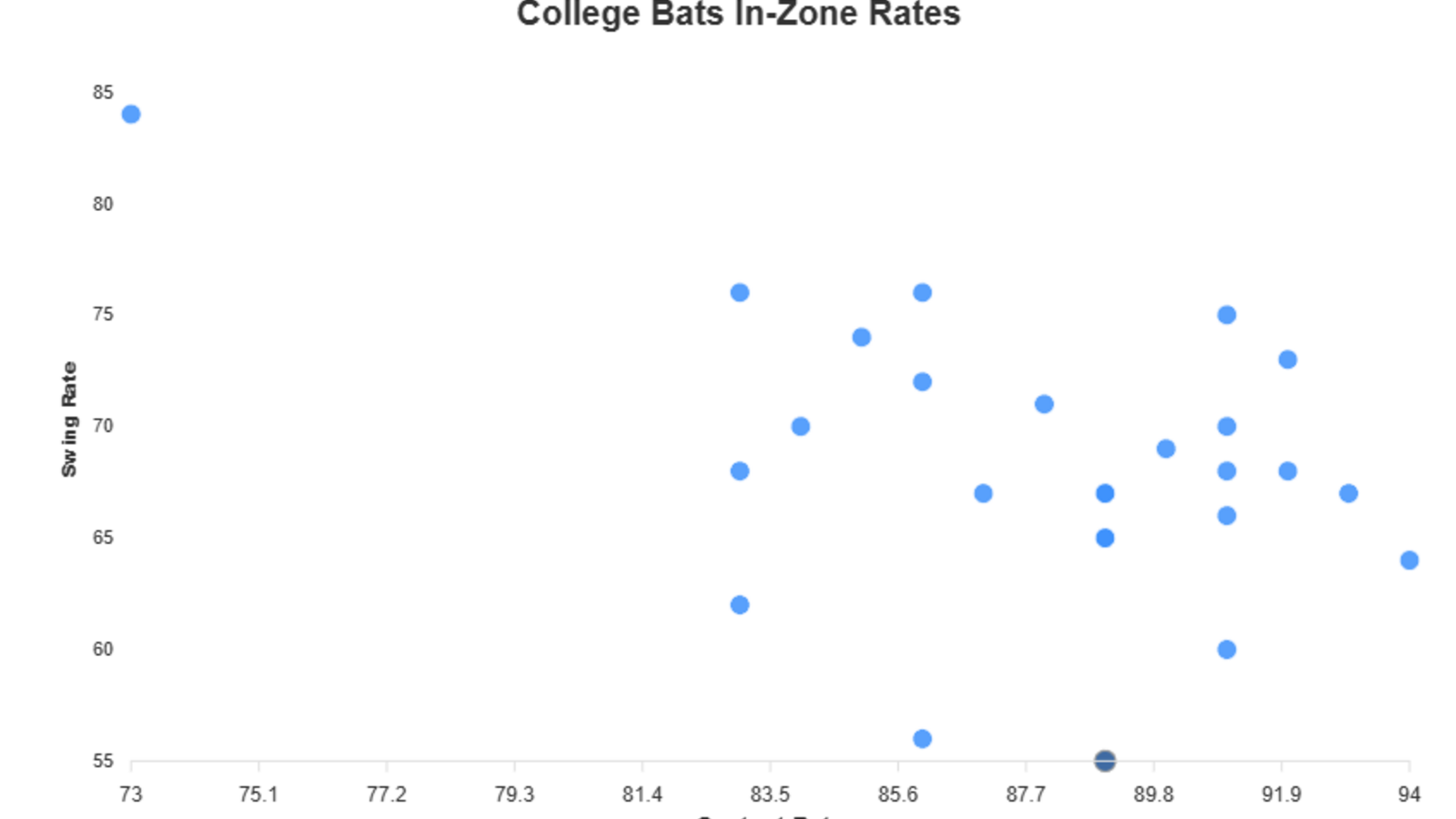
Are we expecting Lawson to overhaul his current approach? Absolutely not. His selectivity and improved swing decisions have helped catapult his draft stock to where it is now. However, adding a bit more aggression to pitches inside the zone will help balance his approach as he inches closer to the majors. As a result, we gave him an above-average grade on his hit tool, but a jump to plus is in the cards.
Defensive Home
This is where Lawson’s evaluation gets a bit murky.
His bat was too good to leave out of the lineup as a freshman, so Florida inserted him at a myriad of positions, playing first, second, and third base. His most frequented home was first base, where he started 37 games for the Gators. As a sophomore, Lawson became Florida’s full-time shortstop, which came with mixed results.
On paper, Lawson recorded the most errors on the team with 13, and his .922 fielding percentage left room for improvement. Given his physical stature and the fact that he had spent a full season on the other side of second base, it shouldn’t be a surprise that he was going through growing pains.
While he’s a solid athlete and runs well, his lateral mobility was limited, and he struggled to maintain his momentum at the position. Furthermore, he felt indecisive on plays and rushed himself, causing him to hurry his throws across the diamond.
Multiple reports indicate that Lawson dedicated time in the off-season to improving his footwork and agility, and it showed during fall workouts. His motions were more fluid and controlled, which bodes well for the future.
If this carries over to a full season, it will improve his odds of staying on the left side of the infield, with his likely home shifting to third base because of his size and arm strength. If he can prove to be an above-average defender at the hot corner, it will be a huge benefit to his draft profile.
Evaluation Summary
Finding bats with this kind of physical firepower is rare. Most bats who see stark increases in power do so at the expense of their contact, but Lawson didn’t. With a potentially plus-hit, double-plus power bat in the making, it’s easy to see why we’ve put Lawson on the pedestal he currently stands on.
That said, the lack of up-the-middle college bats certainly helps his case, and even with a stout pitching crop on the collegiate side, his offensive upside is too good to pass up.
Other outlets have used this comparison, but I can’t shake it myself: there’s Gunnar Henderson to his game. A left-handed stick with loud power and speed on the left side of the dirt? Sign us up.
Lawson’s floor suggests a solid big-leaguer with on-base skills and robust power. However, the ceiling is that of a perennial All-Star third baseman. There’s a non-zero chance that Lawson reaches the big leagues quickly. He will hold the top spot on our big board when it releases after New Year’s.
More must-reads:
- Exclusive Q&A: Dusty Baker talks about Hall of Fame chances
- Mets to land ace Tarik Skubal with historic nine-year deal
- The 'Multiple Cy Young Awards' quiz
Breaking News
Trending News



Customize Your Newsletter
 +




Get the latest news and rumors, customized to your favorite sports and teams. Emailed daily. Always free!
PRIVACY POLICY COOKIE POLICY CONTACT US
ABOUT YARDBARKER TERMS OF SERVICE


By using this site, you agree to our Terms of Service and Privacy Policy.
This site is for entertainment purposes only.
There is no gambling offered on this site.
Gambling Problem? Call 1-800-Gambler.