
-


Follow Us

 On Facebook
 On Flipboard
 On Twitter

News broke on Tuesday that Edwin Díaz was heading west to the Dodgers for three years and $69 million, in a deal that, of course, includes deferrals.
But this has me thinking about the pretty nuanced debate over whether teams should pay relievers big money.
You see, relief pitchers in MLB are kind of like running backs in the NFL.
Outside of the obvious ‘should we pay them’ debate, it is a position with high volatility that is often more reliant on the team’s infrastructure or strategy than on the individual’s talent. A position that constantly has guys coming out of nowhere to be elite, while the primes of the game’s perceived best can be over in an instant.
Do you get a bell cow back/arm, or focus on the committee approach?
Of course, the S-tier guys have longevity, but I am sure you could name as many or more relievers who went from godly to obsolete in the span of a few years as you could running backs.
But, is the controversy over paying these guys warranted? Well, here is how their biggest paydays have turned out.
Edwin Díaz: 5 Years, $102 Million – New York Mets (2023)
The star of the hour.
Edwin Díaz struck out over half of the batters he faced in 2022. So, the reliever record $100 million the Mets gave him seemed justifiable, although this contract got off to as rough a start as you could imagine.
Prior to the season, Díaz tore his patellar tendon while celebrating in the World Baseball Classic.
This caused him to miss all of 2023, while the injury lingered at the start of 2024.
However, down the stretch and in the playoffs, Díaz refound that dominant form.
In 2025, he ripped off a 1.63 ERA to give him the hype to opt out of that contract and take his talents to Los Angeles on the open market.
Even with the wash that was the first year-and-change of this deal, Díaz was a huge part of the Mets’ deep 2024 playoff run, and without him in 2025, that collapse would likely have come sooner.
Given the circumstances, I don’t think the Mets and their infinitely deep pockets regret this one.
Josh Hader: 5 Years, $95 Million – Houston Astros (2024)
Josh Hader’s first year in Houston started and ended poorly.
He had an ERA over 9.00 through nine outings, and while he quickly righted the ship, he gave up the deciding blow that ended the Astros’ season in the playoffs.
However, he returned to prime form in 2025.
This past year, Josh Hader had an ERA of 2.05, the second-lowest BB% of his career, and he only blew a single save. From a peripherals standpoint, his 1.98 xERA was easily the lowest of his career.
His arm slot crept back down to where it was with Milwaukee (29 degrees instead of being in the low-to-mid 30s), and he had the most balanced pitch mix of his career, dropping his sinker usage from 71% to 54%.
Of course, that arm slot change may have been related to a shoulder issue that saw him miss the final seven weeks of the 2025 season.
I think Hader has some great years left, so I don’t see this deal as that bad. Although, it could see them part ways with Bryan Abreu, who is an absolute demon in the bullpen, and perhaps make them a bit gun-shy about spending elsewhere.
Aroldis Chapman: 5 Years, $86 Million – New York Yankees (2017)
In the 2016-17 offseason, Aroldis Chapman reunited with the team that traded him the previous trade deadline on a big-money contract. And it worked.
From 2017 to 2021, Chapman had a 2.82 ERA, 124 saves, and 14.5 strikeouts per nine innings.
He also had an impressive 1.71 postseason ERA with New York, although a pair of untimely playoff homers hung over him like a dark cloud.
In 2022, though, he dealt with Achilles tendonitis, an infection from a tattoo, and diminished play. Meaning, when he missed a mandatory team workout towards the end of the season, he was left off the playoff roster.
But to be fair, that season was a part of an extension he signed with the Yankees in 2020, not the original deal.
So overall, I’d call this a success.
Kenley Jansen: 5 Years, $80 Million – Los Angeles Dodgers (2017)
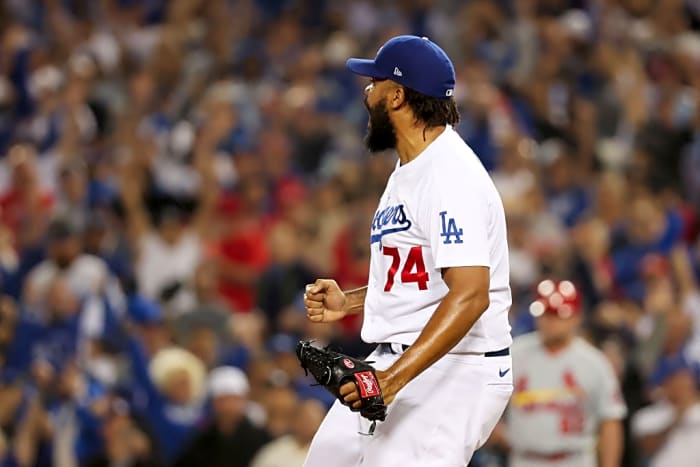
The former catcher re-upped with the organization he had been with since 2004 and came out of the gate hot.
In 2017, Kenley Jansen had a 1.32 ERA, he didn’t have a losing decision, and he saved 41 games while blowing only one. A tremendous season that resulted in a fifth-place Cy Young finish.
He never quite matched that again, but he was awesome throughout the contract, especially in the playoffs.
So, paying relievers seems not to be that bad, right? Well…
Tanner Scott: 4 Years, $72 Million – Los Angeles Dodgers (2025)
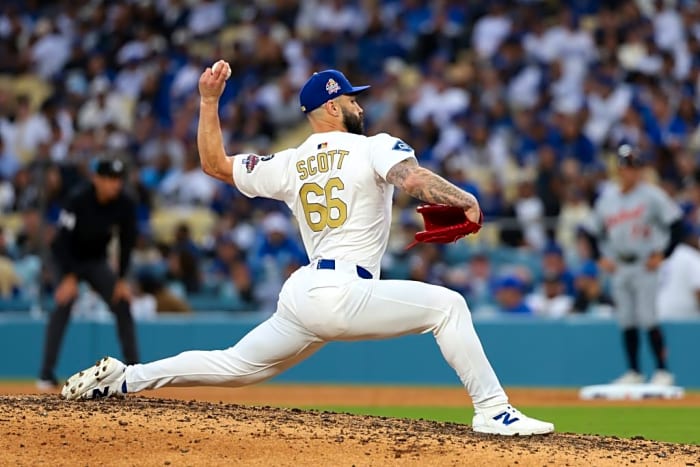
The first year of this deal was rough, although it didn’t seem that way for the first third.
Tanner Scott had a 1.74 ERA through 21 outings, then a 6.44 ERA in his final 40.
An elbow injury saw him miss a few weeks, and then he didn’t throw in the postseason because of a lower-body infection.
Scott still has swing-and-miss stuff, and he nearly cut his BB% in half in 2025.
However, his average exit velocity jumped by 6.5 mph, in large part due to the heater being over the plate a bit too much.
A healthy Scott can definitely bounce back, but, especially with the addition of Díaz, he won’t be the main leverage option like he was originally intended to be.
Edwin Díaz: 3 Years, $69 Million – Los Angeles Dodgers (2026)
This is where Díaz’s new reliever record deal (from an AAV perspective) with the Dodgers comes in. Interesting that they went around $70 million in back-to-back offseasons for bullpen help.
Mark Melancon: 4 Years, $62 Million – San Francisco Giants (2017)
You may forget, but from 2013 to 2016, Mark Melancon had a 1.80 ERA over 290 innings.
So he earned this payday. But, he didn’t quite live up to it.
In 2017, he had a 4.50 ERA and had his season cut short by arm surgery.
And while he was fine upon his return, he lost the closer role and was dealt to Atlanta in 2019.
Melancon finished his contract with the Braves strongly in 2020 and then returned to form with a 2.23 ERA and 39 saves in San Diego.
However, the contract, especially for the Giants, was pretty much a dud.
Raisel Iglesias: 4 Years, $58 Million – Los Angeles Angels (2022)

The Angels traded for a rental Raisel Iglesias prior to 2021, and he responded by having such an excellent season that he got some down-ballot Cy Young votes.
The Halos clearly wanted more of this, so they gave him $58 million, but they weren’t quite patient.
Igesias, whose numbers were down for a struggling Angels team, was dealt to the Braves at the trade deadline in the first year of his contract.
Although, this was kind of a blessing for Iglesias, as he quickly became the star of the Atlanta ‘pen.
Since the trade, he has a 2.35 ERA with 97 saves over 218 innings for the Braves. And after the deal concluded this past season, he re-signed with the team for another year.
So, Igesias lived up to the money. He just did so for the “wrong” team.
Liam Hendriks: 3 Years, $54 Million – Chicago White Sox (2021)
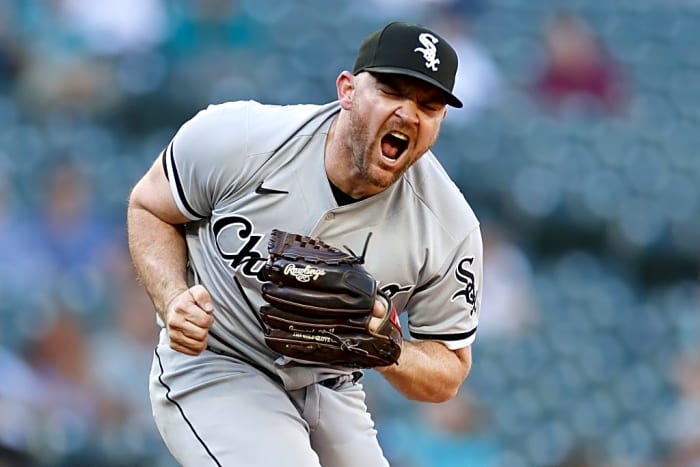
Liam Hendriks deserved this contract.
Following an up-and-down almost decade in MLB, Liam Hendriks had a 1.79 ERA for the A’s from 2019 to 2020.
And he didn’t get complacent after securing the bag, having almost 40 saves in each of his first two seasons with the White Sox while striking out nearly 14 batters per nine innings.
But to make this more impressive, Hendriks was sadly diagnosed with stage 4 non-Hodgkin’s lymphoma following the season, meaning he was pitching with cancer.
However, believe it or not, he battled through chemotherapy to return to the mound the next June, although he shortly thereafter tore his UCL and underwent season-ending Tommy John surgery.
Regardless, Hendriks did all he could and more, and I consider this to be a net-positive reliever contract.
Wade Davis: 3 Years, $52 Million – Colorado Rockies (2018)
Wade Davis may have had the greatest reliever peak ever.
I am going to dive deep into that one day soon, but for now, I will explain it simply.
Wade Davis, from September 4, 2013, until July 24, 2016, had an ERA under 1.00.
So, it wasn’t really a surprise when the Colorado Rockies, a team that plays in the least pitcher-friendly park in baseball, wanted his services.
But he wasn’t alone, as they re-signed Jake McGee and grabbed Bryan Shaw in free agency that same offseason. However, despite over $100 million in commitments for the trio, none of them panned out, especially Davis, who had an ERA of 6.49.
While he is a legend in my book, this contract was a different kind of L.
Devin Williams: 3 Years, $51 Million – New York Mets (2026)
This is where Devin Williams’ deal with the Mets slots in.
It hasn’t started yet, so obviously, I cannot make any objective claims. But, based on his track record, the promising profile in a down year, and his previous success on a David Stearns-led team, I believe he will be a beast again in 2026.
Jonathan Papelbon: 4 Years, $50 Million – Philadelphia Phillies (2012)
Right guy, wrong time.
In the four seasons preceding 2012, the Phillies won two pennants and a championship. They were coming off a 100-win season.
Meaning, adding one of the best closers in the game made a ton of sense, but it was a year too late.
Jonathan Papelbon came as advertised for Philadelphia, pitching to a 2.38 ERA while averaging over 30 saves a season. However, the Phillies did not exceed a .500 winning percentage in any year of his deal.
Papelbon was traded to Washington before the end of the contract in exchange for Nick Pivetta. The most notable moment of his stint with the Nationals saw him choke Bryce Harper in the dugout.
Was this contract bad? No, not at all.
Would the Phillies do it again? I don’t know. Having a great closer on a bad team is like having a Lamborghini without a wheel.
Closing Thoughts
Is paying relievers worth it? In my opinion, it depends. Yes, that is a fence-sitter take, but it is just true.
If you’re a team that is not within striking distance of a pennant, that money is better served elsewhere. And even if so, what does your franchise’s financial flexibility look like?
Giving money to a relief pitcher is like buying organic instead of store brand. The latter might be lower quality, but it is cheaper and, in some cases, may be just as good.
More must-reads:
- Edwin Diaz has stinging words for Mets fans after Dodgers introduction
- Yankees set a condition to re-sign Cody Bellinger
- The 'AL and NL MVPs since 2000' quiz
Breaking News
Trending News







Customize Your Newsletter
 +
+




Get the latest news and rumors, customized to your favorite sports and teams. Emailed daily. Always free!
PRIVACY POLICY EDITORIAL POLICY CONTACT US
ABOUT YARDBARKER TERMS OF SERVICE


Use of this website (including any and all parts and
components) constitutes your acceptance of these
Terms of Service and Privacy Policy.
This site is for entertainment purposes only.
There is no gambling offered on this site.
Gambling Problem? Call 1-800-Gambler.
