-

-


Follow Us
-

 On Facebook
 On Flipboard


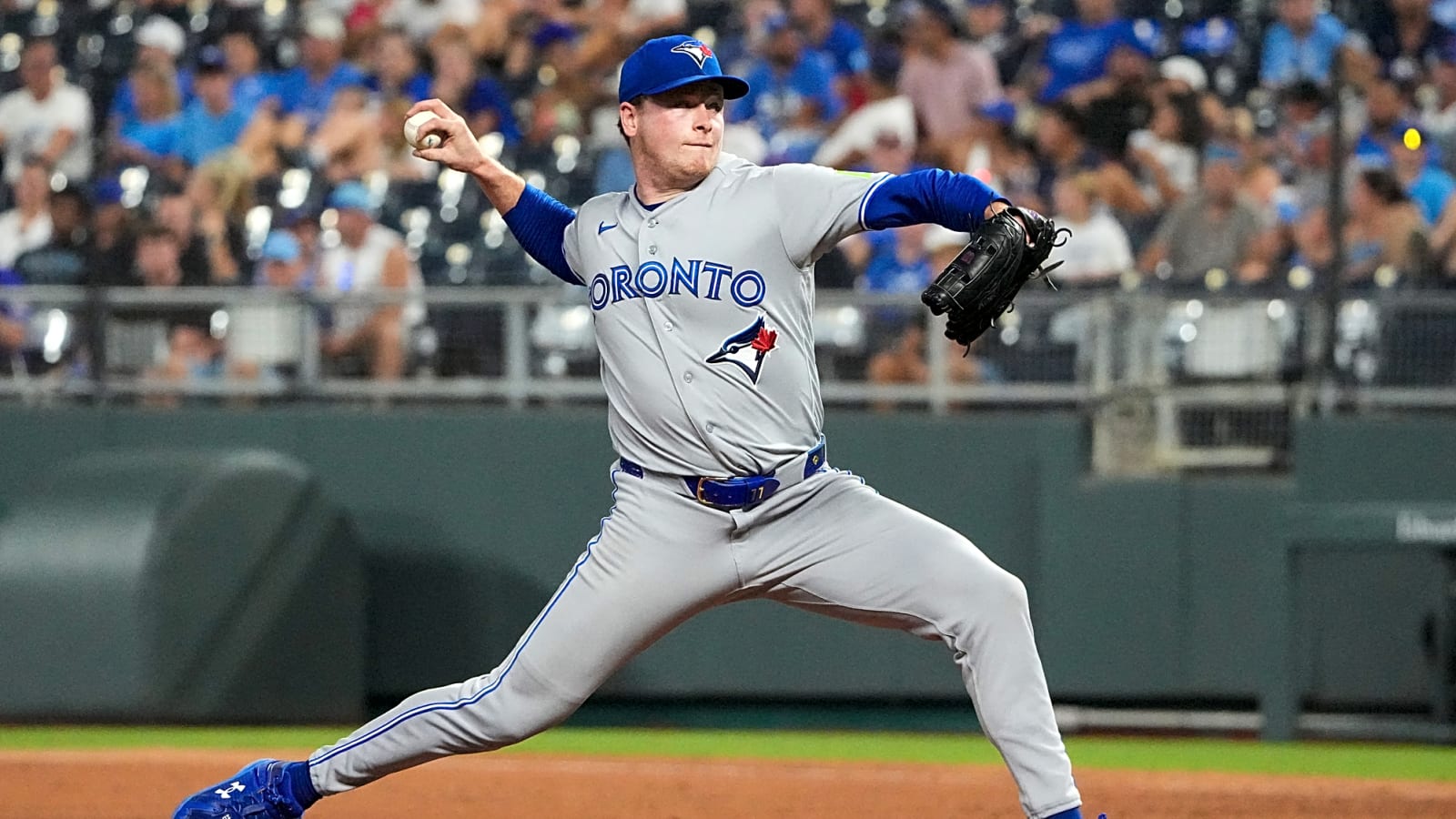
In baseball, there are relievers who pitch lots of low-leverage, low-quality innings, and relievers who pitch a few high-leverage, high-quality innings. But in Toronto, there is a reliever who pitches some of the highest-quality innings in the game, and he does it more often than anyone.
Louis Varland won the BBWAA’s newly-created AL Reliever Of The Year award on Wednesday, narrowly beating out Cleveland’s Cade Smith. Smith put together an outstanding campaign for the Cleveland Guardians in his own right. In 74 innings of work, he carried a 1.95 ERA and 2.18 FIP, a 28.5% K-BB ratio that ranked fourth-best in baseball, and his 41 saves in 46 opportunities tied for the most in all of MLB.
That he came second to Varland says less about Smith’s quality and more about the dominance of the Toronto Blue Jays’ newfound closer.
The lowest single season ERA in Toronto Blue Jays history, min. 60 IP:
— Just Baseball (@JustBB_Media) November 12, 2026
2026 LOUIS VARLAND • 1.27 ERA
He was incredible in his first full season with Toronto pic.twitter.com/k3jjsRNEao
Varland tore the AL apart in his first full season in Canada. His 1.27 ERA (348 ERA+) was the lowest (and highest) of any pitcher who pitched 78 innings or more in 2026, starter or reliever. His 1.83 FIP was also the lowest in baseball under the same parameters. Among qualified relievers, only flamethrowers Mason Miller and Jhoan Duran bested him in that category, and neither pitched as many innings.
What changed to make Varland into the AL’s most dominant closer? Was there an argument that Smith ought to have received the reward after all? And why did the ex-players who chose MLB’s Mariano Rivera AL Reliever Of The Year award pick Rays closer Bryan Baker over both of them?
An Unlikely Evolution
Baseball Savant offers insight into what Varland adjusted to transform himself from a struggling starter with the Twins into the best closer in the AL.
In 2024, Varland was rendered helpless by major league hitters. His unsightly 6.40 ERA in 32.1 innings as a starter looked award-worthy in comparison to his 9.87 ERA in 17.1 innings of relief, and he spent much of the year in Triple-A.
The main culprit was a particularly lifeless slider which nevertheless was his go-to breaking ball. With nearly four inches less vertical break than the average big-league slider, batters teed off on the pitch to the tune of a .333 batting average, a .603 slugging percentage, a 46% hard-hit rate on batted balls, and a brutal run value of -9.
His primary pitch, a 96-mph fastball, wasn’t much better. Hitters again had a field day, batting .306 and slugging .553 to create a -2 run value for the pitch. His other secondary pitches, a curveball and a changeup with a rarely-used sinker mixed in, carried run values of -2, 0, and -1 respectively.
The long ball plagued Varland as a result. In 2023, when his pitch mix was similar, his HR/9 stood at an ugly 2.12. In 2024, it moved to 2.17. One in every five fly balls hit off of Varland turned into home runs in those two years.
A reset was desperately needed.
Change In Scenery, Changing Pitches
After such a bad season in 2024, Varland’s role and arsenal entered a period of total overhaul.
Not only was he moved to the bullpen for good in 2025, allowing him to up the velocity on his fastball, but he dropped his malfunctioning slider almost entirely in exchange for his more effective curve. The improvements were immediately noticeable.
His ERA dropped to 2.02, his HR/9 fell to 0.6, and the Concordia-St.Paul product had finally emerged as a productive pitcher with his hometown team.
He was so productive, in fact, that when the Twins chose to sell everything not nailed down at the deadline, Varland was among those shipped out despite not even having hit arbitration yet. His trade to Toronto for Alan Roden and Kendry Rojas was controversial in the moment and has only grown more so with time.
While the Twins struggled to compete with a bottom-ten bullpen unit by fWAR in 2026, Varland’s rise in Toronto only accelerated. Among the adjustments he made in Canada was a change in grip to his changeup in order to better attack left-handed batters.
That, along with another leap in his fastball velocity and the reintroduction of a revived slider, transformed Varland from a solid bullpen option into a breakout star. The reinvented changeup, thrown almost exclusively to left-handers, turned batters into paste with a .123 batting average and .140 slugging percentage against the pitch.
The 99-mph fastball with a newfound extra inch of vertical movement produced similar results, with a .193 batting average and .228 slugging percentage against. Even the once-lifeless slider, now exclusively thrown to righties with an additional two inches of horizontal movement, graded out as a plus pitch with +3 run value.
Perhaps the most impressive mark for Varland is that expected stats back his dominance as genuine. Batters’ wOBA (weighted on-base average) against the fastball was a measly .243, but the xwOBA sat at .244. For comparison, Varland’s fastball’s wOBA in 2024 was .390 while its xwOBA was .338, suggesting he’d actually been unlucky when it graded out so poorly on the field.
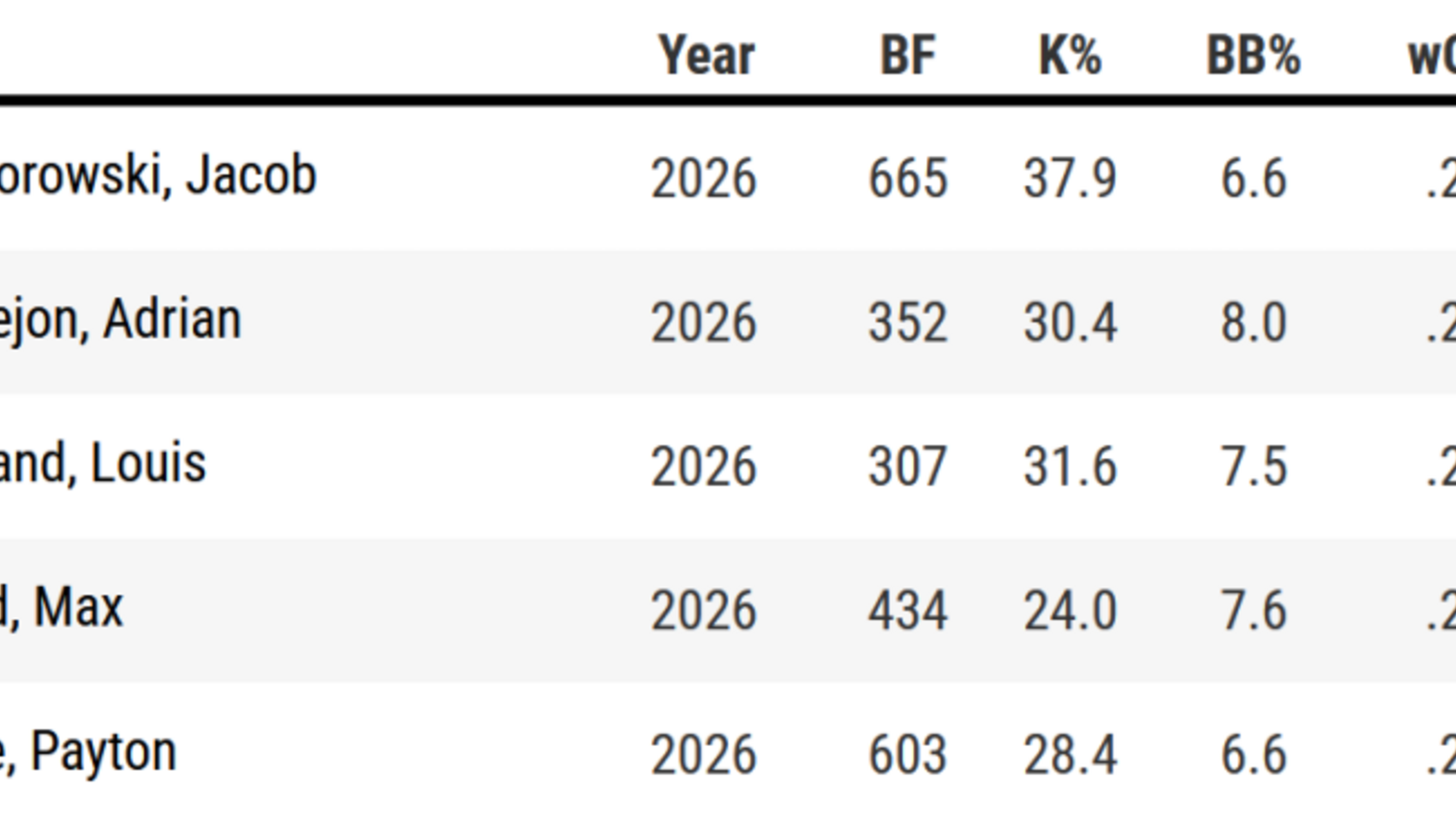
His changeup (.124 wOBA, .180 xwOBA) and slider (.202 wOBA, .230 xwOBA) both appear relatively fortunate in comparison, but even the expected numbers are wildly impressive. Varland’s .239 overall xwOBA ranks third in baseball among all pitchers with over 75 innings pitched, only behind Adrian Morejon and Jacob Misiorowski.
Rarefied Air
When given proper historical context, Varland’s 2026 only becomes more exceptional.
Among relief pitchers who finished a season with under 1.50 ERA in 75 innings or more since 2000, he ranks third in ERA, second in ERA+, and fourth in FIP and fWAR. In a table that includes legendary relievers like Eric Gagné and Rivera himself, Varland fits right in.
| Year | Innings Pitched | ERA | ERA+ | FIP | fWAR | |
| Eric Gagné | 2003 | 82.1 | 1.20 | 337 | 0.86 | 4.7 |
| Blake Treinen | 2018 | 80.1 | 0.78 | 531 | 1.82 | 3.6 |
| Rafael Betancourt | 2007 | 79.1 | 1.47 | 307 | 2.22 | 3.3 |
| Louis Varland | 2026 | 78.0 | 1.27 | 348 | 1.83 | 3.1 |
| Dellin Betances | 2014 | 90.0 | 1.40 | 274 | 1.64 | 3.0 |
| Mariano Rivera | 2005 | 78.1 | 1.38 | 308 | 2.15 | 2.9 |
Even more impressively, if you shrink these parameters to only include seasons after 2020, Toronto’s bullpen star stands alone entirely. What he accomplished in mixing both quantity and quality is unmatched in the post-COVID era of reduced pitching workloads.
That historic level of play sums up what separates Varland from Smith, despite the latter’s strong season. More confusing is the inclusion of Tampa Bay closer Bryan Baker, who a panel of ex-players chose as MLB’s Mariano Rivera AL Reliever Of The Year, in this conversation.
| Innings Pitched | Saves | ERA | ERA+ | FIP | xwOBA | fWAR | |
| Louis Varland | 78.0 | 35 | 1.27 | 348 | 1.83 | .239 | 3.1 |
| Cade Smith | 74.0 | 41 | 1.95 | 212 | 2.18 | .261 | 2.6 |
| Bryan Baker | 62.1 | 41 | 1.44 | 295 | 3.07 | .272 | 1.3 |
Make no mistake that Baker had a remarkable season in his own right. Any campaign which ends with 41 saves and an ERA under 1.50 is one to be proud of. But any advanced metric will tell you that his season was not on the same level as either Varland or Smith.
Smith and Baker did both have more saves than Varland – something which must have weighed heavily in the panel’s considerations – but unlike Smith and Baker, Varland didn’t start the season as a closer. It took until late April for Jeff Hoffman to lose his grip on the role.
It wasn’t that Varland hadn’t forced his way into the conversation, either. Through March and April, he ran an 0.56 ERA, an 0.60 FIP, and mowed batters down with 14.63 K/9. Swapping him in for the struggling Hoffman eventually became a matter of time.
Until the move was made, however, Varland couldn’t earn saves because he wasn’t being put into save situations. Punishing him in awards voting because his team didn’t have him in the closing role to begin the season is fundamentally unfair and more than a little silly.
But even if you accept saves as an important part of the award, the decision to grant the award to Baker over Smith is just as strange as the decision to not go with Varland.
Smith and Baker both earned 41 saves, and if advanced stats weren’t being considered, the deciding factor must have come from ERA, where Baker outpaces Smith by over 50 points. However, Baker enjoyed an unusually low BABIP of .203, the third-lowest BABIP in baseball among pitchers with over 60 innings of work.
Pitchers do have some control over their batting average on balls in play, but defense and dumb luck heavily influences BABIP for pitchers and hitters alike. Such an outlier result suggests that Baker, while excellent in his own right, was elevated into awards contention by a heaping dose of good fortune as well.
Smith and Varland, meanwhile, achieved their outstanding results while running league-average BABIPs, explaining why their FIPs – and their FanGraphs WAR estimates – are far better than Baker’s.
It’s a shame that Louis Varland will not receive MLB’s Reliever of the Year honors as he received the BBWAA’s. He absolutely deserved them both. But he can take solace in the recognition that he has received, and in the knowledge that he dominated baseball in 2026 as nobody else has this decade.
More must-reads:
- Brewers nab potential bounceback pitcher in trade with Giants
- Red Sox may be ready to move on from Kristian Campbell
- The 'National League MVPs' quiz
Breaking News
Trending News




Customize Your Newsletter
 +




Get the latest news and rumors, customized to your favorite sports and teams. Emailed daily. Always free!
PRIVACY POLICY COOKIE POLICY CONTACT US
ABOUT YARDBARKER TERMS OF SERVICE


By using this site, you agree to our Terms of Service and Privacy Policy.
This site is for entertainment purposes only.
There is no gambling offered on this site.
Gambling Problem? Call 1-800-Gambler.