
-

-


Follow Us
-

 On Facebook
 On Flipboard

If you asked fans what the strength of the Cincinnati Reds team was heading into the 2026 season, I’m sure most would say the rotation. Having Elly De La Cruz on your team is always going to pull eyes away from other areas, but the rotation was really the only reason the Reds made the playoffs in 2025.
What was seen as their greatest strength ended up being underwhelming. Hunter Green’s injury was a massive blow, Nick Lodolo was essentially a non-factor, while Andrew Abbott and Brady Singer both took steps back. The spring training hype surrounding Brandon Williamson did not translate to the regular season either.
One player who might have been seen as an answer to these struggles was Rhett Lowder. The seventh overall pick from the 2023 draft dealt with injuries of his own in 2025 but was expected to have a real chance to show his value this season. Some even expected a true breakout.
Well, that didn’t happen. Was Lowder a complete bust? I wouldn’t go that far, but he certainly wasn’t what you would have expected from a top-10 pick the Reds needed him to be. With this season now behind us, the question becomes whether Lowder can become a valuable asset for the Reds in 2027 and beyond.
Concerns Surrounding Rhett Lowder
Before we dive into the season Rhett Lowder had, I want to emphasize that this is far from a finished player. He missed what was essentially an entire year due to injury, and at 24 years old, has only made 32 career starts. While I’ve always personally been lower on Lowder than many, I do think there’s a better pitcher in there than what we saw this season. How much better? That’s what needs to be answered.
Let’s first start with his profile. A right-handed pitcher without much velocity who relies more on movement to get batters out. He won’t overwhelm you with his stuff, but his sinker-heavy arsenal, in theory, will allow him to rack up a lot of ground balls and not rely on strikeouts to drive his value. He gets enough movement to miss barrels when his pitches are located well.
The problem is locating those pitches. You’ll see times when Lowder is on, hitting his spots and allowing the ball to move away from the barrel, forcing soft contact and ground balls. However, that isn’t consistent enough, at least not yet. Too often, his pitches landed over the middle of the plate or in a zone where hitters could attack, and they did plenty of damage.
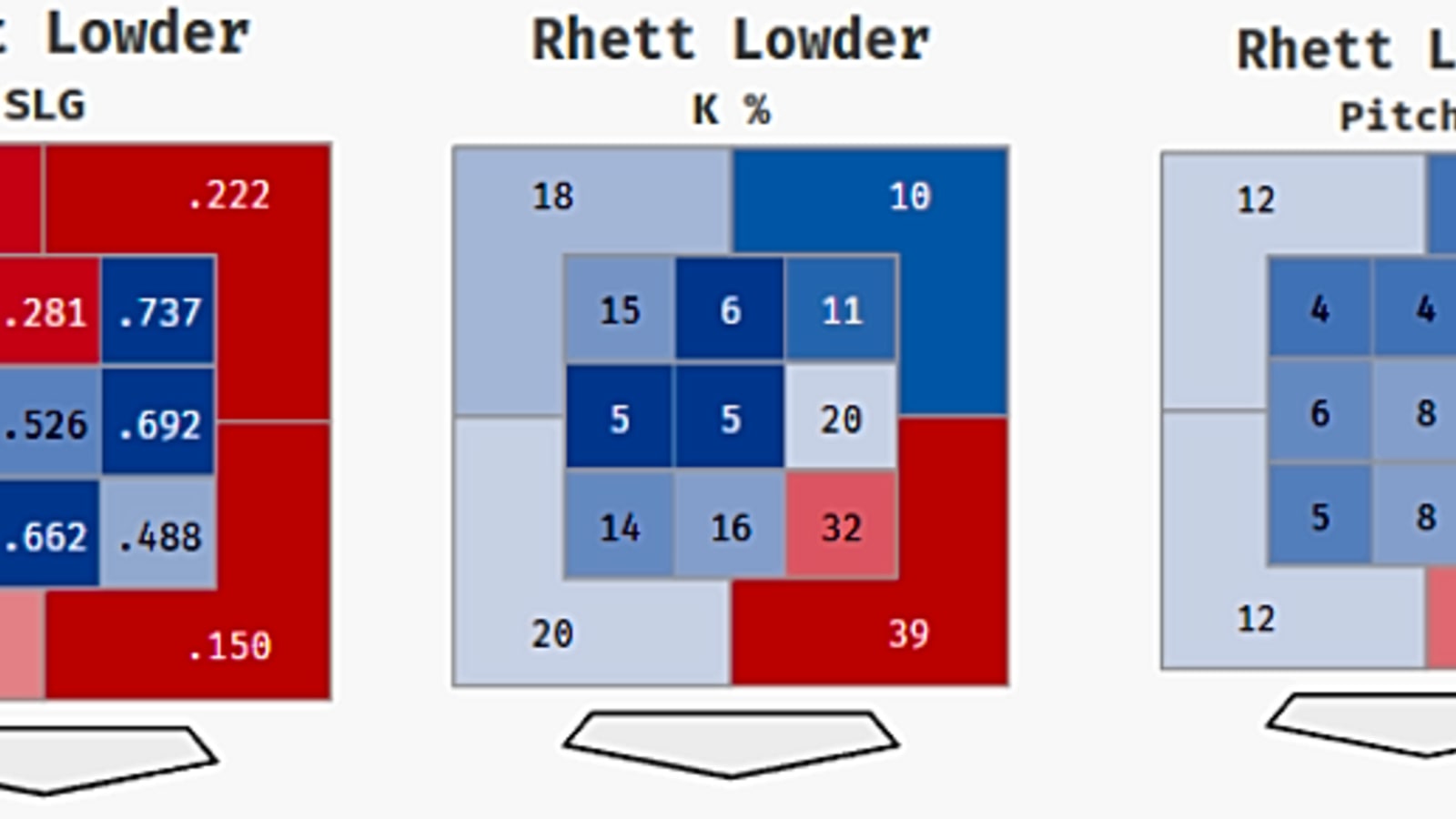
Via Baseball Savant
What you see pictured above might look like three random categories that I’ve selected, but they all tell a story. These pictures are areas of the zone from the catcher’s perspective. As you can tell in the first one on the far left, his slugging percentage allowed in the zone is high across multiple quadrants. Batters were often teeing off against Lowder anytime he entered the zone, which resulted in an average exit velocity of 90 mph and a barrel rate just below 10%.
A lot of that impact is due to Lowder’s pitches oftentimes landing in the middle of the zone, as you can see in the far right, where the highest percentage of his in-zone pitches landed in the middle and middle-third of the strike zone. Sinkers were not located nearly low enough, and his fastball was not providing much of anything throughout the year. He threw a sinker more than any other pitch (30.2%) and allowed an average exit velocity of 91.5 mph with only a 7% whiff rate.
Of course, sinkers are oftentimes going to have a higher exit velocity and lower whiff rate, as they’re balls that are typically hit into the ground, so you almost welcome contact. The sinker will not necessarily be a strikeout pitch, but Lowder has to find a way to get more swing and miss from his other offerings.
Look at the middle picture in the graphic above. That is his strikeout percentage by zone. Right now, there’s only one way that Lowder can consistently get a strikeout, and it’s with a breaking ball low and away. When you have limitations to the way you can get outs, you become more predictable, making the guessing game easier on the hitter.
This is not to say that Lowder cannot change and add more dynamics to his game. We did see a few 95 mph fastballs up in the zone getting swings and misses, but we need to see that more consistently in 2027. If Lowder can get better with the command of his fastball, it will help open up his other offerings, especially against lefties, where he can go to his changeup away in the zone to get swing and miss.
I don’t think that Rhett Lowder is ever going to be known as a true strikeout pitcher, but I know that he can be better than what we saw this season. Sitting at a 6.95 K/9 with a 3.78 BB/9 isn’t going to cut it. You just don’t find too many pitchers who have success with numbers like that, as was evident by his 5.74 ERA and 4.71 FIP.
With Brady Singer being a potential free agent, Hunter Greene still injured, and other questions surrounding the Reds’ rotation, Cincinnati needs Lowder to step up in a big way in 2027.
Reds Rotation Needs More From Lowder
It’s funny how quickly a strength becomes a weakness in this sport. Hunter Greene being out next season, Brady Singer potentially hitting the open market, and Nick Lodolo looking less and less like an answer emphasizes the need for rotation help.
We all know how cheap the Reds can be and how difficult it is to sign free-agent starting pitchers to play in Great American Ball Park, making it that much more crucial to develop from within. Lowder is going to get a chance, like it or not. Think of how important it would be for this team if Lowder could step up and even pitch to a 4.30 ERA. I don’t think that’s an unreasonable ask for a player going into his second full season.
Rotation spots will be up for grabs. Chase Burns has developed into one of the bright young pitchers in the league and will hold down the ace spot. Andrew Abbott should be at number 4 or 5. Outside of those two, I can’t say for sure that anybody will have a spot written in Sharpie. Rumors have been that they want to bring back Brady Singer, but I don’t think that would be the brightest idea.
Bringing back Lodolo is becoming less likely. The injuries, the underperformance, and the rising salary do not seem like the greatest fit for the Reds. If Lodolo could be the answer, say, to the number five spot in the rotation, then the Reds would have one less pitcher they would need to add.
Before you scramble to look up the top prospects and see which pitcher you want to insert into the Reds’ rotation in 2027, I’ll save you the trouble. You won’t find any. At least none that have a confidence level above about 10% in providing an impact in 2027.
I see Lowder as the Reds’ greatest internal upgrade, and it all has to do with how he improves from now until the start of next season. We’ve seen the flashes in the good outings. We’ve also seen blow-up outings. I think those types of outings are par for the course with pitchers who have this type of profile.
Look at Framber Valdez. You might have considered him the best of the sinker-heavy profiles heading into this season. Every year, he has 8-11 blow-up starts as well. When you throw a pitch that does not get much swing and miss as often as these pitchers do, a lack of command on a certain day could lead to a disaster start.
I’m fine stomaching a blow-up start from time to time so long as Lowder finds a little more swing and miss and slightly better command, which he showed throughout the minors.
Final Thoughts
Let’s be brutally honest. The Reds need a lot to go their way if they want to find success in 2027. They need repeat years from Elly De La Cruz and Sal Stewart, a number of their rookie bats to find success, and several answers in their bullpen. If they don’t plan on adding much from outside the organization, then they need more from inside.
To me, a step forward from Rhett Lowder would be one of the more impactful things to happen for the 2027 Reds. While I wouldn’t put my confidence level super high, I do think it is possible. If he doesn’t take a step forward, the Reds’ rotation could be in serious trouble.
More must-reads:
- Massachusetts native Ben Rice destroys Red Sox in record-tying postseason performance for Yankees
- Hagen Smith gave the White Sox exactly what they needed as Game 1 opener
- The 'Most 200-K MLB seasons' quiz
Breaking News
Trending News






Customize Your Newsletter
 +
+




Get the latest news and rumors, customized to your favorite sports and teams. Emailed daily. Always free!
PRIVACY POLICY COOKIE POLICY CONTACT US
ABOUT YARDBARKER TERMS OF SERVICE


By using this site, you agree to our Terms of Service and Privacy Policy.
This site is for entertainment purposes only.
There is no gambling offered on this site.
Gambling Problem? Call 1-800-Gambler.
