-

-


Follow Us
-

 On Facebook
 On Flipboard


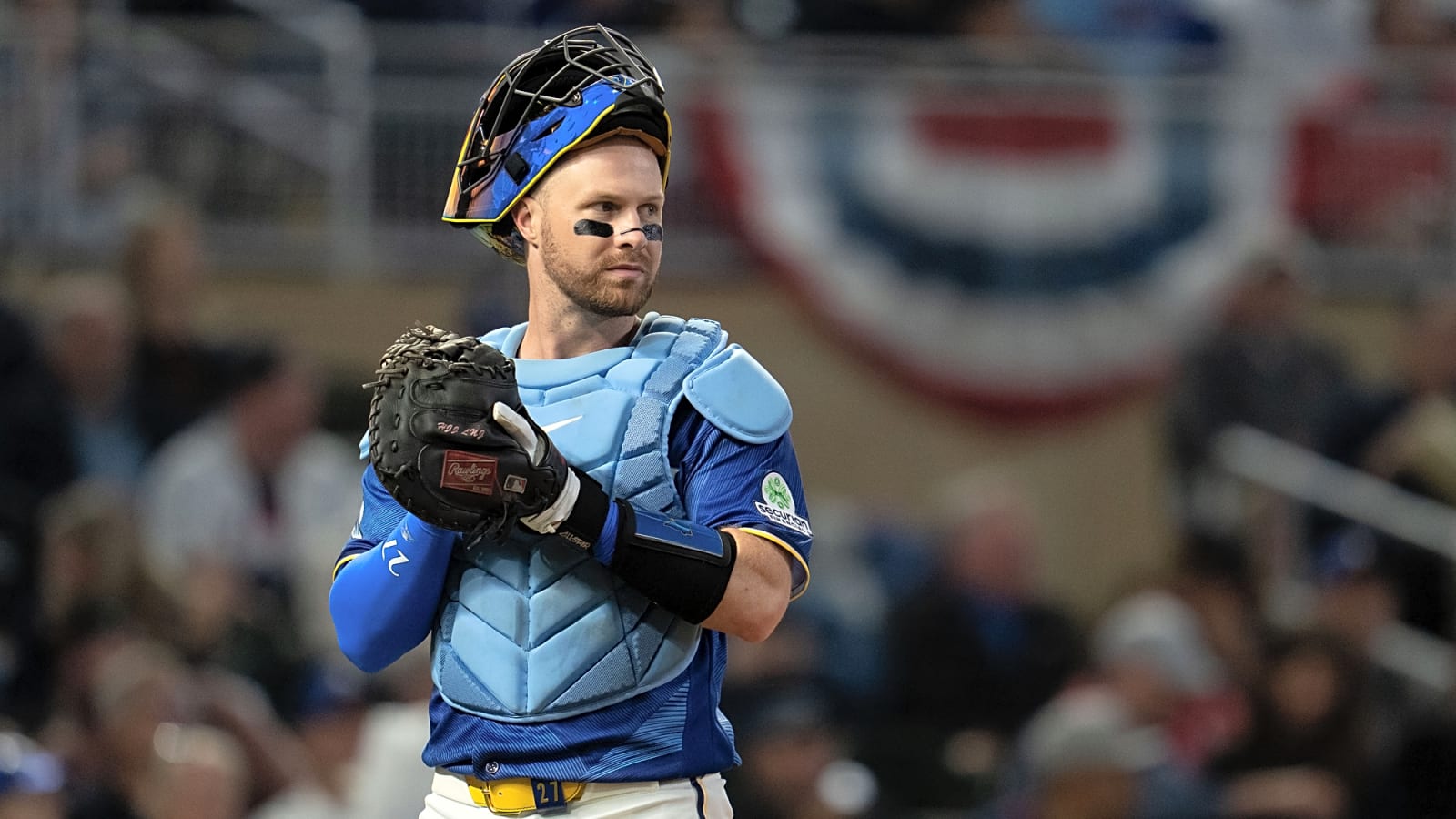
Twins catcher Ryan Jeffers has opted to accept his $23.15MM qualifying offer, reports Tyler Kepner of The Athletic. It’ll immediately (and narrowly) establish a new AAV record for catchers, which had previously been held by J.T. Realmuto at $23.1MM (on a much longer, five-year term). Jeffers, a Boras Corporation client, heads back to the Twins on a one-year deal. It’s an about-face for the slugging backstop, who as of last week was reportedly planning to decline in search of a longer-term deal.
It’s a surprise outcome but surely one the Twins welcome. General manager Jeremy Zoll had already spoken about his hope to retain the 29-year-old Jeffers. The two parties had discussed parameters of contracts beyond just the QO acceptance, Zoll noted last week. Perhaps today’s decision to accept the QO is just a waypoint on the road to a more lucrative multi-year deal that’ll keep Jeffers with the only organization he’s known, but even if that’s not the case, it’s a nice outcome for the Twins.
Had Jeffers departed, Minnesota would have picked up a compensatory draft pick but been left without a clear starting option in 2027. Veteran Victor Caratini is signed through 2027 but is coming off a down year at the plate. Jeffers will step into the primary catching role and push Caratini to a backup role for which he’s better suited. (It’s also possible the Twins look to trade Caratini and add a more affordable backup, though that’s purely speculative.)
Jeffers, it should be noted, cannot be traded without his consent. Any free agent who signs a big league deal is barred from being traded without consent until the following June 15, and accepting a QO is considered akin to signing as a free agent under the terms spelled out in the collective bargaining agreement.
As such, Jeffers now provides a one-year bridge to top catching prospect Vahn Lackey, the No. 3 overall pick in the 2026 draft, and/or to touted young catcher Eduardo Tait, the headline prospect of the 2025 trade that sent Jhoan Duran to Philadelphia. Even if Jeffers and the Twins end up working out a multi-year arrangement, Jeffers has enough bat to move into an occasional first base/designated hitter role when one of Lackey or Tait proves ready for a look in the majors.
Jeffers started the 2026 season on an absolute tear and appeared to be barreling toward a breakout — at least until an errant fastball during a mid-May plate appearance resulted in hit-by-pitch … and a left hamate fracture. Jeffers missed about two months of action, during which time Caratini took up the lion’s share of playing time. Jeffers hit well upon returning but not to the same extent he did pre-injury — though that’s not a total shock for any hitter returning from a hamate fracture. He finished out the season with a .256/.353/.461 batting line, 14 homers, 19 doubles, two triples, a big 12.5% walk rate and a 17.9% strikeout rate that was nearly five points lower than average.
That marks four straight seasons in which Jeffers has been a decidedly better-than-average hitter. Dating back to 2023, he’s posted a .254/.342/.440 batting line and clubbed 58 homes in 1632 plate appearances. By measure of wRC+, Jeffers was 28% better than average in 2026 and has been 19% better than average dating back to ’23. Considering the standard catcher is around 10 to 12 percent worse than average at the plate, his production is all the more valuable.
Jeffers has cut his strikeout rate in three straight seasons and walked at a career-best 12.5% rate in 2026. His four-year platform to free agency stacks up quite nicely with Willson Contreras’ own four-year run to free agency, wherein the former Cubs/Cardinals catcher (and current Red Sox first baseman) hit .249/.349/.467 in a near-identical sample of plate appearances. Like Contreras, Jeffers is a bat-first catcher with some questions about his glovework. It wouldn’t be a shock to see him move to first base or designated hitter down the road. Jeffers posted passable framing and blocking marks in 2026 while struggling to control the run game and excelling in ABS challenges.
By accepting the QO, Jeffers becomes the highest-paid player on the Twins’ roster, edging out Pablo López and his $21.75MM salary. MLBTR’s Payroll Tracker showed a projected $124,514,426 payroll for Minnesota in 2027 before he accepted the QO — already up nearly $15MM from 2026’s year-end mark. That figure includes projected arbitration salaries for several players who are non-tender/trade candidates, however: Bailey Ober ($6.9MM projection), Royce Lewis ($5.1MM), Trevor Larnach ($6.3MM) and Cole Sands ($1.3MM) among them.
For the time being, Jeffers’ decision pushes the Twins’ projected payroll north of $146MM. That’s way higher than the $105MM at which they opened the 2026 season but shy of 2023, when they approached $155MM. Newly installed control person Tom Pohlad, who supplanted his younger brother Joe in that chair, has pledged to raise payroll in an effort to win back a fanbase that felt jilted when 2023’s postseason run was immediately followed by a two-year period that saw about $50MM of payroll slashed from the budget. The Twins added some payroll at the deadline, bringing in righties Jeff Hoffman and Dean Kremer as well as lefty A.J. Minter. Hoffman is signed through 2027, while Kremer is arb-eligible.
Betweenn Ober, Lewis, Larnach, Sands and possibly others, there will likely be some subtractions, but next year’s payroll will clearly be meaningfully higher than the 2026 levels. Much of that is due to what’s now a major salary hike for Jeffers and arb raises to key players like Joe Ryan, Taj Bradley and Kody Clemens, however. As things stand, next year’s roster still looks a lot like this year’s, but the Twins will surely add to the bullpen and likely to the rotation as they look to build around an emerging young core that includes well-regarded young players like Luke Keaschall, Brooks Lee, Kaelen Culpepper, Walker Jenkins and Emmanuel Rodriguez. They’re also said to be looking to add a bat to the right side of the infield, whether at second base (thereby pushing Clemens from second base to first) or at first base.
Now that he’s accepted his QO, Jeffers won’t be eligible to receive a second one at any point in his career. Barring a new multi-year deal in Minnesota, he’ll become a free agent again next offseason at 30 years of age and without being attached to draft pick compensation.
More must-reads:
- Cardinals beat writer revives Jackson Holliday rumors
- 19-year-old Astros pitcher suddenly retires
- The 'National League MVPs' quiz
Breaking News
Trending News

Customize Your Newsletter
 +

Get the latest news and rumors, customized to your favorite sports and teams. Emailed daily. Always free!
PRIVACY POLICY COOKIE POLICY CONTACT US
ABOUT YARDBARKER TERMS OF SERVICE


By using this site, you agree to our Terms of Service and Privacy Policy.
This site is for entertainment purposes only.
There is no gambling offered on this site.
Gambling Problem? Call 1-800-Gambler.