
-

-


Follow Us
-

 On Facebook
 On Flipboard


Arizona Diamondbacks starter Ryne Nelson is well known for his four-seam fastball. It's a pitch that he's been especially proud of, and for good reason. But it appears he has introduced a new pitch into his arsenal to compliment the four-seamer, that being a two-seam fastball.
Ryne Nelson's Four-Seam Dominance Turns Negative in 2026

Nelson's fastball averages 96 MPH and tops out around 98. Statcast pitch metrics measured it to have a 19.2 Induced Vertical Break, or IVB in 2025 and 18.9 in 2026. League average is around 16.
IVB is simply a modern way to describe what was traditionally referred to as "ride." A fastball with a high IVB is considered to have a "rising" effect. The pitch doesn't actually rise, but it creates that illusion by dropping less than the average fastball.
Nelson rode that pitch to a whopping +24 Run Value in 2025, the most in MLB, en route to an excellent 3.39 ERA in 154 innings. The batting average against was just .207 and slugging percentage .360.
With that kind of success, it's no wonder he used the pitch 62% of the time, which was far and away the heaviest usage of the four-seamer by any starter in the league. Houston's Ben Brown was second with 56%.
Nelson used his slider and curveball just enough in 2025 to keep hitters honest, and on the days he was able to land those pitches for called strikes he was dominant.
2026 has been a different story however. Hitters are batting .247 with a .518 slug against the four-seamer. Part of the issue has been command, as Nelson has been in the zone with the pitch less this year.
When he does come back in the zone, hitters are ready for it and swinging more at his fastball strikes, with obvious good results for them and bad for Nelson.
After his first six starts this year his ERA stood at a whopping 7.71. That included an eight-run first inning against the Toronto Blue Jays in which he recorded just two outs. He looked nothing like the dominant fireballer of 2025. Something had to change.
Enter Ryne Nelson's Two-Seam Fastball
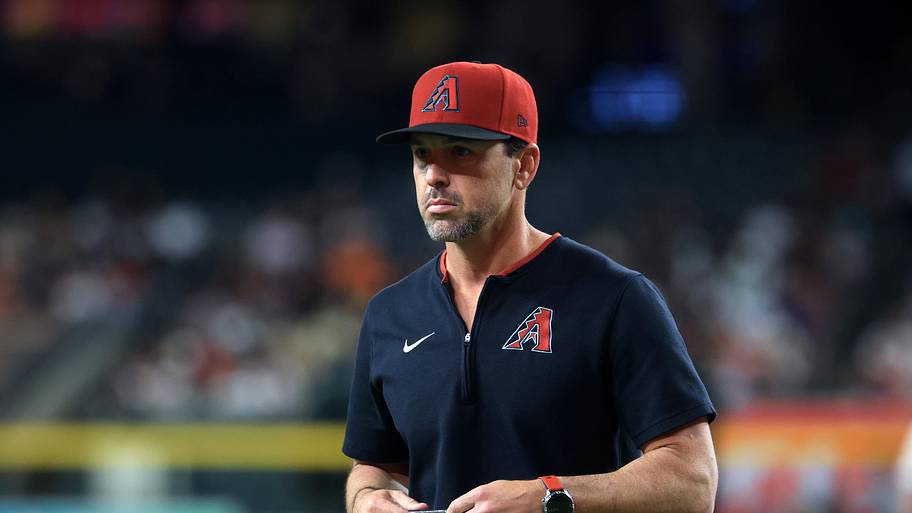
On May 2 of 2026, Nelson faced the Chicago Cubs, and had what is potentially a turn-around outing. He went 5.2 innings and gave up just one run on a solo homer. There was a subtle change proposed by pitching coach Brian Kaplan that probably escaped the eyes of all but the most astute observers.
For the first time in his career, Nelson introduced a two-seam fastball. While a two-seamer is often thought of as a sinking fastball, or "sinker," that is not the case with this pitch.
Speaking to both Kaplan and Nelson, they made sure to say this is a two-seamer, but not a sinker. The pitch is designed to create more arm-side lateral (horizontal) movement compared to the four-seamer.
That was indeed the case last Saturday. According to Statcast, Nelson threw 18 two-seamers.
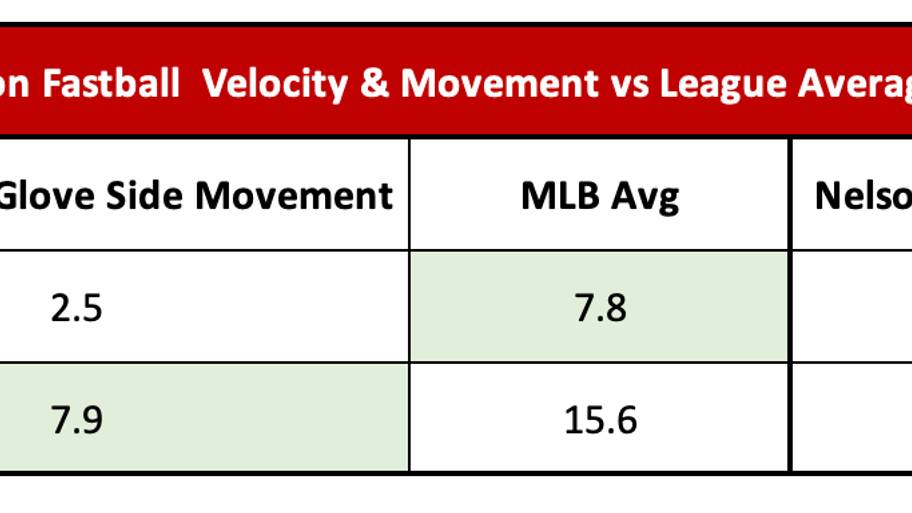
This is most definitely not a traditional two-seamer or sinker. In fact, the pitch hardly sinks at all, as can be seen by the IVB of 17.6. While somewhat lower than the four-seamer, Nelson's two-seam IVB is still higher than the MLB average four-seamer.
What this pitch is doing, however, is giving hitters a look at a fastball from Nelson that has the same amount of arm-side lateral movement (horizontal break) as an average four-seamer.
The reason Nelson needs this is because his four-seamer is very straight compared to the league average, with just 2.5 inches of arm-side movement this year. It was 3.2 last year, still much straighter than average.
But the 7.9 inches of arm-side movement he's getting on the two-seamer with almost the same velocity and IVB as the four-seamer might help him get hitters off the barrel more. Manager Torey Lovullo explained it like this:
"I think we're trying to be as creative as possible with certain adjustments. I don't want to give away his arsenal or his plan, but I think certain pitches insulate his four-up fastball. It's elite. It's a standalone pitch.
"We've got to be very careful with throwing it as much as we do, and we've got to find things that come off of that four-seamer. I think he's just being as creative and as adaptable as possible to have success," Lovullo said.
The desire to "not give away the arsenal" was a sentiment that Kaplan and Nelson both expressed as well. They even looked a little surprised and caught off-guard when the question was posed.
But thanks to Statcast data, these types of changes don't go unnoticed by analysts, whether they be amateur or team-employed professionals. It's likely team analysts for the Mets (his next opponent) already noticed this wrinkle.
And it's not like this is some big secret in baseball. Having both a four-seam and two-seam fastball in the arsenal is pretty standard.
It's notable that Zac Gallen introduced a similar pitch last year, that he calls a "runner," which also gave him more arm-side movement (10.6) while still recording well above average IVB (13.6) for a two-seamer.
Of the 18 two-seamers recorded by Statcast for Nelson last Saturday, there were six swings, four called strikes, and eight balls. Three balls were put in play, with two flyouts and a groundout. There was one swing-and-miss and two foul balls. There were no hits allowed on the pitch.
This was a successful trial run for the pitch. Only time will tell how much Nelson relies on this adjustment and how effective it will be over the long haul.
More must-reads:
- MLB announces punishment for Framber Valdez
- Details emerge on 'inappropriate' behavior that led to firing of Tigers' Triple-A manager
- The 'NBA scoring champions' quiz
Breaking News
Trending News






Customize Your Newsletter
 +
+




Get the latest news and rumors, customized to your favorite sports and teams. Emailed daily. Always free!
PRIVACY POLICY COOKIE POLICY CONTACT US
ABOUT YARDBARKER TERMS OF SERVICE


By using this site, you agree to our Terms of Service and Privacy Policy.
This site is for entertainment purposes only.
There is no gambling offered on this site.
Gambling Problem? Call 1-800-Gambler.
