
-


Follow Us

 On Facebook
 On Flipboard
 On Twitter

When Casey Mize was selected first overall in 2018, Detroit Tigers fans thought they had their future ace. Fast forward a few years, and we are left with more questions than answers about Mize.
Can he improve the swing-and-miss? Do we trust his health? What is a realistic ceiling and how high is his floor going forward?
The pitcher we have seen over the past two years is not the level of pitcher you’d expect to get with a first overall pick. The electric stuff you usually see from that draft position does not land in Mize’s profile, but he has still found a way to be successful — to an extent.
The question becomes, has his success warranted a contract extension to keep him in Detroit? Should the Tigers look to sign him this offseason in hopes of getting a steal, or should they weight for another year of sample size?
Let’s break down both sides of the argument.
Why It Makes Sense
On paper, the Tigers’ rotation is good enough to compete in the AL. Is it the best? Not quite, but it’s still a strength for the 2026 season. The glaring issue comes when you look at the 2026 season and beyond.
As of now, the Tigers are set to lose Tarik Skubal, Jack Flaherty, and Mize to free agency at the end of the 2026 season. Those are three arms they have relied on over the past two seasons, including the best pitcher in baseball. Obviously, it’s a problem that will need to be addressed.
The Skubal discussion is for another day, but let’s assume he doesn’t re-sign. Are the Tigers comfortable enough with Flaherty to give him another contract? It’s an interesting question considering the farm system does not have many options that fans can feel comfortable knowing they will be major leaguers.
In order to keep some consistency while also filling innings, the Tigers need to sign someone and Mize looks like the most reasonable pick.
What fans saw in 2025 looked great out of the gate. Mize pitched to a 3.15 ERA across 16 first-half starts which ultimately earned him an All-Star selection, the first of his career. The second half wasn’t nearly as successful, but more on that later.
Mize is the type of pitcher that does not overwhelm hitters with stuff, but instead lives in and around the zone, relying on a five-pitch mix to keep batters off balance and off the barrel. His plus command prevents walks but is susceptible to base hits.
Pitchers that pitch to contact are going to often have up and down years. They are usually at the mercy of their fielders making a play mixed in some some BABIP luck. That’s why fielder independent pitching (FIP) is often used to evaluate a pitcher’s performance, and Mize posted a 3.89 FIP in 2025 and a 3.95 FIP in 2024. Those are both good marks.
It’s important to remember how much time and development Mize missed because of his injury. He started two games in 2022 (age-25 season) and missed all of 2023 before making 22 starts in an up-and-down 2024 season.
Mize has continued to tinker with his pitch mix and arm angle. He’s adjusted his arm angle more and more over the years from 32 degrees in 2020 to 45 degrees last season. I’d image this change is to get more vertical movement on his offerings, which we have seen seen with his fastball jumping from 16.4 IVB to 17.2 and his spitter from 3.8 IBV to 4.4.
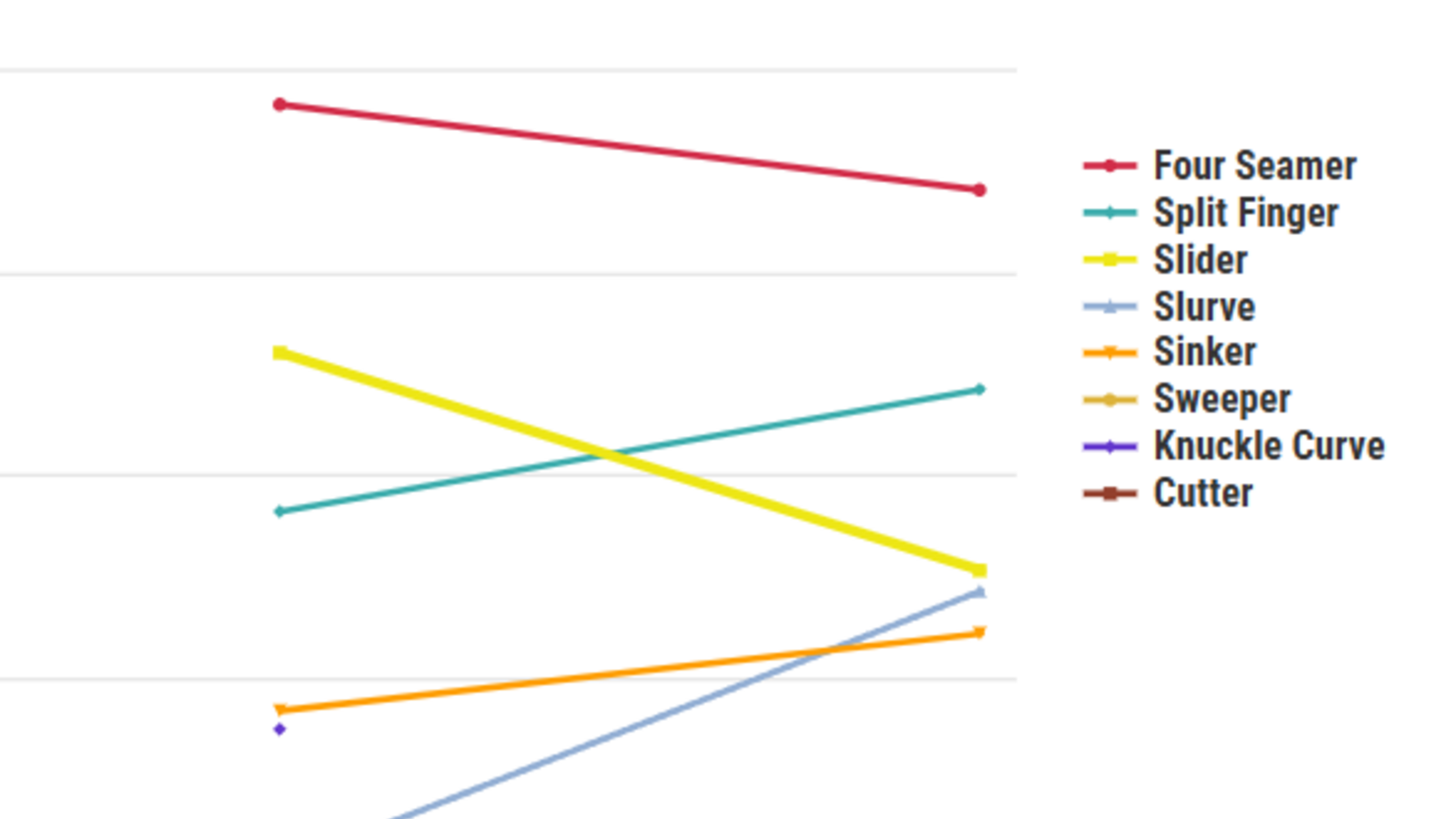
Casey Mize Pitch Mix Via Baseball Savant
The image above shows the change in how often Mize threw each pitch from 2024 compared to 2025.
His slider was not getting enough movement to get the level of swing-and-miss he would want, leading to a jump in his slurve which is more or less a different type of slider that comes with more downward movement.
His slurve produced a 28.9% whiff rate and held batters to a .214 xwOBA. A pitch that was relatively new to Mize in 2025, it could be the breaking ball he needs to unlock even more going forward.
To put it simply, Mize is still developing. He’s working through his challenges, learning more about what works and what doesn’t, and adjusting. The 2024 season was better, in many ways, than 2022, and 2025 was his best yet. We could be looking at an ascending arm.
I don’t personally view Mize as a top-three option in a contenders rotation. That might be more preference than anything, but he’s a high-end four or five and the Tigers need that, too.
Considering there could be more to unlock, keeping him around makes sense and gives the Tigers a high-floor option.
Why It Doesn’t Make Sense
Let’s go ahead and get the obvious disclaimer out of the way: Paying pitchers is a risky game and Mize comes with his own injury past.
Also, the Tigers haven’t exactly flexed their muscles when it comes to payroll, so extending Mize would eat into their budget. Money and risk aside, is Mize the level of pitcher they want to invest in?
Usually pitchers of his profile rely on a high ground-ball rate, which indicates a pretty safe pitcher. Giving up contact is much less of a problem when it is on the ground. Well, Mize saw his groun-ball rate drop from an impressive 49% in 2024 to only 38.7% in 2025, which isn’t yet concerning but worth monitoring for next season.
Another common trait with pitch-to-contact arms is giving up weak contact. They look to allow contact, so long as it is not hard. His 42.5% hard-hit rate and 9.1% barrel rate resulted in a 90 mph average exit velocity, which is not great if the ground-ball trend does not track back closer to 2024 numbers.
We saw a dip from Mize in the second half of last season. His 4.92 second-half ERA was mostly due three starts allowing four or more runs in a six-start stretch, but we know the room for error is small with Mize. One or two of those batted balls doesn’t go his way and suddenly he is in trouble.
Pitchers who do not have at least an average ability to get strikeouts can have trouble when runners get on. Although we did see his strikeout rate improve, I’d want to see another season showing that can stick before buying in too much.
Mize does not have anything that truly sets him apart. Not an elite fastball, a ridiculous breaking pitch, or off-speed offering that truly makes him stand out. But, that’s not to say he isn’t a good pitcher.
Look around the league. You see a number of guys in a similar talent pool as Mize getting significant money in free agency because quality innings are tough to come by. The question isn’t if Mize is worth the money — he is — but it’s whether or not the money is worth it for the Tigers, who seem to have a strict budget.
What a Contract Could Look Like?

If the Tigers do not reach a deal with Mize before his team control expires then he’ll hit free agency a little over 29.5 years old. Depending on how his 2025 season goes, he could be looking at a longer contract, say three or more years.
If his 2025 is a step back, or comes with injury, a one or two-year deal could be in play.
What works in the Tigers’ favor is the fact that pitchers like Mize don’t usually get four-plus years unless they are on the higher end of the spectrum.
This offseason you have Ranger Suarez and Zac Gallen, who I view as closer to the best case scenario for what Mize could become. Those guys are likely to net deals more expensive than what Mize’s contract would look like.
In the past few years you have Michael Wacha ($18 M AAV), Jameson Taillon ($18 M AAV), and Tyler Mahle ($11 M AAV), who are not perfect comparisons but close enough to work with.
Mahle hit free agency about a year younger than Mize, while set to miss a year of his contract due to injury, and still net an $11 million AAV. Taillon is the most similar in terms of success and profile; Plus command, mid-to-high-3.00s FIP, and similar trajectory.
Taillon missed most of 2019 and all of 2020 due to injury, posted a 4.30 ERA/4.43 FIP in 2021, and a 3.91 ERA/3.94 FIP in 2022 before signing his deal. Mize missed 2022 and 2024, posted a 4.49 ERA/3.95 FIP in 2024, and a 3.87 ERA/3.89 FIP in 2025.
Taillon hit the market with deGrom, Rodon, Verlander, and Walker as the only stateside free agents to get a bigger deal. Presumably, Mize will enter free agency with potentially Corbin Burnes, Tarik Skubal, Brandon Woodruff, Kevin Gausman, Robbie Ray, Jose Berrios, and other established vets.
Another pitcher who is in the final year of his contract, has a similar track record, profile, and age is Brady Singer. I’d expect both him and Mize to land similar deals, depending on how 2025 goes.
So, I’d say an extension, depending on if it happens now or next year to go along with several other factors, could be between $15-$20 million AAV.
Final Thoughts
The Tigers will likely have a lot of change in their 2026 rotation. Jackson Jobe still needs to prove what he could be — along with Troy Melton — and Reese Olson will have to show he can stay health. Unless the Tigers add a multi-year starter this offseason, Mize might have to be retained.
This season is obviously a pivotal one for Mize. Should he perform at a high level, he’ll get rewarded. An injury or sub-par year could have him facing a prove-it deal. But, what if he puts up a so-so, average, season? That’s where the contract and risk gets even more complicated.
At the end of the day, the Tigers need innings. If Mize can stay healthy and pitch to around a 4.00-4.25 ERA, I think the Tigers will look to keep him around, as long as the contract does not get out of hand.
More must-reads:
- Twins part ways with team president two weeks before spring training
- Brian Cashman offers defiant response to criticisms of Yankees' offseason
- The 'MLB active doubles leaders' quiz
Breaking News
Trending News






Customize Your Newsletter
 +
+




Get the latest news and rumors, customized to your favorite sports and teams. Emailed daily. Always free!
PRIVACY POLICY EDITORIAL POLICY CONTACT US
ABOUT YARDBARKER TERMS OF SERVICE


Use of this website (including any and all parts and
components) constitutes your acceptance of these
Terms of Service and Privacy Policy.
This site is for entertainment purposes only.
There is no gambling offered on this site.
Gambling Problem? Call 1-800-Gambler.
