
-

-


Follow Us
-

 On Facebook
 On Flipboard
 On Twitter

A Colorado Rockies hype piece? In this economy? Believe it or not, that’s exactly where this is going.
Fresh off a 2025 season where they finished 43-119 with a convoluted -424 run differential, you’d be forgiven if you thought there wasn’t a single redeeming quality about the 2025 Rockies.
In fairness, there really wasn’t, except for Hunter Goodman and some intriguing, less-heralded names in their bullpen.
Those very bullpen arms didn’t produce eye-popping surface-level stats. There isn’t one arm where you look at and find a sub-3.00 ERA, but what you will find are underlying traits that paint the picture of a very good potential reliever in the right circumstances.
Those circumstances, in all likelihood, mean leaving Colorado. Aside from being well behind from a player development standpoint, pitching in Colorado has long been a death sentence for arms for obvious reasons.
Enter the Toronto Blue Jays.
From the Jays’ perspective, their bullpen is in an interesting spot. They have not one but two Rule 5 guys vying for likely one spot in the bullpen, a guy in Tommy Nance who’s out of options and out-performed is expecting results in 2025, and arms in Brendon Little, Braydon Fisher, and Mason Fluharty, who were key contributors but have multiple MiLB options still intact.
All three of the arms we’re going to be talking about in this piece are still pre-arb and many years away from free agency, so the acquisition cost would be somewhat substantial. For the Blue Jays, any further augmentation to their bullpen would have to be a ceiling raiser, and the relievers we’re about to dive into would provide exactly that.
Seth Halvorsen
Let’s start here: Seth Halvorsen throws absolute gas.
Averaging 100 MPH on his four-seamer and generating an elite seven feet of extension, only four other arms throw a harder fastball than Halvorsen.
The pitch produced a solid 27.2% whiff rate but was hit hard when batters made contact. An average exit velocity of 90.7 MPH against, hitters hit .302 and slugged .429 off of the pitch, but the xBA of .253 and xSLG of .370 tell us there may have been some bad luck on Halvorsen’s side.
From a pitch data standpoint, Halvorsen’s fastball was dead zone shape, averaging just 12.9 inches of IVB. However, due to the 18% thinner air in Denver, pitches generally lose about two percent of movement per 500 feet of elevation.
This results in four-seam fastballs losing an average of three to four inches of IVB (sometimes up to 20% of their total IVB) at Coors Field compared to sea level. Which, in reality, tells us Halvorsen’s fastball dramatically plays up on the road.
One thing to note is Halvorsen raised his arm angle by three degrees in 2025 to 44°, which caused a full inch drop in his four-seam IVB. We don’t know if that was a purposeful change or not at this point, but just something to keep in mind.
He rounds out his arsenal with a splitter and the slider, with the latter being his best pitch from a Stuff+ standpoint (125). Each offering induced above-average whiff rates (35.5% on the slider, 28.9% on the splitter). The split was used predominantly against lefties while the slider was used almost exclusively against right-handed batters.
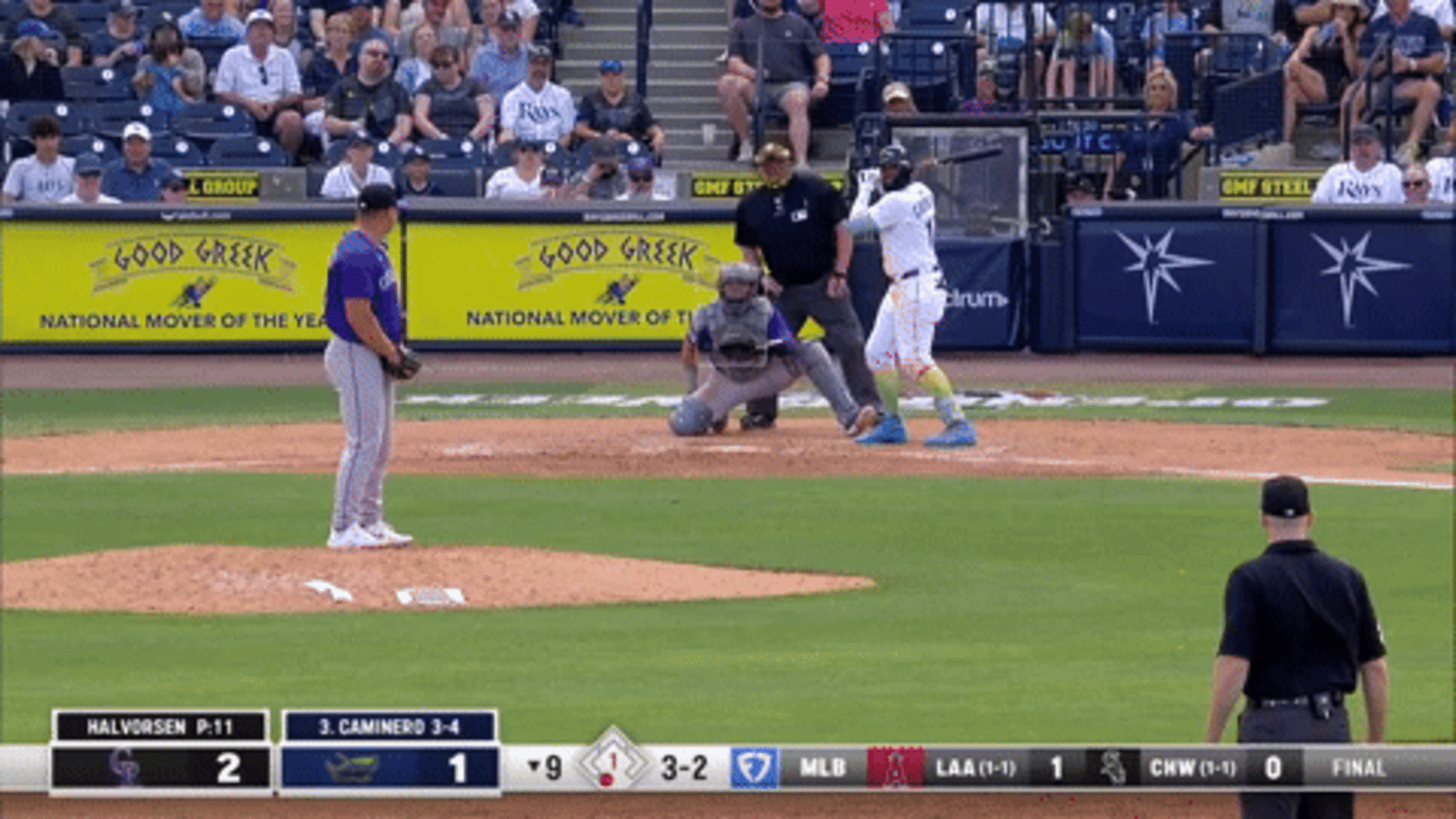
One interesting note on Halvorsen is just how radical his home-road splits were in 2025, and not the way you would think. Halvorsen was a borderline great pitcher at home while being almost unusable on the road:
One year samples are tough to depict anything meaningfully, and it’s entirely possible it’s more of an effect from having to shift from pitching at and above sea level so close together. The arm talent is undeniable here, though, and I shudder just thinking about how that four-seamer would play consistently at sea level.
Juan Mejia
Juan Mejia may just be one of the better relievers that you’ve never heard of. The rookie right-hander quietly burst onto the scene in 2025 and pitched to a 3.99 ERA across 61.1 innings.
The ERA alone isn’t anything special until you see the 2.98 expected ERA along with unbelievable hard contact suppression. His Baseball Savant page bleeds red as a result:
As we can see, Mejia simply nullified damage contact.
Not only did he have a 76th percentile strikeout rate, but hitters did absolutely nothing of consequence when they did make contact.
It was a 99th-percentile average exit velocity against, 92nd-percentile barrel rate, and 89th-percentile hard-hit rate. Mejia had hitters in prison in 2025. His .306 xwOBAcon against also sat in the 99th percentile.
How did he achieve this level of contact suppression? Well, Mejia wields two pitches — a fastball and a slider — with the usage of his fastball being significantly higher, as he threw it 67.2% of the time in 2025.
What’s funny is that it’s the significantly worse pitch of the two, averaging 96.6 MPH with just 12.3 inches of IVB and next to no horizontal break. From a Stuff+ standpoint it graded out at 84. Yet it produced an elite 28.6% whiff rate, 84.2 MPH average exit velocity, and .276 xwOBA against.
Mejia worked his fastball almost exclusively in the upper quadrant of the strike zone, which was key to his success.
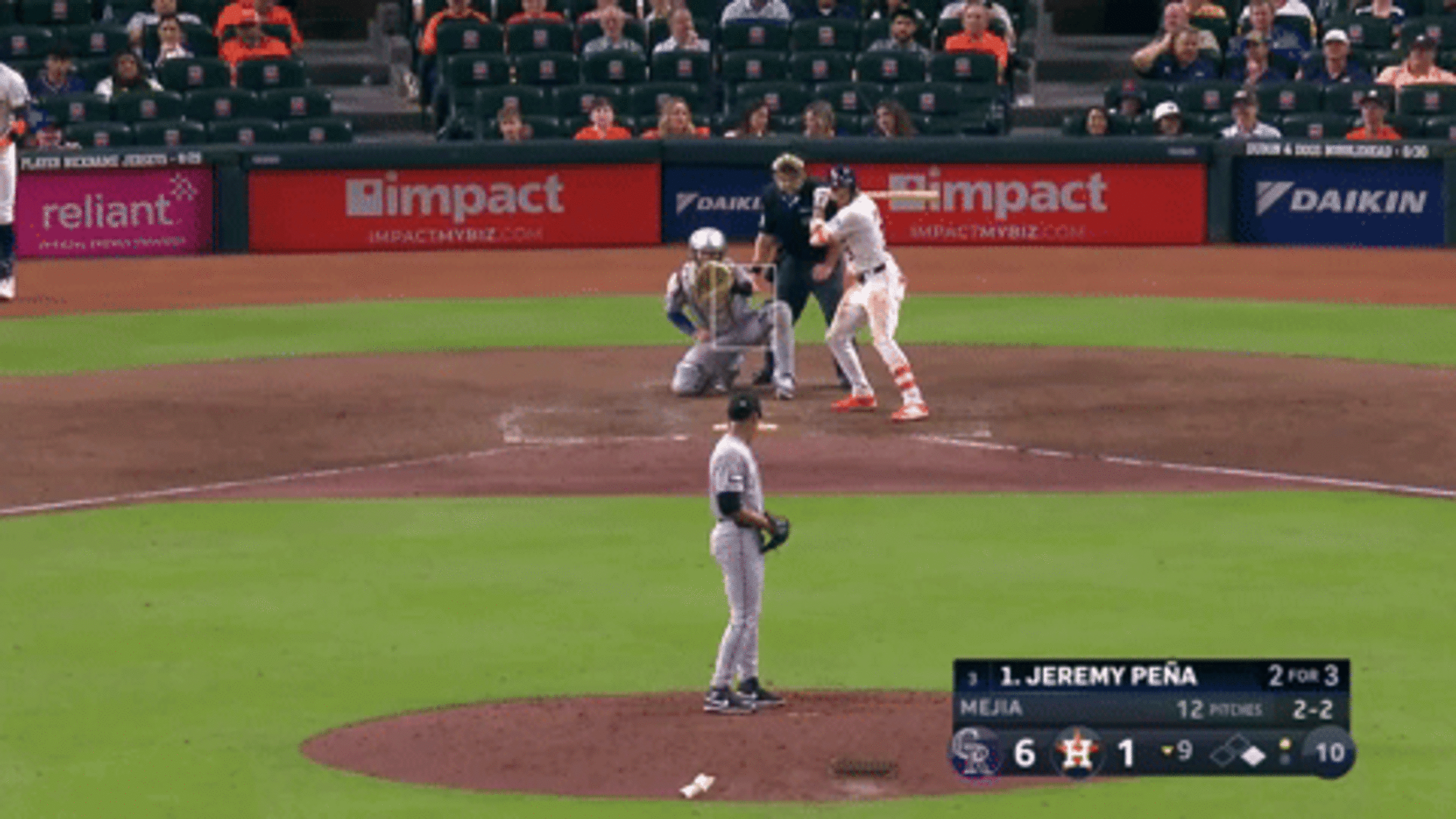
On the other hand, Mejia’s slider has a 134 Stuff+ grade, which should make it an elite offering. It sits around 83 MPH with 13.9 inches of glove-side horizontal break (8.3 inches more than the average offering) and has some sweeper-like characteristics in its movement profile.
On the surface, it performed much worse than his fastball. Hitters hit .250, slugged .500, and produced a .321 wOBA against it. The expected results, however, tell a different story: .220 xBA, .351 xSLG, .259 xwOBA. The surface numbers likely improve drastically if Mejia could throw his slider exclusively against right-handed hitters, which leads us to another potential issue.
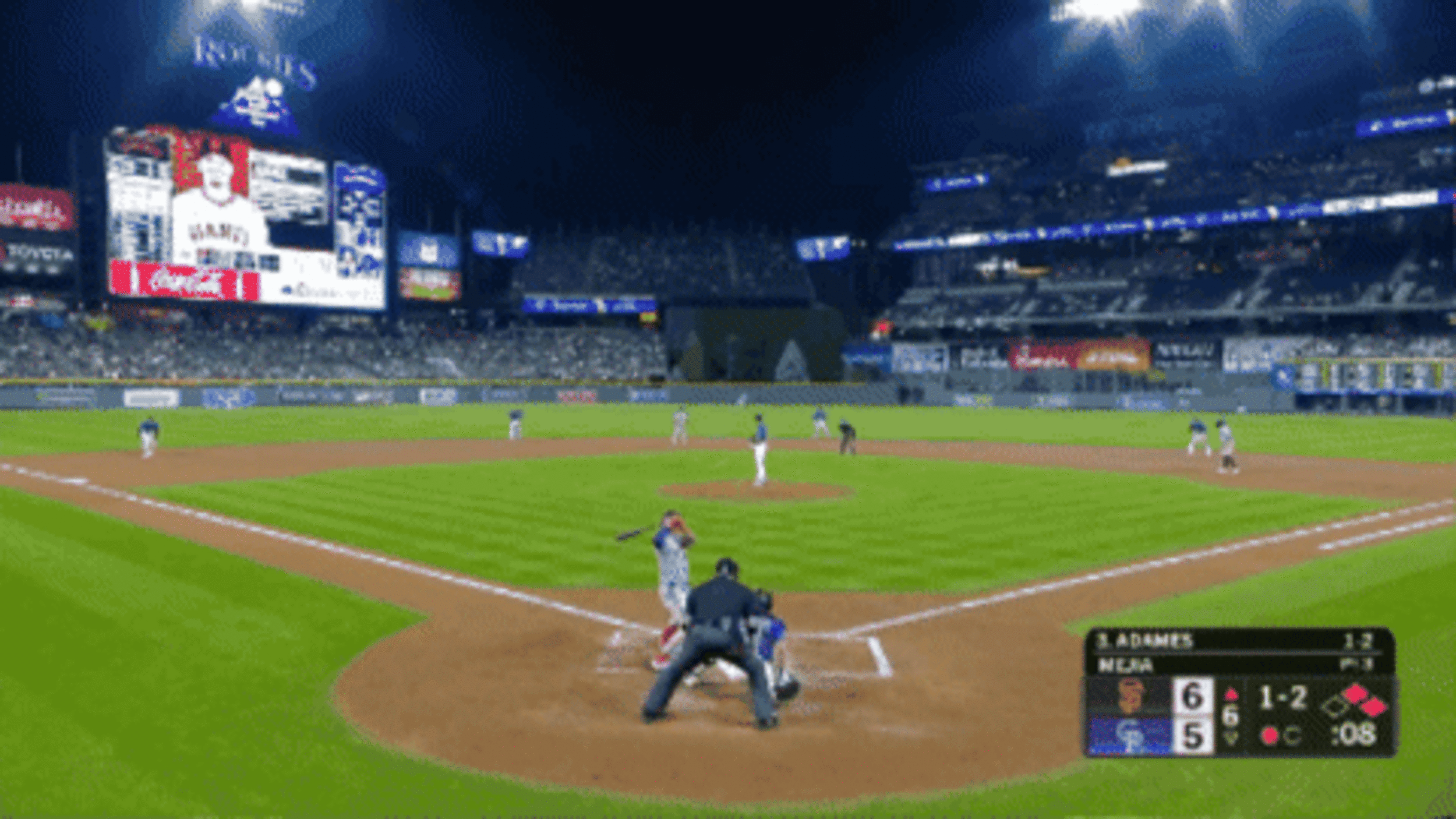
The one thing Mejia stands to really benefit from is the development of a third pitch that moves arm-side, whether it be a changeup or splitter, to combat left-handed hitters.
The stark contrast in platoon splits warns that there could be negative regression coming if Mejia can’t find a reliable secondary weapon against lefties other than his fastball. He used the slider 20.6% of the time against lefties, meaning he was essentially a one-pitch pitcher against lefties.
To tie a bow on Mejia, lets remember the one thing the Blue Jays pitching development loves to do more than just about anything else: develop a splitter. They love their splitters. I can’t think of a reliever who could benefit more from adding one of those into their repertoire other than Juan Mejia.
Victor Vodnik
Victor Vodnik is such a fascinating case of, “Why does your fastball perform as bad as it does?”
His four-seam fastball averages 98.7 MPH with 13.4 inches of IVB and 5.8 inches of horizontal. Vodnik’s fastball, much like Halvorsen’s and Mejia’s, is deadzone shape, but actually has the highest IVB of the group.
Stuff+ doesn’t like it much either, as it sits at a mark of 94. Hitters absolutely tee off on it, as it produced a 93.9 MPH average exit velocity against, .283 batting average (.271 expected), .442 SLG (.477 expected), and .357 wOBA (.364 expected).
Compounding this issue was the fact it didn’t miss any bats either, as hitters only whiffed 17.1% of the time.
When you’re working with a fastball that lacks in shape and plays worse than it should, locating it becomes that much more crucial.
99 MPH isn’t what used to be. Most relievers are throwing consistently in the upper 90s, hitters can catch up to 104 if it’s right down the middle. So guess where Vodnik was locating the majority of his fastballs? Right down Broadway.
What Vodnik’s fastball lacks is counterbalanced by an absolutely dominant changeup and an above-average slider.
The changeup in particular is truly an elite pitch, the -15 degree launch angle tells us it’s nearly impossible for hitters to lift the pitch, and it’s buoyed by a gaudy 44.2% whiff rate. It’s one of the most dominant individual pitches in baseball.
Vodnik pitched to a 3.02 ERA (4.17 expected) in 2025 despite being in the fifth percentile in walk rate and second percentile in hard-hit rate.
The latter of which is almost exclusively due to his fastball getting inexplicably crushed. How he managed such respectable numbers despite the multiple red flags can be dulled down to maybe a bit of an oversimplification: he kept the ball on the ground.
Vodnik’s 54.3% groundball rate was in the 92nd percentile in 2025, and he’s been consistently a groundball-dominant pitcher throughout his career.
When the ball does get in the air, though, it stays in the ballpark. Despite pitching the majority of his games at Coors, Vodnik has a career 0.74 HR/9 and has avoided getting bit by the long ball.
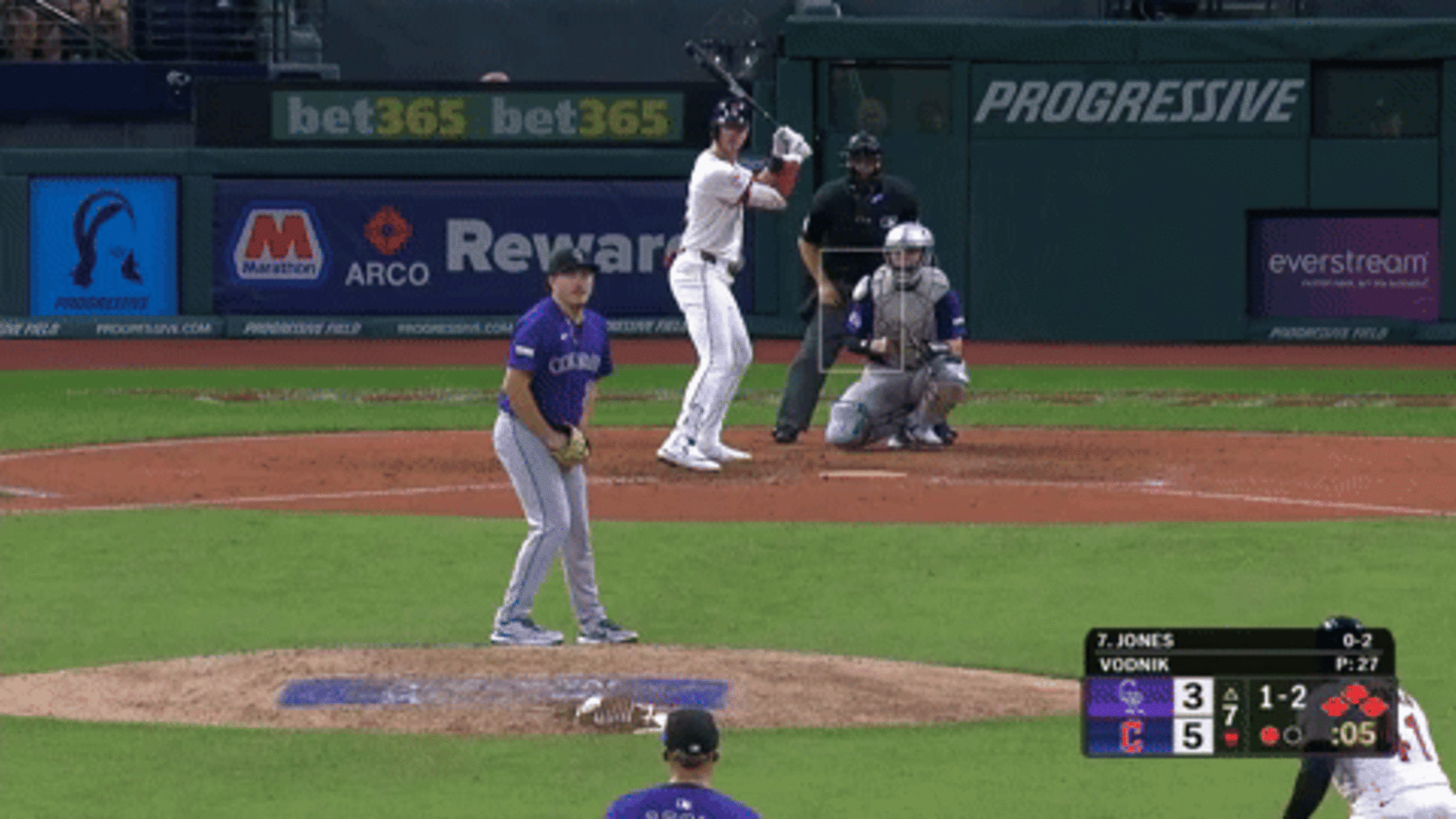
Vodnik has long been rumored to be a change-of-scenery arm that’s drawn interest from a number of pitching-savvy organizations for a reason.
The baseline is there for a really good fastball. Whether that’s dropping the arm slot, developing a different grip, or whatever the solution may be, pairing the potential of a reformed fastball with an elite off-speed pitch and an above-average breaking ball gives him the makings of an elite reliever.
More must-reads:
- Rangers sign former MVP to minor league deal
- Unlikely suitor willing to give Kyler Murray a new home
- The 'A.L. wins leaders since 2000' quiz
Breaking News
Trending News



Customize Your Newsletter
 +
+




Get the latest news and rumors, customized to your favorite sports and teams. Emailed daily. Always free!
PRIVACY POLICY COOKIE POLICY CONTACT US
ABOUT YARDBARKER TERMS OF SERVICE


By using this site, you agree to our Terms of Service and Privacy Policy.
This site is for entertainment purposes only.
There is no gambling offered on this site.
Gambling Problem? Call 1-800-Gambler.
