
-

-


Follow Us
-

 On Facebook
 On Flipboard
 On Twitter

Chaim Bloom’s reign as the head of baseball operations is off to a scorching start, with household names Nolan Arenado, Willson Contreras, and Sonny Gray all being moved to contenders.
Each was under a guaranteed contract last season; no such player from the 2025 season remains a member of the organization, as the club has established a clear direction for the franchise by shedding salary in favor of acquiring prospects.
It’s not just them, however. Arbitration-eligible players like Brendan Donovan and JoJo Romero have been on the rumor mill for months, with the former being among the league’s most popular trade chips.
Looking forward to March, several spots on the MLB roster will be up for grabs during Spring Training.
There are more deserving options than openings, but those who don’t make the Opening Day roster will undoubtedly receive opportunities throughout 2026. Let’s break down the most notable names who could make a splash next season.
JJ Wetherholt
The crown jewel of the Cardinals’ farm system and a former Dick Howser Award finalist, Wetherholt was a true 1:1 contender before the 2024 collegiate season.
A hamstring injury and a dip in production led to him falling into St. Louis’s lap at No. 7 in the 2024 draft.
Since his professional debut, he’s done nothing but rake, posting a 140 wRC+ in the Fall after the draft and a 154 wRC+ between Double-A and Triple-A in 2025.
There were rumblings about him being a September callup, but given the Cardinals’ organizational strategy, their front office opted to keep him at Triple-A throughout the season.
With Nolan Arenado in Arizona and Brendan Donovan’s unclear status, JJ could settle in at 3B or 2B as early as Opening Day.
Looking under the hood, it’s not difficult to justify his consensus top-10 prospect ranking.
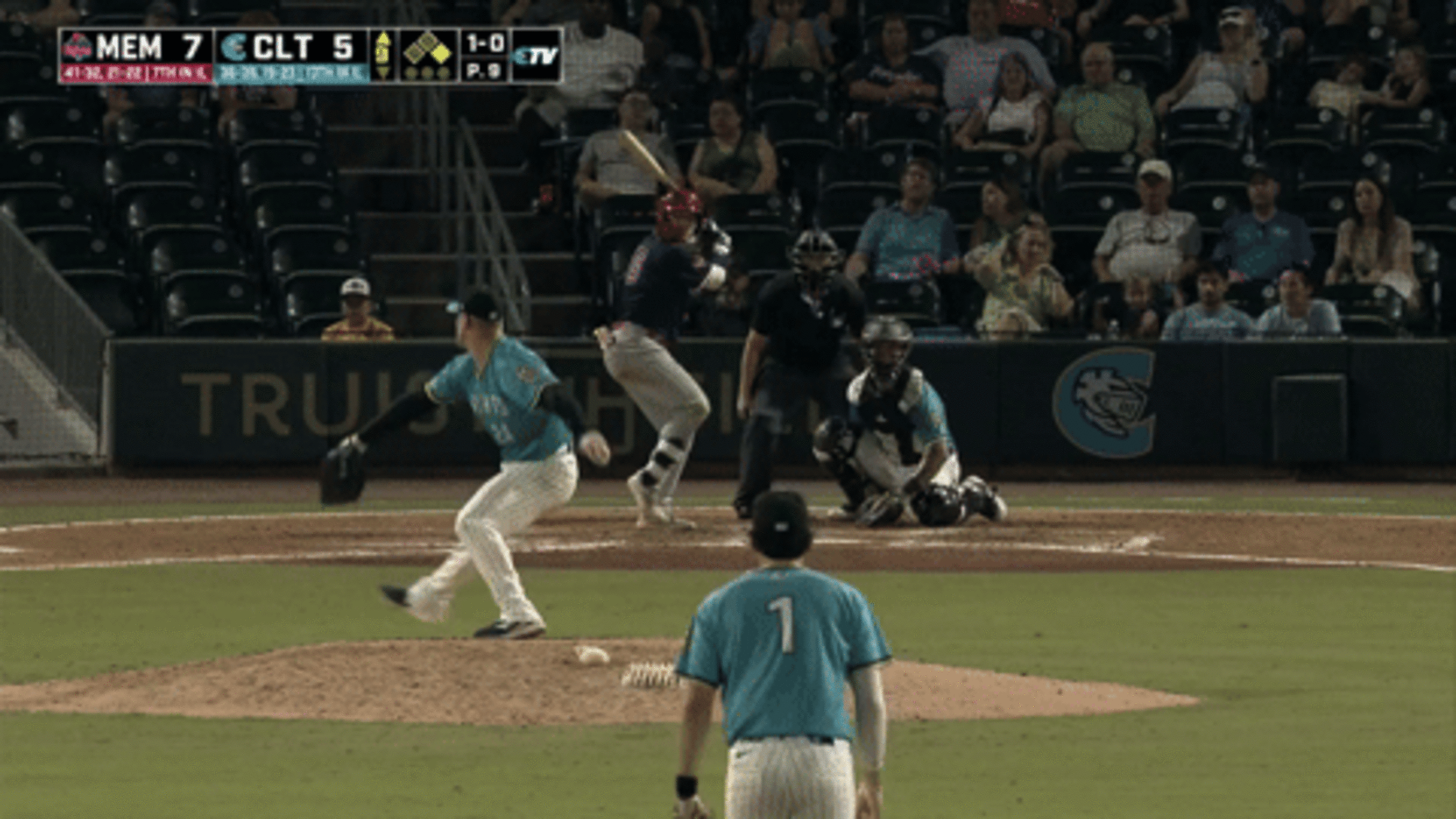
Wetherholt boasted a 48.1 HardHit% at Triple-A Memphis, and although he made less contact at the level (83.3 Z-Contact%), it was clear he was selling out for more power.
An 88.4 Z-Contact% on two-strike counts proves that he can protect the plate when he needs to.
Despite having success getting to his in-game power, he lacks top-end raw power (107.6 max EV measured by StatCast).
A major swing factor will be continuing to consistently record top-end exit velocities. If he fails to do so, he could struggle to succeed should he fall into a cold spell offensively.
This could prevent him from being a perennial All-Star, but he’s still an outstanding prospect.
His current 50th percentile outcome is an above-average everyday starter who should make at least one All-Star Game throughout his first six years of team control (2.5-3 WAR average per season).
Liam Doyle
Fortune favored the Cardinals in the 2025 MLB Draft lottery, and they took advantage when Doyle, arguably the class’s best talent, fell to them at the fifth overall pick.
Initially coming out of the ‘pen during his freshman year at Coastal Carolina, he transferred to Ole Miss for his sophomore year. He showed promise against SEC bats at Oxford, but struggled with command.
Doyle eventually settled in at Tennessee for his junior season, where he was the ace of the reigning National Champions.
In 95.2 IP, he recorded a staggering 42.6 K%, while limiting free passes to an 8.3% clip.
It was this improvement in command and control, as well as an impressive 3.20 ERA, that vaulted him into the highest echelon of college arms.
Doyle is an absolute beast and boasts one of the most electric fastball/slider combinations of any left-handed collegiate pitcher we’ve seen in years.
Max velocities for the Cardinals’ first four pitcher selections in the 2025 MLB Draft:
— Kareem Haq (@KareemSSN) July 14, 2025
Liam Doyle (1): 100.4 MPH
Tanner Franklin (CB-B): 101.2 MPH
Cade Crossland (4): 97.8 MPH
Ethan Young (5): 98.7 MPH pic.twitter.com/Dju4pRLzLM
His heater is his main selling point, where he’ll sit 96-97 and occasionally flash triple digits. The pitch gets 17.4 inches of vertical carry from a 5.64 FT. slot, albeit with below-average extension (6.1 FT.).
Scouts initially questioned whether he could handle the workload of a starter, as he’d never thrown more than 56.1 IP before his junior year and struggled with walks.
He quelled all of these concerns as the 2025 season progressed, showing he could maintain his scathing velocity deep into individual starts and well into SEC and postseason play.
Its most interesting characteristic is the 3.6° flat VAA in the top third of the zone, making it extremely difficult for batters to recognize.
Overall, he generated a 20.1 Swinging Strike% with the fastball, which was tops in Division 1 last season.
His second claim to fame is his two-plane slider, which generates 6 in. of gloveside movement at an 85.8 MPH average velocity.
It tunnels well off the heater, with over 18 inches of vertical offset, 15 inches of horizontal offset, and a 10.3 MPH velocity difference from the fastball.
While his changeup is a work in progress, scouts can find solace in the fact that he still gets almost 18 inches of vertical offset from the heater, as well as an 8.8 MPH difference from the fastball.
When hitters are used to his high-90s fastball, it’s no easy task to adjust when Doyle slams the brakes.
For someone who induces as many whiffs as he does, he showed impressive command, as shown by his aforementioned 8.3 BB%.
He’ll likely have fringy to average command as a big-leaguer, hovering in the high-single digits to low-teens in walk rate. This is entirely passable given his arsenal’s ability to make hitters look absolutely foolish.
This past Fall, Doyle made his professional debut with Single-A Palm Beach, making one start before jumping to Double-A Springfield for another, where he’s expected to begin 2026.
While he has a lot to prove at two different levels before MLB, it’s entirely possible he receives a late-season cup of coffee.
He’s the best pitching prospect in the organization and a clear top-30 prospect league-wide.
Doyle currently profiles as a 2-3 starter on a championship-caliber rotation (2.5-3 WAR average per season throughout his first six years of team control).
Joshua Baez
A year ago, Joshua Baez’s 50th percentile outcome was a depth outfielder; major publications didn’t dare rank him as a 35+ FV or higher after his strikeout-riddled 2023 season.
The former cold-weather amateur always had the tools to be special, but this was the first year he put it all together.
Baez spent the 2024/25 offseason tweaking his attack angle to be flatter, allowing him to take High-A and Double-A by storm with a 145 wRC+ between the two levels.
Before this, he consistently ran zone contact rates in the low-mid 70s, but now he sits much more comfortably in the low-80s.
These improvements have translated to vastly improved strikeout rates. In 2025, he did so at a 20.6% clip, compared to 35.5% in 2024.
Joshua Baez Z-Contact% by level:
— Adam Akbani (@AdamAkbani) January 23, 2026
2024
Single-A: 80%
High-A: 74%
2025
High-A: 80%
Double A: 82%
A flattened attack angle has led to improved plate coverage and vertical barrel output, allowing his raw power to do more in-game damage pic.twitter.com/dlCwHsJ3g1
Equipped with thunderous raw power, Baez has been clocked as high as 114.4 MPH off the bat in Statcast-tracked games.
As an amateur, he ran the 60-yard dash in 6.4 seconds, which was the fastest in the 2021 prep class.
Two Prospects in all of the minor leagues had a 20HR/50SB this season
— Redbird Farmhands (@RedbirdFarmhand) September 23, 2025
Konnor Griffin
Joshua Baez
It is only the third time since 1958 that two prospects have had a 20/50 season in the same year.
Griffin is the de facto #1 prospect in all of baseball, and Baez can't find his…
He also reached 98 MPH as a pitcher, which translates seamlessly to the outfield as a plus arm.
In the minors, he’s gotten most of his run in right field; this was no different at Double-A Springfield, where he logged 419 innings at the position. Given his athleticism, I’d love to see him take more reps in center field, where he spent 138 innings.
The overwhelming changes in contact ability and barrel accuracy have landed him on top-100 prospect lists.
He has all the ingredients of a superstar if he continues putting it all together. He’ll likely begin 2026 at Triple-A Memphis, and if he picks up where he left off in 2025, an MLB debut will come much sooner rather than later.
Even with the 2025 breakout, there’s still some helium in the Baez balloon. He may continue ascending lists if he proves his contact rates in 2025 weren’t a fluke, or if he makes even more contact than before.
The Puerto Rican import is another Cardinal top-100 prospect (2-2.5 average WAR per season over the first six years of team control profiling as an average everyday rightfielder.
Leonardo Bernal
The signature trait of the Cardinals’ player development team is their ability to produce countless top-tier catching prospects.
Leonardo Bernal is no exception, with the Panamanian product slowly but surely ascending through the minor leagues while flashing average to above-average tools across the board.
The 2025 season was a tale of two halves for Leo. He registered an impressive 135 wRC+ through 6/30, but a putrid 68 wRC+ from July 1st to the end of the season.
He’s always been a solid hitter at the plate, registering a 79.4 contact% this past season at Springfield, suggesting a Z-Contact% somewhere in the low-mid 80s.
Bernal also showcases impressive exit velocities despite not showing it consistently in games. He did hit a career-high 13 round-trippers this past year, which should raise eyebrows considering it was accomplished in just 107 contests.
His career-high exit velocity in Statcast-tracked games is 110.4 MPH as an 18-year-old in 2022, a missile off the bat that cleared the right field fence by a country mile.
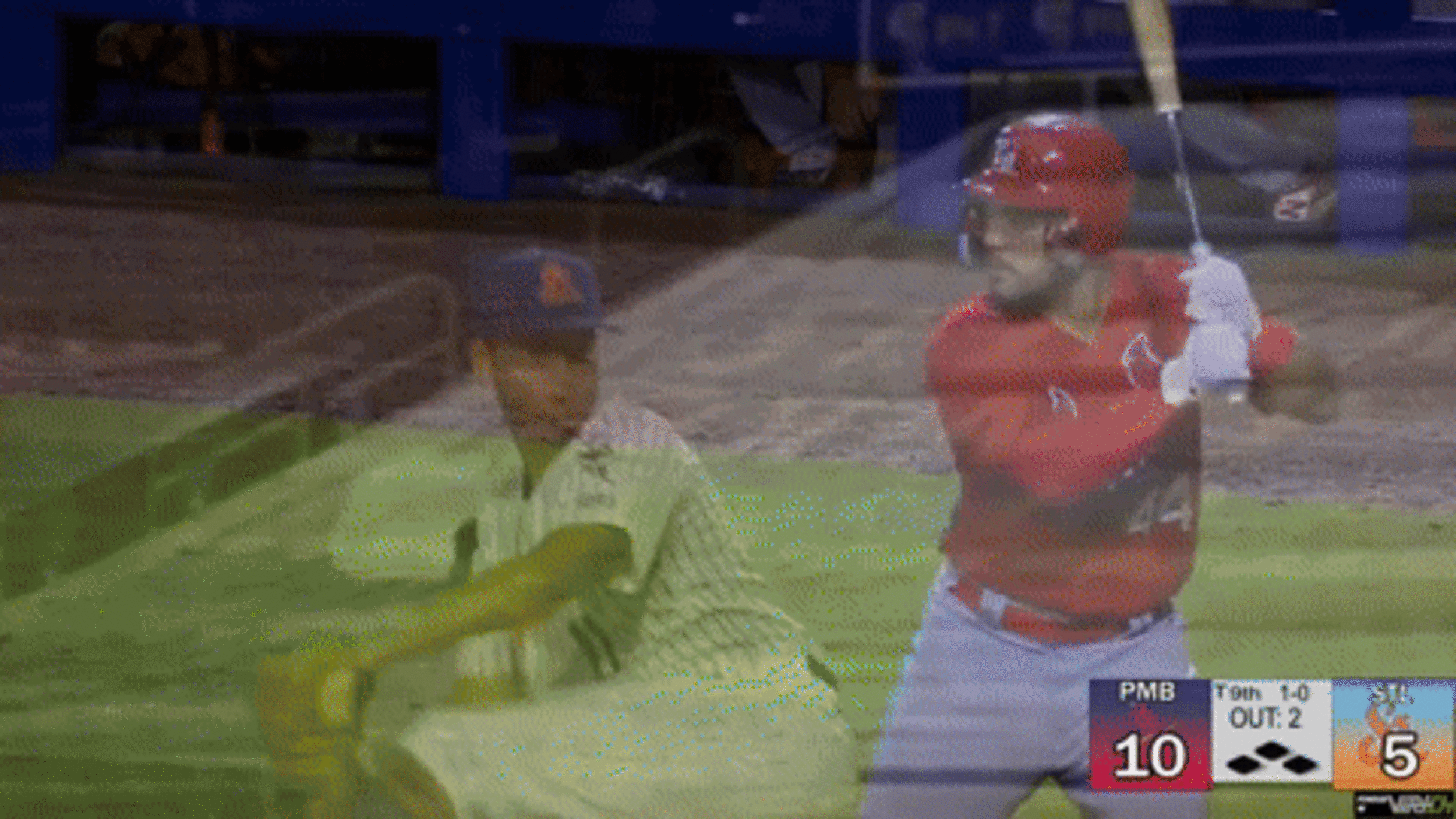
This put him on the prospect radar early on, and it’s entirely possible he’s beaten this mark since then at High-A or Double-A, which don’t have publicly available data.
Defensively, Bernal has all the makings of a guy who’ll stick at catcher long-term. He has impressive bounce and agility for a guy his size.
Arguably the most impressive part of his profile is his arm strength, where he nabbed 39.1% of basestealers in 2025 (across 747 1/3 innings caught), a mark that would’ve ranked fourth in all of MLB amongst qualified backstops.
There’s lots of congestion towards the top of the organization at the catcher position. Ivan Herrera is likely to begin the season as the starting catcher, while Pedro Pages should serve as a premium defense-first backup.
Yohel Pozo has also re-upped with the club, completing a trio of backstops who could arguably produce the most team WAR at the position by season’s end.
Given this depth, the front office will surely begin his 2026 at Memphis, where he’ll likely spend most of the season with a potential cup of coffee towards the back-end of the campaign.
Bernal is a fringe top-100 prospect (2-2.5 average WAR per season over the first six years of team control) who currently profiles as an average everyday catcher.
Quinn Mathews
After a monster 2024 campaign that saw him climb four levels of the minor leagues, Quinn Mathews was primed to debut in 2025 and claim his spot in the big league rotation.
Since being drafted, he’s completely overhauled his fastball by adding 2-3 ticks of velocity, doing so without sacrificing his elite command. A year later, he was a consensus top-50 prospect.
Yet, after a 2025 where he battled a shoulder injury, loss of velocity, and shaky command, he enters 2026 without having accrued any MLB service time.
Quinn’s heater was the primary reason he ascended as quickly as he did in 2024, with stellar peripheral data to support his 26.4 whiff%.
He was likely never fully healthy last year, which led to nearly a tick and a half dip in velocity, as well as over an inch of depth off the four-seamer.
While the extension remained the same, his release height was slightly higher. Overall, it’s easy to see why there was such a dramatic decrease in whiff rate on the pitch, and he was more scared to throw it as often.
Quinn Mathews Key Fastball Specs From 2024 to 2025
| Year | Pitch% | Velocity | IVB | Vertical Release Point | Extension | Whiff% |
| 2024 | 48.3% | 94.4 MPH | 17.2 in. | 5.58 ft. | 6.4 ft. | 18.2 |
| 2025 | 40.7% | 93.1 MPH | 16 in. | 5.64 ft. | 6.4 ft. | 26.4 |
His secondary offerings played a huge role in supporting his ailing heater this year, with the most-used offering being a gyro slider that generated a 38.7 whiff%. It flashes 4.4 in. of glove-side movement with 3.4 in. of rise, giving him a nice middle point in his pitch plot.
His signature secondary, however, is his changeup. It gets 11.1 in. of vertical offset from the fastball, but is 11.5 MPH slower.
Hitters have a hard time adjusting to the change in velocity, as shown by the eye-watering 55.6 whiff% on the offering. It’s a true plus-plus cambio.
Mathews’s curveball is another impressive pitch, dropping off the table and getting 26.7 in. of vertical offset from the four-seamer, while also showing 9.6 in. of gloveside movement.
The hammer also gives him something to work with against lefties, as a solid 14.1 in. of horizontal offset from the fastball makes it easier to work them inside.
Barring a complete return to his 2024 form, Quinn is almost certain to begin 2026 at Memphis, and while his command was slightly better towards the end of 2025, the peripheral data was shaky the entire season.
If he puts it all together at Triple-A, he’ll crack the big-league rotation very soon.
He’s a mid-rotation starter on a championship-caliber team at his best, but given his clear regression last year, he currently profiles more as a back-end rotation starter (1.5-2 average WAR per season over first six years of team control).
Other Names to Consider
Nathan Church
Considered to be a defensive-minded prospect, Church turned in a stellar campaign in 2025, posting a 144 wRC+ between Double-A and Triple-A.
Before this “breakout,” it was difficult to consider Nathan as anything more than organizational depth or a fifth outfielder at best.
He ran a 94.9 Z-Contact% in AAA this year, and with a lack of true power, he’ll need to hit if he wants to start.
I think he makes the MLB roster and will serve as the fourth outfielder, but don’t be shocked if Church usurps Victor Scott II in the starting lineup if VSII starts slumping.
Jimmy Crooks
Another intriguing backstop, Jimmy Crooks is ahead of Bernal in the pecking order, given that he’s already had a taste of big-league action.
After struggling to begin 2025, he surged in the second half, mustering a 129 wRC+ in 136 PAs.
Crook’s offensive game currently lags behind his defense, showing poor plate discipline amid average contact and power.
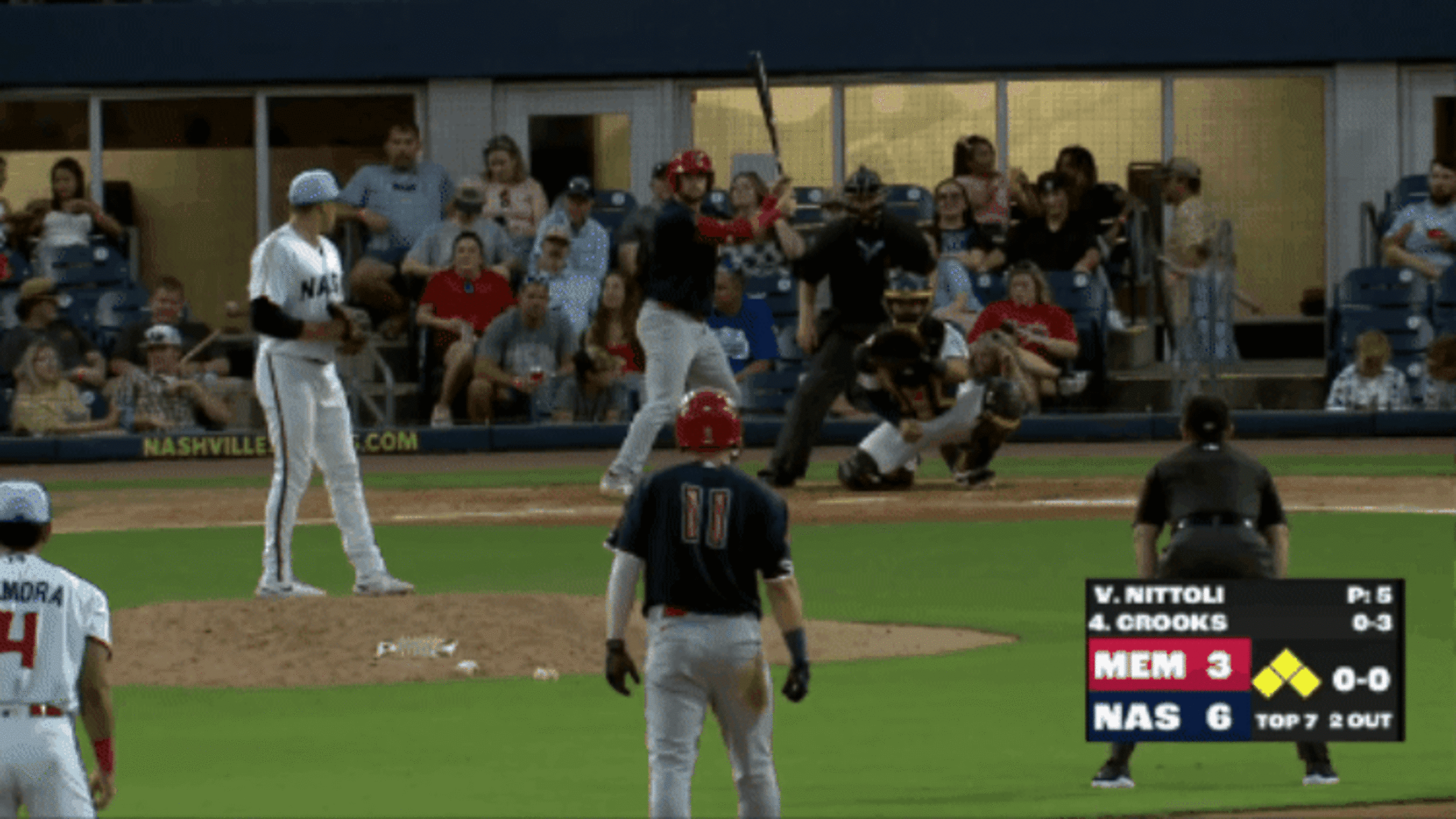
Behind the dish, he showcases an impressive throwing arm, nabbing 29.4% of baserunners at Memphis.
Jimmy’s also an above-average framer and blocker, and has been lauded at every level for effortlessly shepherding his pitching staffs.
He currently profiles as an average starter and looks like a premium backup at worst.
Blaze Jordan
Acquired in the Steven Matz trade, Blaze Jordan has been in the spotlight since he was 15 years old.
He hasn’t quite lived up to the hype as a professional, failing to consistently translate his thunderous raw power in-game.
In 2025, Jordan posted a cool 114 wRC+ with Triple-A Worcester, but was terrible at Memphis with a putrid 56 wRC+.
His swing decisions aren’t stellar, but he flashed an impressive 88.9 Z-Contact%, giving him a projectible bat-to-ball/ raw juice combination.
Before the Willson Contreras deal, there was a logjam of 1B/LF/DH profiles on the 40-man, but his departure should create some plate appearances for Blaze. He looks like a future platoon hitter with some helium.
Outlook
Going into 2025, the Cardinals’ farm system was slightly below the league average.
Surprise gems such as Joshua Baez, Rainiel Rodriguez, and Deniel Ortiz have strengthened the premium and foundational talent tiers.
Fortune in the draft lottery allowed them to land a rotation spearhead in Liam Doyle and a potential All-Star in JJ Wetherholt.
Recycling the stars of yesteryear has yielded high-upside lottery tickets such as Yhoiker Fajardo and Brandon Clarke.
The system now comfortably ranks in the top-10 leaguewide as a tier-2 system, and a Brendan Donovan trade could put them over the top, with the 2025 All-Star expected to net 1-2 top-100 prospects should he be moved.
Chaim Bloon and John Mozeliak deserve credit for setting up the blueprint for future success.
While it may be some time before the franchise returns to its former glory, 2026 will offer plenty to watch at the MLB level with so many promising names knocking at the door.
More must-reads:
- Konnor Griffin megadeal would be franchise-shifting moment for Pirates
- Trevor Story blasts Red Sox amid 'unacceptable' start to season
- The 'Youngest MLB 30/30 seasons' quiz
Breaking News
Trending News





Customize Your Newsletter
 +
+




Get the latest news and rumors, customized to your favorite sports and teams. Emailed daily. Always free!
PRIVACY POLICY COOKIE POLICY CONTACT US
ABOUT YARDBARKER TERMS OF SERVICE


By using this site, you agree to our Terms of Service and Privacy Policy.
This site is for entertainment purposes only.
There is no gambling offered on this site.
Gambling Problem? Call 1-800-Gambler.
