
-

-


Follow Us
-

 On Facebook
 On Flipboard
 On Twitter

As the 2026 season approaches, the Major League Baseball landscape is once again defined by contrasting organizational trajectories. Some franchises are grinding their way toward contention, others are still laying the foundational pieces, and a select few might be knocking on October’s door.
In our 2024 piece, we explored teams that could flip the switch and end long rebuilds.
This year, we take a deep dive into two of the most compelling rebuild narratives in the sport: the Miami Marlins and the Athletics.
Each club has charted its own unique course, blending prospects, trades, and calculated risks. Using advanced projections, roster profiles, and a “tale of the tape” comparison through offense, pitching, and bullpen analysis, we assess who is closest to completing their rebuild and staking a claim on meaningful October baseball.
Offense

Miami Marlins Offense
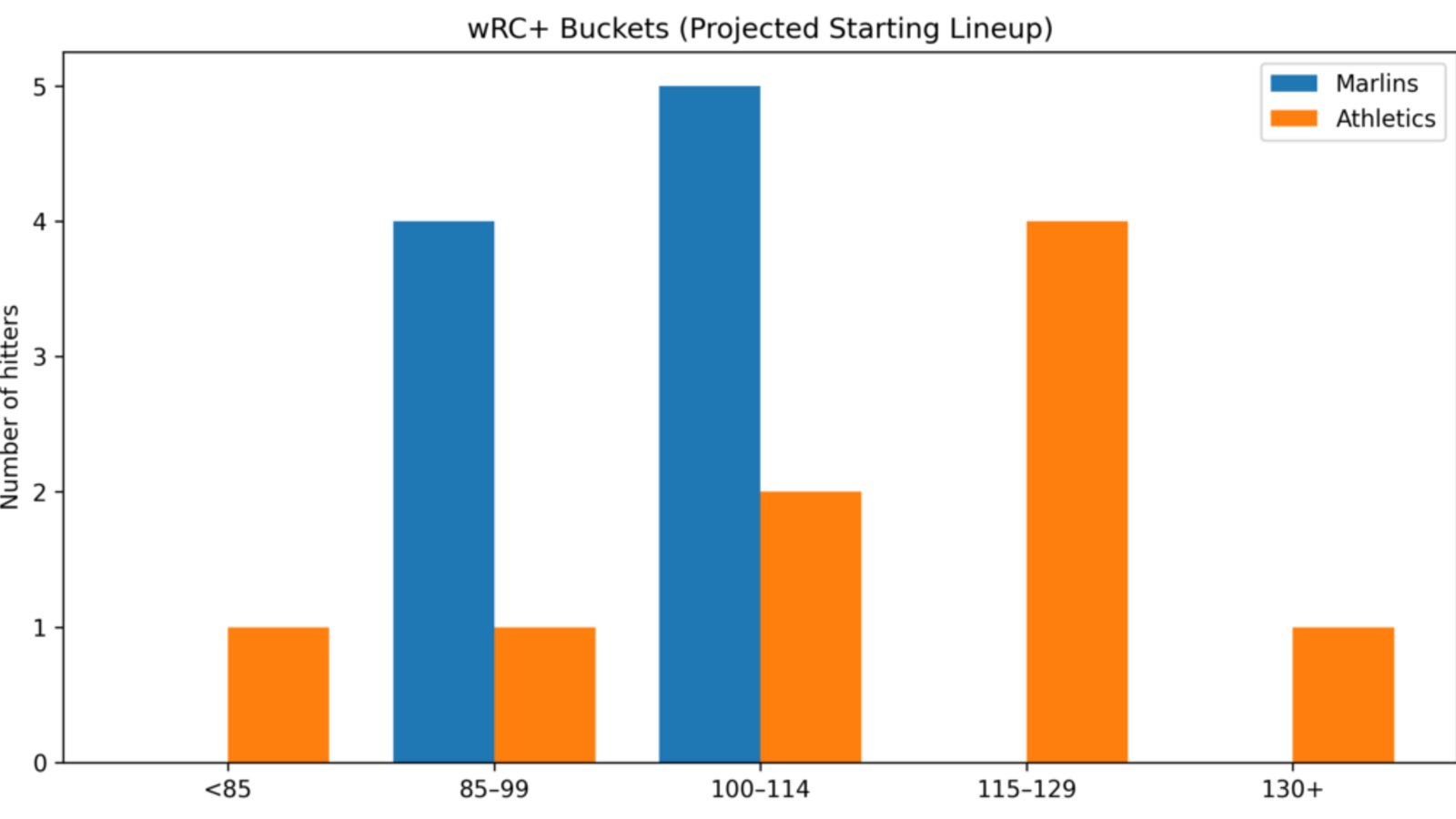
The Marlins’ offense was a scrappy but underwhelming unit in 2025, but they featured several quiet breakouts.
Jakob Marsee posted a 133 wRC+ and 2.2 fWAR in just 55 games, Otto Lopez slid to shortstop and delivered a 2.3 fWAR season, and Kyle Stowers emerged as a first-time All-Star with a 149 wRC+ and 4.0 fWAR in 117 games.
Xavier Edwards remains one of the best bat-to-ball players in baseball, and Agustín Ramírez showed elite pop in his first big–league action with exit velocities near 117 mph and a hard-hit rate above 47%.
The X-factors for 2026 are newcomer Owen Caissie and Griffin Conine, who is returning from injury.
Caissie dominated Triple-A at age 22 with a 52.6% hard-hit rate and improved batted-ball angles, offering the potential for an above-average middle–of–the–order bat. Conine, after a red-hot start in 2025 before a shoulder injury, brings some of the best raw power in baseball and adds thump to a lineup that badly needs it.
Connor Norby and Graham Pauley project as second–division regulars, but Norby in particular retains intriguing upside.
This lineup projects as a feisty, fun group, even if its ceiling currently looks closer to the 18th-best offense in baseball.
Athletics Offense
The Athletics’ lineup is full of young, exciting players already establishing themselves at the big-league level.
Nick Kurtz is coming off an AL Rookie of the Year–caliber season, posting a 170 wRC+ in 117 games with 36 homers and 4.6 fWAR. He struck out over 30% of the time, but his elite contact profile and power made that largely irrelevant.
Shea Langeliers, Brent Rooker, and Tyler Soderstrom provide excellent lineup protection. Langeliers posted a 132 wRC+ with 31 homers, Rooker rebounded to a 122 wRC+, and Soderstrom posted a 125 wRC+ and 3.4 fWAR while learning a new position.
Add above–average bats like Jacob Wilson, Lawrence Butler, and Jeff McNeil, and the A’s lineup balances power and contact well. Butler’s volatile profile suggests upside, while Wilson and McNeil provide contact–first value despite muted impact.
Rounding out the lineup are Max Muncy (not the Dodgers’ third baseman) and Denzel Clarke, an elite defensive center fielder with below-average offensive output. All told, this lineup blends star power and depth and projects easily among the ten best offenses in baseball in 2026.
Offensive Advantage: Athletics
Starting Rotation


Miami Marlins Pitching
The Marlins feature two high-end arms at the top with intriguing depth behind them. Sandy Alcántara is likely to draw Opening Day duties. In his first season removed from Tommy John surgery, he struggled early (4.64 FIP, 1.48 WHIP) but settled in during the second half with a 3.89 FIP, 3.73 xFIP, and 1.04 WHIP — a promising sign for his age-30 campaign.
Eury Pérez remains one of the most exciting young arms in the game; in his age-23 season he threw 95 innings with mid-to-upper-90s heat and still has significant untapped potential.
After trading Edward Cabrera and Ryan Weathers, the rotation beyond the top two gets murkier. Max Meyer may ultimately be better suited as a swingman or reliever, Braxton Garrett missed 2025 due to injury but profiles as a middle-rotation arm, and Janson Junk projects as a rock-solid innings eater.
The potential for top prospects Robby Snelling and Thomas White to contribute in 2026 adds upside beyond what the raw projections currently show.
This rotation isn’t elite by projection, but the combination of established arms and emerging talent makes it deeper and more flexible than many rebuilding staffs.
Athletics Pitching
In contrast, the Athletics’ pitching staff lags behind the potency of their offense. There is no starter projected for more than 2 WAR, and in a ballpark that can yield “crooked numbers,” this presents a real challenge.
Luis Severino will take the ball on Opening Day and delivered 2.5 WAR across 162 innings in 2025, but a career-low 6.86 K/9 raises questions about his ability to miss bats consistently.
Jeffrey Springs posted a 4.11 ERA and 1.7 fWAR in his first healthy season since 2022 and has the craft to repeat, but he offers limited upside. Luis Morales, a 2025 debutant and Just Baseball’s No. 27 overall prospect, flashes high-leverage upside with a plus fastball and sweeping secondary, and could emerge as the staff’s best arm by season’s end. Jacob Lopez, using extension and deception, posted 1.2 fWAR in limited innings and could become a steady mid-rotation piece if his workload expands.
The back end remains unsettled with Luis Medina returning from injury and upper-minors arms like Jack Perkins and Gage Jump lurking as options. Even if Morales and Lopez take meaningful steps forward, this rotation projects closer to the bottom third of the league.
Pitching Advantage: Miami
Bullpen


Miami Marlins Bullpen
The addition of veteran Pete Fairbanks is a significant bolster to the Miami ‘pen. Calvin Faucher is projected to handle eighth–inning duties, with Tyler Phillips slated for the seventh. If the Marlins can get leads into the late innings, this group has the definition and experience to shut the door with reasonable reliability.
The rest of the unit is a mix of useful but unspectacular arms, though the rotation’s depth and the potential for Max Meyer to transition to relief provide added flexibility.
Athletics Bullpen
The Athletics plan to go closer by committee in 2026, with Hogan Harris, Justin Sterner, and free-agent addition Mark Leiter Jr. sharing ninth–inning responsibilities. Like their rotation, the A’s bullpen trails their potent offense, but this trio should be capable of preserving wins when given a cushion.
They profile more as a bridge and protect group than a dominant late–inning squad, which places a ceiling on their reliability in high-leverage situations.
Bullpen Advantage: Miami
Final Verdict
While Miami’s pitching potential makes them a threat to be in the Wild Card mix, they have a much higher mountain to climb to be a true postseason contender.
The National League East, anchored by division powers like the Philadelphia Phillies, Atlanta Braves, and the resurgent New York Mets, is one of the most competitive environments in baseball and offers little margin for error.
On the flip side, the Athletics operate in a division in flux.
The Seattle Mariners enter 2026 as clear favorites, but the rest of the American League West presents opportunities. With established offensive firepower that ranks among the best in baseball and a pitching staff that, while flawed, could exceed expectations if its young arms take steps forward, the A’s are positioned to make meaningful progress.
Their ballpark environment will amplify offensive strengths, and their rebuild appears closer to translation into consistent wins and a return to the postseason.
In our 2026 rebuild comparison, the Athletics are the team closest to completing their rebuild and returning to October baseball.
More must-reads:
- A new era begins for Pirates with Konnor Griffin's anticipated MLB debut
- Sandy Alcantara returning to Cy Young form through two starts
- The 'Youngest MLB 30/30 seasons' quiz
Breaking News
Trending News





Customize Your Newsletter
 +
+




Get the latest news and rumors, customized to your favorite sports and teams. Emailed daily. Always free!
PRIVACY POLICY COOKIE POLICY CONTACT US
ABOUT YARDBARKER TERMS OF SERVICE


By using this site, you agree to our Terms of Service and Privacy Policy.
This site is for entertainment purposes only.
There is no gambling offered on this site.
Gambling Problem? Call 1-800-Gambler.
