
-

-


Follow Us
-

 On Facebook
 On Flipboard

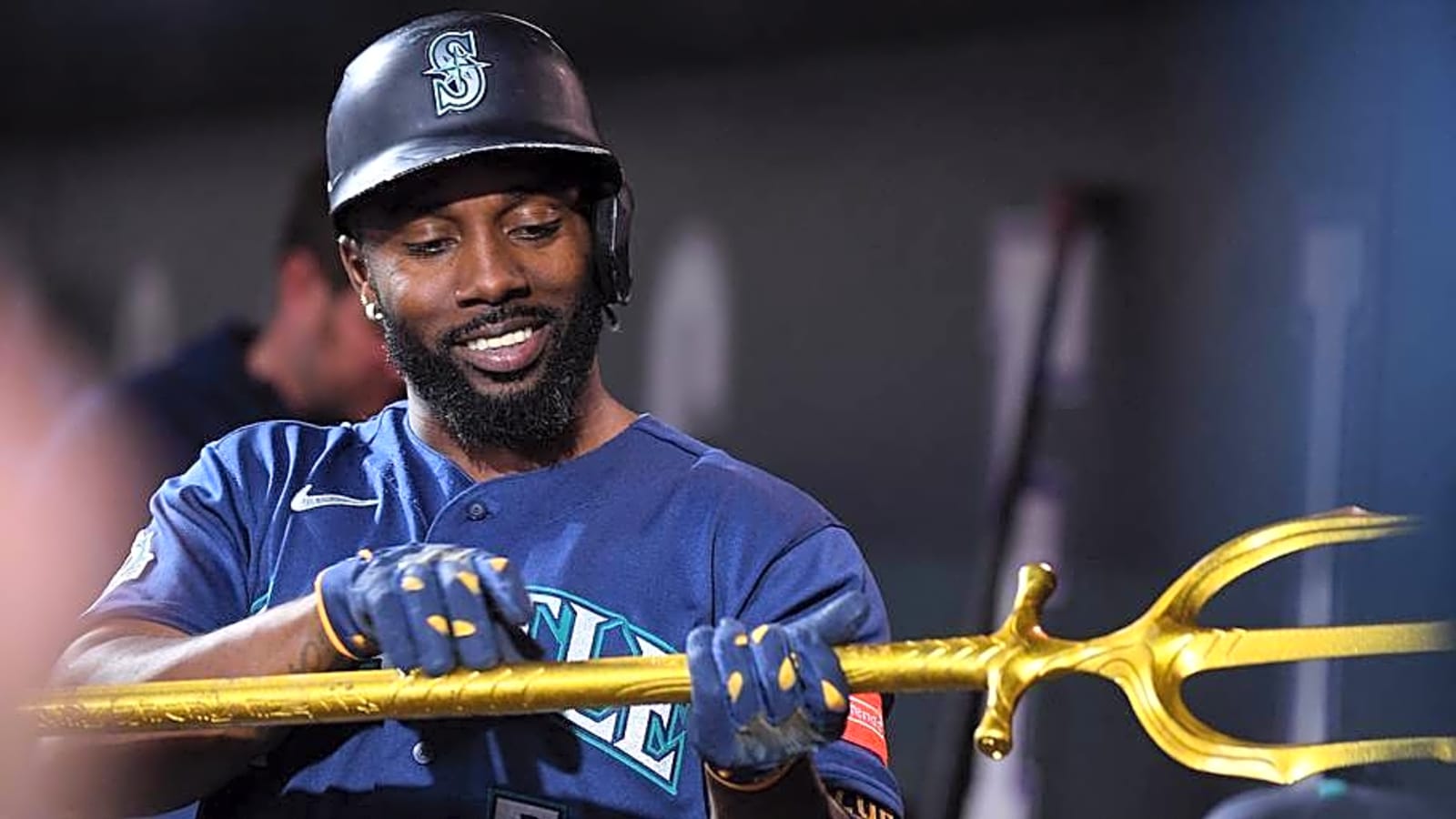
The Mariners can survive losing any one of their impending free agents. However, doing so without adequately replacing them is how a disappointing season turns into something much worse.
Jerry Dipoto and Justin Hollander face a challenge with replacing a couple of veteran options. They could lose their most consistent offensive player in 2026, its longest-tenured clubhouse leader and some of the experience surrounding a young roster.
The farm system offers options but it doesn’t offer ready-made solutions for everyone walking out the door.
Seattle should use its prospects to replace complementary players. Asking them to replace established stars could be the equivalent of doing nothing while insisting it has a plan. Here is what the Mariners’ replacement blueprint should look like.
Randy Arozarena Leaves the Mariners With Their Biggest Problem
There’s nobody inside the organization who can replace Randy Arozarena right now. Lázaro Montes has enormous power and upside. Michael Arroyo has a fascinating bat. Luke Raley has been inconsistent and injury-prone. And we can only hope Dominic Canzone can replicate his breakout season. None should be presented as a clean replacement for the player who gave Seattle 26 home runs, 26 stolen bases, 113 runs and a steady presence near the top of the lineup.
It’s not a dig at their young guys. There just hasn’t been enough data gathered to assume they’re a sure thing.
The Mariners reasonably believe an Arozarena contract will age poorly. So it’s likely they won’t enter a bidding war to get him back in Seattle. They do, however, have to replace the offense.
Free-Agent Option: Seiya Suzuki
Seiya Suzuki (.270/.368/.473, 26 HR, 86 RBIs in 2026) would be the closest free-agent substitute. He brings right-handed power, on-base ability and stubborn at-bats the Mariners could use. He’s also slightly older than Arozarena and should attract plenty of competition. If the Mariners are unwilling to enter one expensive corner-outfield market, we shouldn’t assume they will suddenly become aggressive in another.
Suzuki makes sense. Whether ownership will pay what it takes to sign him is a separate question.
Trade Option: Matt Shaw
Matt Shaw (.237/.327/.410, 5 HR, 24 RBI, 4 SB, 77 games in 2026) fits the organization’s usual preferences. He’s young, controllable, right-handed and capable of moving around the diamond. He’s not close to the offensive force as Arozarena, but at least there’s a coherent argument for betting on his upside. Shaw could provide Seattle with a long-term lineup piece rather than another short-term stopgap.
Acquiring him would require a meaningful trade package. Logan Gilbert would be an overpay. Trading a frontline starter to replace an outfielder who left in free agency would create a new problem while solving only part of the old one.
Emerson Hancock or a prospect-based package would be easier to justify. If that’s not enough, Seattle should consider it.
Internal Option: Luke Raley or Dominic Canzone
Raley and Canzone can help cover the position. But even collectively, they can’t replace the production. Canzone has graduated to more of an everyday role in the lineup between the outfield and DH. Raley has been more useful in a platoon.
Best path: Sign Suzuki or acquire another established impact bat. Treat the internal choices as complementary pieces.
Colt Emerson Should Get the First Chance at Shortstop
J.P. Crawford’s departure will feel different. He didn’t provide enough offense in 2026, but his value to the Mariners cannot be reduced to only a slash line. He became a clubhouse leader, survived several versions of the organization’s roster plan and gave Seattle stability at a premium position.
Still, as painful as it is, this may be the moment to move forward. The Mariners spent years building one of baseball’s best farm systems. At some point, that young talent has to receive an honest opportunity.
Internal Option: Colt Emerson
Emerson has already reached the majors, so the Mariners don’t need to invent a temporary path to him. They need to decide whether he is ready to own the position.
His first exposure to the big leagues didn’t look great, but that’s hardly unusual for a young shortstop. The bat looked overmatched at times, and his health remains an important part of the conversation. Neither concern should automatically send him back to the minors.
If Emerson returns healthy and looks sharp in camp (if there is camp due to the impending CBA lockout), the shortstop job should be his to lose. At the same time, that shouldn’t mean he’s guaranteed 600 plate appearances with no safety net. Remember, Emerson will not be swinging a bat this offseason while he recovers from wrist surgery.
The Mariners are going to need a backup plan. Let’s assume that it won’t be a short-term deal with J.P. Crawford and look at other options.
Stopgap Option: Mauricio Dubón
Mauricio Dubón (.276/.321/.399, 12 home runs, 10 stolen bases in 2026) would make sense as insurance. He could cover shortstop if Emerson struggles, move elsewhere when Emerson settles in and prevent Seattle from forcing Leo Rivas or Michael Arroyo into roles that may not fit them.
That is what a stopgap should be: protection for the plan while not being the plan itself.
Dubón would also give a young roster another experienced player capable of handling several positions. With Crawford potentially leaving, that stability would be big. Dubón would also be a massive upgrade as a defender after finishing 2026 with +6 OAA.
Expensive Option: Jazz Chisholm Jr.
Jazz Chisholm Jr. (.231/.312/.399, 19 HR, 55 RBI, 41 SB in 2026) would raise the ceiling considerably, but he would also bring a substantial price tag and a volatile offensive profile.
The power and speed can play anywhere, including T-Mobile Park. He has proven he can change a game on the bases or put a mistake in the seats. He can also be an extremely frustrating watch. At times he looks befuddled at the plate, his strike zone awareness can look poor and fans tend to lose patience when the strikeouts pile up during a cold streak.
Seattle should still explore the market. Though he’s not a fix at shortstop, he could still boost the infield at third base and work the keystone if the Mariners need to slide Cole Young over.
Development Option: Expand Michael Arroyo’s Role
The Mariners should continue developing Arroyo at multiple positions. He doesn’t need to become a full-time shortstop, but increasing his comfort around the infield would create more paths to playing time and keep his bat in the lineup. He only appeared in 15 games in September, but hit safely 13 times in 35 bats. That’s a .371/.439/.514 slash line. The Mariners could use more of that.
A player with Arroyo’s offensive potential becomes much easier to carry if the manager can move him between second base, third base, the outfield and occasional shortstop duty.
Best path: Give Emerson the first opportunity while adding a versatile veteran capable of covering shortstop.
The Mariners Can Replace Taylor Ward Internally
This is the easiest decision of the group. The Mariners paid a prospect price to acquire him at the deadline and received very little in return. His collapse after arriving in Seattle shouldn’t erase the productive seasons that came before it, but it should end any discussion about extending the relationship.
Prospect Option: Lázaro Montes
Montes deserves meaningful consideration for the DH and corner-outfield rotation. His power is legit. We’ve already seen him change a game with one swing, which isn’t something Seattle’s lineup offers often enough. The swing-and-miss is brutal, but we knew that coming in. The Mariners should expect the adjustment period to continue going into 2027.
What they shouldn’t do is send Montes back to the minors and keep him there until he becomes a flawless hitter. That player doesn’t exist. Yes, Montes has drawn comparisons to Yordan Alvarez, but keep in mind that those comparisons stem from their similar size, enormous power, Cuban backgrounds and experience working with the same hitting instructor in the Dominican Republic.
He still has a long way to go before producing Alvarez-esque at-bats, but that doesn’t disqualify him as a legitimate power threat whom the Mariners could eventually plug into the middle of the order.
Seattle can give him regular at-bats without making him responsible for replacing Arozarena. Those are two very different assignments.
Lazaro Montes hit one WHERE?!?! pic.twitter.com/uYM8mtlNYD
— MLB (@MLB) September 9, 2026
Versatility Option: Michael Arroyo
The Mariners have talked about versatility for years. Arroyo gives them a chance to develop the useful version of it rather than filling the bench with light-hitting utility players.
Veteran Option: Luke Raley
Raley can absorb whatever outfield and DH opportunities remain. He has legitimate power and can handle a complementary role, but that last part may matter more than we think.
With Canzone’s breakout and Montes’ rise, there may not be much playing time left for Raley. Arroyo’s emergence could squeeze him even further, making his skill set somewhat redundant. The good thing about Raley is that he’s a gamer and a resourceful defender. He even filled in at first base at times during the 2024 and 2025 seasons.
Still, if the roster becomes too crowded, don’t be surprised if the Mariners package Raley in a trade that addresses another need.
Best path: Prioritize opportunities for Montes, Arroyo and Canzone, then retain Raley as a complementary piece or use him to improve the roster elsewhere.
Declining Victor Robles’ Option Should Be Straightforward
Victor Robles’ $9 million club option for 2027 is too expensive for an injury-prone depth outfielder who hasn’t reproduced his brilliant first few months in Seattle.
Declining it wouldn’t mean the Mariners have given up on depth. It would mean they understand that depth players should be paid like exactly that: depth players.
Robles brought speed, energy and strong defense when healthy. The problem was the “when healthy” portion of that sentence.
Internal Option: Michael Arroyo
Back to Arroyo. Honestly, it’s great to have a versatile prospect like this. He could receive some of the reserve outfield opportunities, particularly if Seattle commits to expanding his defensive responsibilities.
Low-Cost Option: A Defensive Fourth Outfielder
Seattle can replace Robles with a less expensive veteran who provides dependable defense without requiring everyday at-bats. Austin Hays would bring experience and some offensive upside, although he fits better in an outfield corner than as a true defensive specialist.
Cedric Mullins is actually the more interesting option. Yes, his recent production stinks. But just hear this out.
Mullins has been unusually productive at T-Mobile Park, slashing .271/.377/.458 with a 137 wRC+, two home runs and seven RBI in 59 career at-bats. Sure, it’s a small sample and he’s another lefty. The Mariners have no reason to treat ballpark history as evidence that a full offensive revival is coming. Still, those numbers make him more intriguing as a low-cost fourth outfielder who can defend in all three outfield positions, run the bases and occasionally provide something at the plate.
Neither player needs to be exciting. But their assignment is simple: Stay healthy (might be hard for Hays), stay ready, catch the baseball and give the Mariners competent at-bats when Julio Rodríguez or one of the corner outfielders needs a day off.
Seattle has too many significant offensive needs to spend $9 million on a reserve outfielder.
Best path: Decline Robles’ option and pursue an affordable veteran such as Mullins, whose defense, speed and curious history of success at T-Mobile Park make him a sensible fourth-outfield candidate.
The Mariners Should Replace Hoby Milner With Velocity
Hoby Milner gave Seattle a veteran left-handed option, but this is not a vacancy that requires a free-agent shopping spree.
Milner turns 36 during the 2027 season and doesn’t need to return to the M’s and stand between the Mariners and a younger arm with better stuff.
Internal Option: Troy Taylor
Troy Taylor should receive a legitimate chance to break camp with the major-league club. His stuff is good when he can control it. If he makes a significant leap going into 2027, the Mariners would probably love to give him a chance.
The Mariners Need One Proven Bat, Not Another Collection of Possibilities
The larger lesson applies to the entire offseason. Internal promotions should replace complementary players. They shouldn’t be used as an excuse for losing stars.
They can hand Emerson the shortstop job and give Montes and Arroyo their share of at-bats. But replacing Arozarena requires more. The Mariners still have an excellent, cost-controlled rotation and enough young position players to build around. What they don’t have is permission to waste another year. Otherwise, this will be another round of subtraction dressed up as faith in the future.
More must-reads:
- Stadium roof ends up being MVP for Brewers in Game 1 win over Padres
- Rays' Drew Rasmussen flirts with no-hitter in Game 1 of ALDS against Yankees
- The 'Most HRs by an MLB first baseman' quiz
Breaking News
Trending News


Customize Your Newsletter
 +
+




Get the latest news and rumors, customized to your favorite sports and teams. Emailed daily. Always free!
PRIVACY POLICY COOKIE POLICY CONTACT US
ABOUT YARDBARKER TERMS OF SERVICE


By using this site, you agree to our Terms of Service and Privacy Policy.
This site is for entertainment purposes only.
There is no gambling offered on this site.
Gambling Problem? Call 1-800-Gambler.
