
-

-


Follow Us
-

 On Facebook
 On Flipboard


Over the past few Major League Baseball seasons, the Milwaukee Brewers have become a powerhouse and a model organization for what player development should look like.
Although they routinely rank within the bottom half of the league in payroll (17th in 2025 and 16th in 2026), they’re able to make the best of their resources and compete. With the best record in baseball last season and the second-best record in the game this season, the Brewers are becoming one of the sport’s gold-standard organizations.
While player development successes such as Kyle Harrison, Brice Turang, and more have deservedly taken a lot of the spotlight when it comes to the club’s success, arguably their biggest win has been with catcher William Contreras. Ever since he was acquired from the Braves in a three-team deal during the 2022-’23 offseason, he’s blossomed into one of the best backstops in the sport.
This season, Contreras is adding to his resume and is playing some of the best baseball of his career, as he’s taken his game to new heights offensively. The reason? Contreras has been tweaking his swing numerous times over the past calendar year, but he has finally made some meaningful changes that have impacted his game tremendously.
Let’s dive in and examine this change a little more closely and explain why Contreras’ swing changes have taken his game to new heights and added to his resume for the title of the best catcher in baseball.
Stats were taken prior to play on July 1.
Meaningful Swing Changes
Before taking a look at the two swings I chose for this breakdown, I want to first mention that during the research for this story, I discovered that Contreras has taken a plethora of different swings over the past year. With seemingly every swing I examined, something was different, and I can’t count on two hands how many differences I stumbled across.
With this in mind, it was important to me that I chose a swing closer to the end of last year to pair with a more recent swing, so that we didn’t skip over too much in terms of his development and mechanical changes. The two swings you’ll see in the frames below are both home runs, with last year’s coming on August 26 and this year’s coming on June 26.
Beginning with Contreras’ setup, the differences are major and stand out almost instantly:
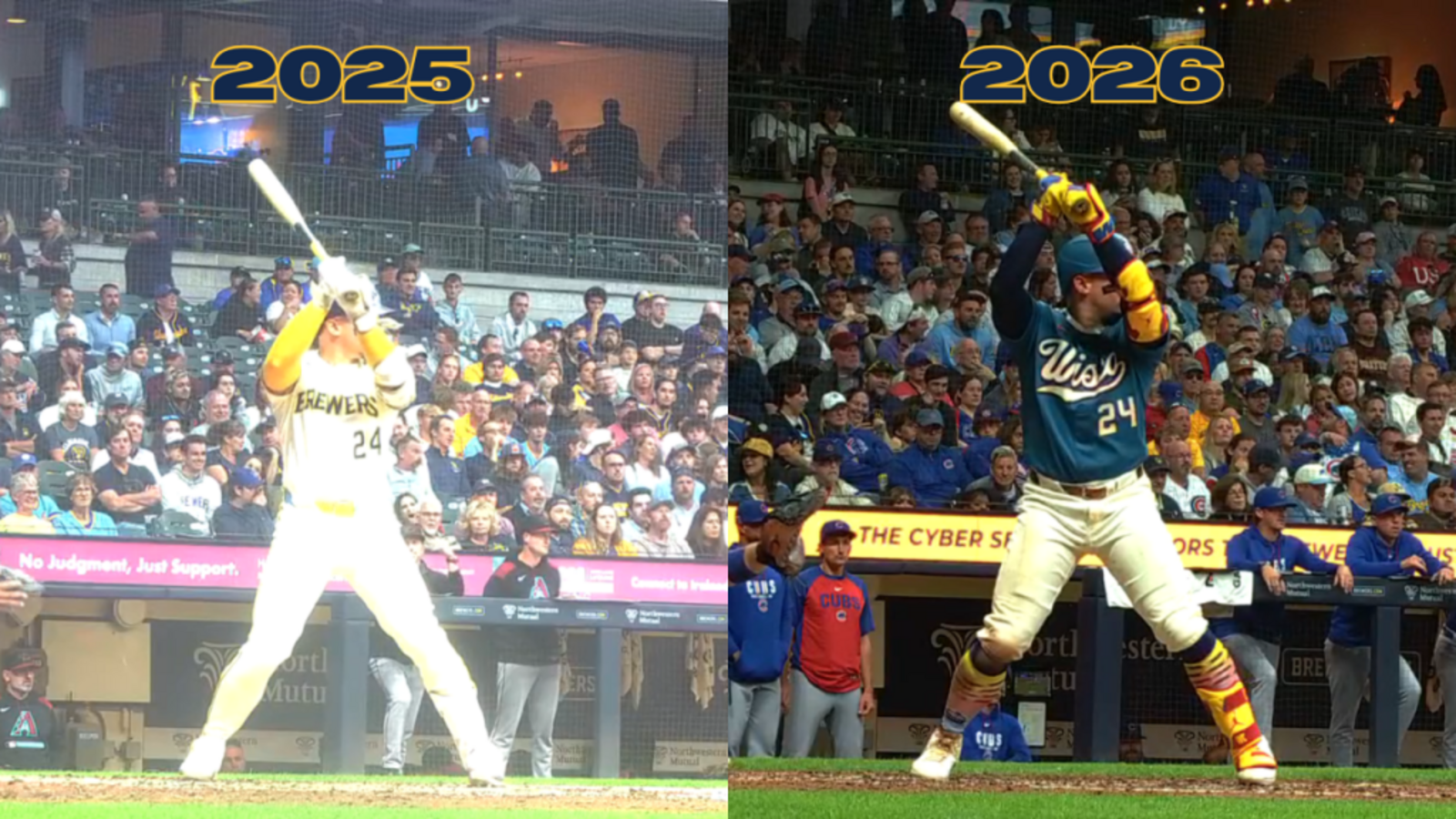
For starters, Contreras’ bat positioning is the main thing that jumped out to me when doing research for this breakdown, as it was routinely the least consistent part of his swing evolution.
Last season, Contreras held his bat far more out in front of him, with the barrel angled ever so slightly to his right. In 2026, Contreras has raised his hands, slid them back slightly, and angled his barrel even more to his left.
My suspicion for this change is that Contreras often had a huge load in 2025 and often almost loaded his hands far too much. This is something we’ll get a better look at later in these frames, but with this current positioning, he’s able to maintain a bigger load without dropping his hands too much.
Instead, he’s better equipped to get them into the desired slot, rather than moving too much.
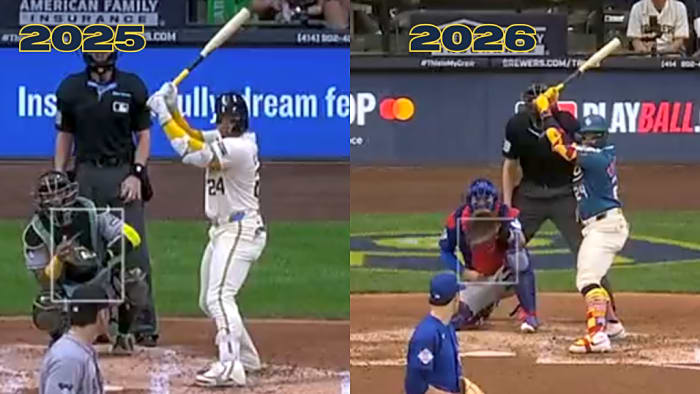
On top of the very clear differences in his bat and hand positioning, Contreras has changed how he’s setting up his lower half as well. He seems more engaged, already having a stronger coil in his back hip and some bend in his knees. According to Baseball Savant’s swing visualizer, he’s also closed off his stance a little bit more, moving from five degrees closed to seven degrees closed in 2026.
If these changes weren’t immediately visible to you in the open side view, fear not, because this is one of the few moments where the broadcast angle actually does it justice.
From the two snippets from the plate camera below, you’re able to see how Contreras’ bat positioning has changed, and how much of a difference being two degrees more closed in his stance really makes:
Moving to the next frame, we’ll be taking a look at the beginning of Contreras’ load, which has been another piece of his swing that has gone through a massive evolution.

Over the past year especially, Contreras has become accustomed to a toe-tap-adjacent move, where he loads into his back side while keeping his toe on the ground. It’s a move that’s fairly unique to his game.
In 2025, Contreras ran into trouble with this move, as he’d often just shift his weight back, drop his hands, and get stuck on his backside, a trio of factors that can cause a swing to fall apart.
The swing above from 2025 serves as a great example of these mechanical inefficiencies. Contreras’ weight is shifted back, he hasn’t truly engaged his backside or lower half, his hands are already dropping, and he’s in a poor position to hit overall.
In 2026, Contreras has hammered out nearly all of these issues. For starters, he’s fully bought into the idea of a toe tap, moving away from the half-and-half move he had in 2026, which is a big change in its own right. On top of that, he’s loading into his backside while engaging his lower half and coiling into his back hip correctly.
Even if he’s a little more stacked on the backside than may be necessary, this is a much better place to be in. His hands are also in a much better place, as they don’t drop nearly as much as they had previously, remaining above his shoulder and in a slot that’s easier to be direct to the baseball from.
With these changes now visible, we can now advance to the next piece of Contreras’ swing: his landing spot.

Up to this point, Contreras’ previous mechanical inefficiencies I’ve mentioned have served as building blocks. With Contreras doing multiple things poorly up until this point, he’s setting the rest of his swing up for failure, which we can see in these frames.
In 2025, Contreras’ hands are dropping significantly, which is a direct cause of the hand positioning we mentioned earlier. With his hands immediately starting lower and the sheer size of his load, he has almost no choice but to drop them further. This would’ve caused him to pop the ball up quite often, have a difficult time catching up to velocity, and more.
In addition to this, Contreras’ lack of ability to be engaged in his lower half really hurt him. He’s loading in a way that tries to overcompensate for his small initial move, but instead just makes his front side more susceptible to collapse, which we see in the frame above.
This season, he’s fixed all of these inefficiencies and more. His hands are no longer dropping, instead staying above his shoulders and in the slot throughout the entirety of the swing, which is a pretty notable development in its own right. This will already produce better batted-ball results, but he didn’t stop there.
William Contreras DRILLS one 449 feet!
— Just Baseball (@JustBB_Media) June 27, 2026
Brewers lead 5-1 pic.twitter.com/O7TptD3oJ7
In the frame on the right, Contreras is much more engaged in his lower half and coiled into his back hip, which both have noticeable effects on his swing. He’s in a much more stable position in the ground, landing more evenly distributed than last season, with neither his front nor his backside collapsing.
Moving one step further, we can also actually see the effect that closing off his stance had on his swing. On the left, Contreras is flying open ever so slightly, but in the frame on the right, he’s able to work through the baseball, as it’s far harder for your hips to fly open with a more closed stance.
Continuing, the difference in quality of contact for these two swings is abundantly clear in the next frame comparison.

Here, the first thing that immediately grabbed my attention was the difference in contact points. For example, on the left, Contreras catches the ball far more out in front of him while still appearing more stuck on the backside, and he’s already beginning to pull off the baseball rather than extending through it.
In 2026, this is completely different. Contreras is more centered in his swing, with his head almost even and looking down over the point of contact. This is a good sign, as it indicates Contreras is extending through the contact point, rather than just throwing his hands at the baseball. Essentially, he’s almost hitting this baseball more over the top of the plate since he’s fully extending through the baseball.
Although the difference is small, you can also see his hips are less open at contact in the swing on the right, which is another indicator that he’s staying through the baseball as opposed to pulling off it. This comes back to his stance being slightly more closed off, a change that’s given him more juice.
Finally, we’ll examine the end of these swings, as they tell us a very important piece of the story.

The main difference I want to point out between these two cuts is how much more Contreras was flying open in 2025 and not staying through the baseball.
On the left, his hips are completely open, his swing path is higher and almost fully toward the stands rather than the middle of the field, and his head is looking forward. All of these serve as indicators of Contreras not working through the baseball, but rather flying open after contact.
On the right, this has improved significantly. While his hips are opening up slightly, it’s a far smaller move than it is on the left, showing that he’s not flying open nearly as much. Importantly, his head hasn’t moved since he made contact, as he’s truly staying through the baseball here and extending through the middle of the field rather than opening up towards the stands.
Another indicator of the improvement here is his swing path. Rather than finishing high and towards the stands, Contreras’ bat is lower and extending more through contact.
If you’re having a difficult time understanding what I mean when I say “opening up” or seeing these indicators I’ve pointed out, look at the back of his jersey in these two frames.
On the left, you can almost fully read “Contreras, 24”, but on the right, you can only see a portion of his last name and the number four visible. This shows that he’s working more through contact, rather than immediately swinging in a way that lets his hips fly open.
With Contreras now in a position where he’s able to better work through the baseball, extend through contact, avoid dipping his hands, better engage his lower half, and more, it should come as no surprise that he’s had excellent results at the plate so far in 2026.
These meaningful changes have fully transformed his offensive game, making him a bigger threat than he already was in the process.
What Do the Numbers Say?
After breaking down the swing changes Contreras has made to get him to this point, we can now shift our focus to the numbers to see if they support the things we noticed in his swing.
On the surface, Contreras is currently slashing an astounding .296/.362/.423 with nine homers and a 118 wRC+. As it currently stands, his entire slash line and wRC+ are better marks than he posted in 2025; he’s on pace to hit more homers, and he’s also managed to cut his strikeout rate even further to a mind-boggling 13.0%.
This is all well and good, but the changes we examined have really had an impact on his underlying metrics.
For example, Contreras is barreling the baseball at a better rate than in 2025, which is significant growth. His barrel rate jumped from 6.4% last year to 7.5% this year, a change that can be explained by multiple of the changes he made at the plate.
While his exit velocities and hard-hit rates haven’t quite come around just yet, he’s building far more sustainable impact this way, rather than simply running into an inside pitch that he’s able to open his hips on to crush out of the ballpark.
This is evident by his improved average launch angle, which has shifted from seven degrees to 12.8 degrees this season. By making this change, Contreras can produce more consistent, hard line drives, which produce the best possible results regularly. With his line drive rate currently sitting at a career-high 25.2%, this is even more supporting evidence for this idea.
His launch angle sweet-spot rate has also improved to 32.3%, meaning he’s producing more batted balls at an ideal launch angle than ever before. The closest he got to this mark was 31.9% in 2022, the season when Contreras was arguably most productive offensively.
Contreras is pulling the ball in the air more than ever right now as well, which is significant due to the fact that pulled fly balls typically produce ideal batted-ball results. Currently, at an 18.0% pull-air rate, this is on pace to be a career high.
In short, the numbers tell us more of what we already knew: Contreras’ swing changes have allowed him to produce more ideal contact regularly, which has transformed his offensive profile.
Is This the Best Version of Contreras We’ve Seen Yet?
With Contreras making meaningful swing changes, producing better batted-ball metrics more often, and turning into a more complete hitter than we’ve seen previously, the final question becomes: Is this the best version we’ve seen of Contreras yet?
The answer is a bit more complicated than it may seem, as it depends on what you value in his game. While he may not be slugging as he did in 2022 or 2024, he’s built an offensive profile that produces more ideal contact regularly, rather than completely selling out for power above all else.
Essentially, this version of Contreras is likely the best all-around hitter we’ve seen from him, even if it’s not the best he’s ever slugged in MLB. Rather than being more reliant on the long ball, Contreras is better equipped to hit the ball into gaps and reach base via line drives.
If he continues to hit at this pace, Contreras is likely going to set career-high marks in multiple metrics across the board. He’s well on his way to having an argument for the title of the best catcher in baseball, and that case only improves by the day.
More must-reads:
- Yankees' Aaron Judge most likely out of AL wild-card series
- The NL wild-card race is setting up for chaos
- The 'Most lefty-homers in a season' quiz
Breaking News
Trending News







Customize Your Newsletter
 +
+




Get the latest news and rumors, customized to your favorite sports and teams. Emailed daily. Always free!
PRIVACY POLICY COOKIE POLICY CONTACT US
ABOUT YARDBARKER TERMS OF SERVICE


By using this site, you agree to our Terms of Service and Privacy Policy.
This site is for entertainment purposes only.
There is no gambling offered on this site.
Gambling Problem? Call 1-800-Gambler.
