
-

-


Follow Us
-

 On Facebook
 On Flipboard
 On Twitter
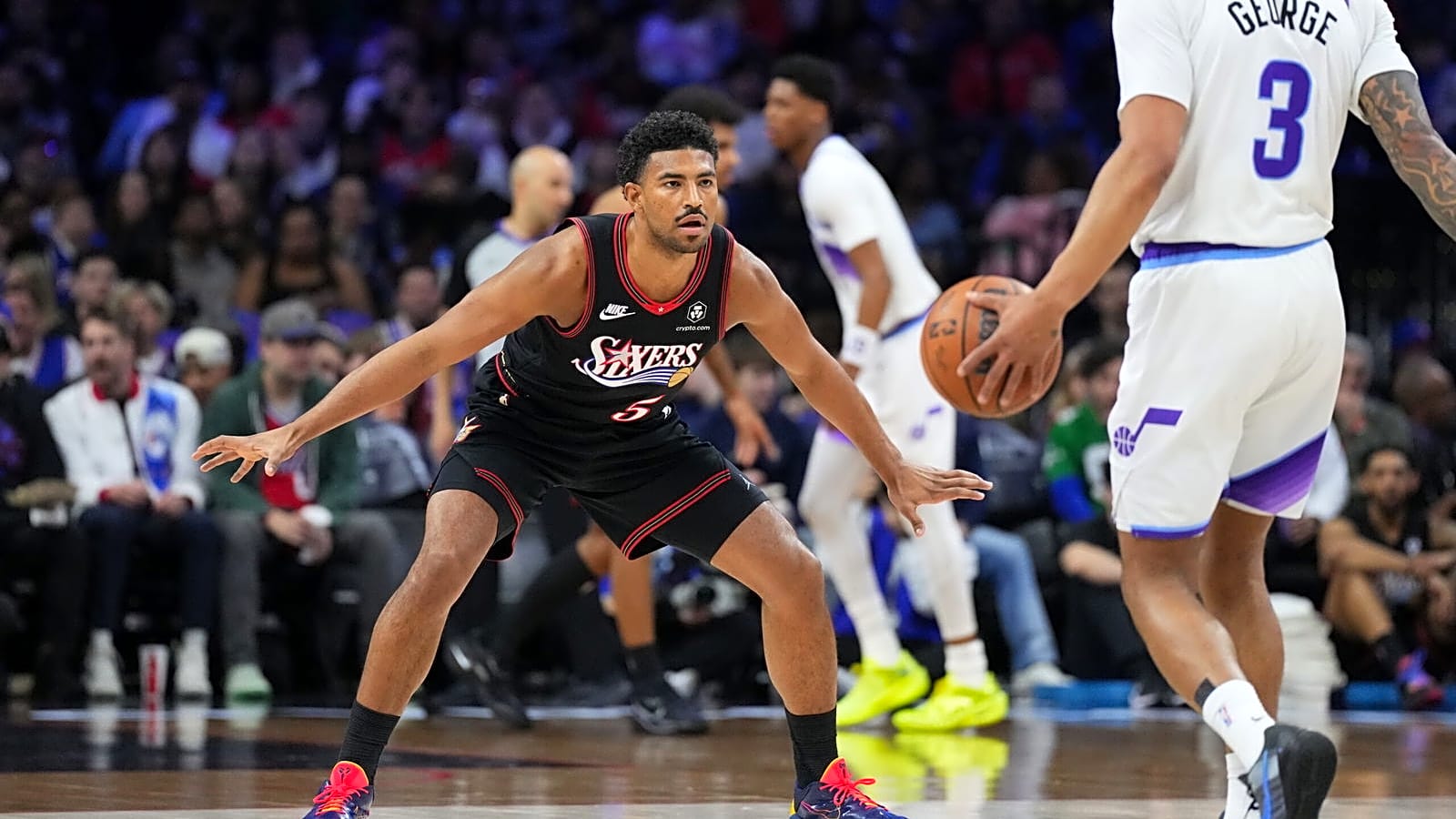
As the Philadelphia 76ers continue to search for lineup consistency behind Tyrese Maxey, one question continues to surface: Are they using Quentin Grimes correctly?
Grimes has quietly been one of the more polarizing role players on the roster. At times, he looks like a dependable starter. At others, he fades into the background.
The difference may not be effort, but role.
A Clearer Role for Quentin Grimes Means Better Results
During the 2024-25 season, Grimes operated primarily as a 3-and-D wing, a straightforward assignment that emphasized spacing the floor, defending the perimeter and capitalizing on catch-and-shoot looks.
The results were steady. Grimes averaged 14.6 points, 4.3 rebounds and 3.0 assists per game while shooting 46.7 percent from the field and 39.3 percent from three. (2.2 makes on 5.6 attempts per game).
He was not asked to orchestrate the offense or initiate sets. His job was simple: defend, space and convert open looks.
That clarity showed in his efficiency and consistency.
A Shift in Responsibilities
This season, Grimes’ role has shifted. Operating primarily as a backup guard behind Maxey, he has been tasked with more on-ball creation.
His numbers have dipped. The 25-year-old is averaging 12.5 points, 3.6 rebounds, and 3.4 assists while shooting 44.4 percent from the field and 34.4 percent from three (1.8 makes on 5.3 attempts).
The assist increase suggests expanded playmaking duties, but the efficiency decline tells a larger story.
Grimes is at his best when playing decisively, attacking closeouts, rotating defensively and moving without the ball. When asked to create off the dribble consistently, his rhythm appears less natural.
That inconsistency has not gone unnoticed. A recent piece from The Sixer Sense described the Sixers as entering a “make-or-break stretch” regarding Grimes’ future, pointing to uneven performances and questions about long-term fit.
The fluctuations may not reflect talent limitations as much as situational miscasting.
The Value of Specialization for the Sixers
The Sixers do not need another primary playmaker. Maxey shoulders that responsibility, and the offense flows best when the ball is in his hands.
What Philadelphia lacks at times is reliable off-ball defense and consistent wing shooting.
Grimes has already shown he can provide both.
As a 3-and-D option, he spaces the floor without disrupting offensive hierarchy. He defends opposing guards and wings, allowing Maxey to conserve energy. His offensive contributions flow within the system rather than forcing it.
Role players often thrive when their responsibilities are narrowed, not expanded. For Grimes, a reduced creative burden could elevate his overall impact.
The Bigger Picture
Modern NBA offenses value versatility, but not every player needs a multi-level creator. Championship rotations are built on players who understand and execute defined roles.
Grimes has demonstrated he can be a solid starter when placed in one.
The Sixers face an important decision: continue developing him as a secondary playmaker, or recalibrate and lean into what he already does well.
If the goal is maximizing efficiency and roster balance, the answer may be simpler than it seems.
Sometimes, maximizing a player is not about expanding his game.
It is about refining it.
More must-reads:
- Adam Silver: 'Substantial changes' coming to deter tanking
- Joe Mazzulla had an all-time quote on Jayson Tatum's potential return
- The 'NBA 30-point game leaders' quiz
Breaking News
Trending News





Customize Your Newsletter
 +
+




Get the latest news and rumors, customized to your favorite sports and teams. Emailed daily. Always free!
PRIVACY POLICY COOKIE POLICY CONTACT US
ABOUT YARDBARKER TERMS OF SERVICE


By using this site, you agree to our Terms of Service and Privacy Policy.
This site is for entertainment purposes only.
There is no gambling offered on this site.
Gambling Problem? Call 1-800-Gambler.
