-

-


Follow Us
-

 On Facebook
 On Flipboard


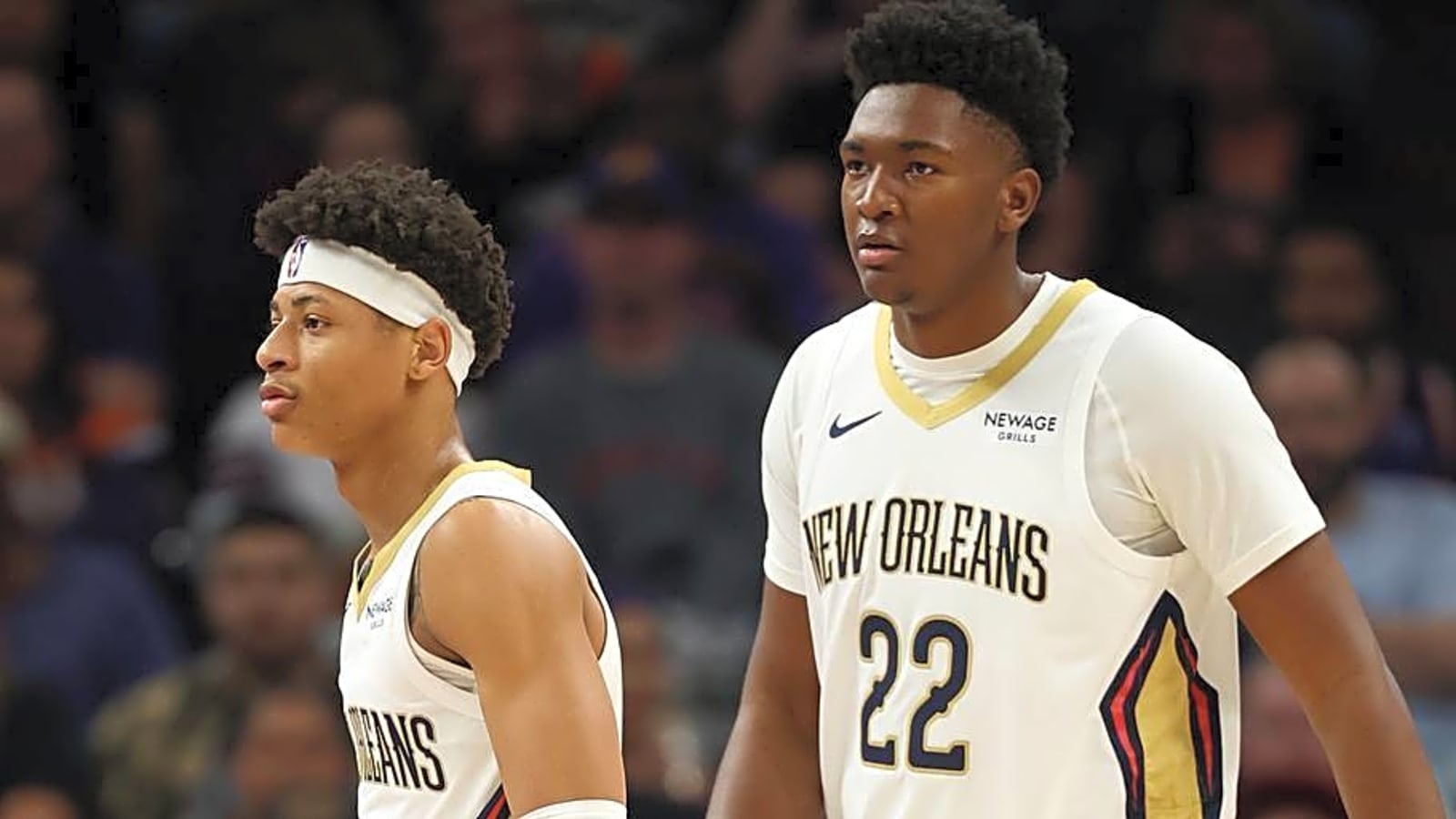
Jeremiah Fears needs the ball to learn how to run the Pelicans. Derik Queen needs it to show how much offense he can create. New Orleans can accommodate both by giving them different responsibilities, but their time together has been a bigger problem.
Fears starts, while Queen does most of his work with the reserves. That arrangement gives each an opportunity to make decisions and allows coach Jamahl Mosley to surround them with different supporting players. The results suggest there is good reason to keep things as is.
Still, the Pelicans have an investment in their partnership, too. Through 19 games, the challenge is finding enough minutes to explore that connection without asking a struggling team to absorb more than it can handle.
Fears is finding more ways to contribute
Fears' second season has revealed more of his ability to create for teammates. His assists have risen from 3.4 to 5.6 per game, an increase that can't be explained simply by an increase in minutes.
Even when accounting for playing time, he is generating more opportunities. Fears is averaging 6.6 assists per 36 minutes, up from 4.8 as a rookie. His rebounding has also increased from 3.7 to 5.1 per game.
That broader involvement matters. Fears contributes when his shot isn't falling, which is important for a point guard whose scoring remains inconsistent. His competitiveness comes through in his insistence on staying involved, though learning when to attack and when to move the ball is still part of the job.
His scoring average has climbed to 16.2 points, but additional minutes account for that increase. He's shooting 43.5% from the field, almost identical to last season, while his three-point percentage has fallen from 33.0% to 28.8%.
Fears is creating more baskets for every turnover than he did as a rookie, though he still gives the ball away three times per game. Fouls have become another obstacle, rising from 2.6 to 3.8 per 36 minutes.
New Orleans is getting more playmaking from him. The next advance will come from reducing the possessions he gives back through rushed decisions and defensive mistakes.
Queen's role brings a different tradeoff
Queen has received less playing time this season, but his scoring and rebounding have held up. He's averaging 12.1 points and seven rebounds in 22.1 minutes, compared with 11.7 points and 7.1 rebounds in 25 minutes last season.
He's making more out of those opportunities. Queen's field goal percentage has improved slightly, rising from 47.3% to 48.8%, and he is drawing more free throws despite spending less time on the floor. His defensive rebounding has improved, too.
His three-point shot remains in development. Queen has made 10 of 27 attempts, although four makes came against Golden State. For now, it's an occasional weapon. Consistently making opponents defend him farther from the basket would give him more room to use his other skills.
His passing has been less productive. Assists have dropped from 3.7 to 2.1 per game, while turnovers have climbed slightly. The decline in assists remains substantial even after accounting for his reduced minutes.
That makes his second-unit responsibilities worth watching. Queen can offer an alternative to an offense built around guards creating off the dribble. Giving him the ball should create chances for cutters and shooters, as well as opportunities for his points. Whether those possessions become a steady source of offense will help determine how much responsibility he can carry.
Their shared minutes expose the roster's limits
The strongest argument for their current roles comes from what happens when those roles overlap.
| On the floor | Minutes | Offensive rating | Defensive rating | Net rating |
|---|---|---|---|---|
| Fears w/o Queen | 407 | 114.5 | 119.4 | -4.9 |
| Queen w/o Fears | 243 | 109.8 | 113.8 | -4.0 |
| Fears + Queen together | 178 | 109.6 | 127.8 | -18.1 |
Source: PBP Stats, through Nov. 23
New Orleans has been outscored in each situation, but the defense has been much worse with both playing. Queen's minutes without Fears have produced nearly the same offensive output as their shared minutes, with substantially fewer points allowed.
Building a workable lineup around them involves competing needs. Fears needs help keeping opposing guards out of the lane. Queen needs defenders who can prevent him from repeatedly having to clean up those drives. Both need shooters who can keep opponents from packing the paint.
Finding three teammates who supply enough of everything is a big ask. Their most-used group includes Saddiq Bey, Herb Jones, and Yves Missi, a combination that adds defensive support without much outside shooting. It has played fewer than 15 minutes.
The shooting results have made their shared minutes especially punishing. Opponents have hit 41.3% of their threes, while the Pelicans have made 26.4%. That gap could shrink with more games, but New Orleans has to give itself better chances at both ends.
Mosley has reason to keep their overlap brief and choose those stretches carefully. A few recurring minutes with a solid supporting group would be better than forcing them through extended stretches because they are both part of the franchise's future.
Starting Fears and letting Queen help direct the reserves gives each a place to develop. Their partnership is going to need a little patience. The Pelicans should give it a fair shot, but sharing a draft class shouldn't mean sharing the floor at any cost.
More must-reads:
- LeBron James posts first triple-double with 76ers in win over Heat
- NBA announces plans for European arena development and renovations
- The 'Most 12-sack NFL seasons' quiz?
Breaking News
Trending News




Customize Your Newsletter
 +




Get the latest news and rumors, customized to your favorite sports and teams. Emailed daily. Always free!
PRIVACY POLICY COOKIE POLICY CONTACT US
ABOUT YARDBARKER TERMS OF SERVICE


By using this site, you agree to our Terms of Service and Privacy Policy.
This site is for entertainment purposes only.
There is no gambling offered on this site.
Gambling Problem? Call 1-800-Gambler.