
-

-


Follow Us
-

 On Facebook
 On Flipboard
 On Twitter
Anatoly Karpov and Garry Kasparov once played a chess match in a race to six wins. Draws didn’t count. The 1985 chess world championship lasted for almost half a year, with 40 draws, before the tournament organizer simply called the thing. Karpov reportedly lost more than 20 pounds with the stress of the extended contest. It was a match between heavyweights, positional geniuses, with neither willing to extend himself and risk a loss. Kasparov was the better open-board player, the more dynamic attacker, but he was just as comfortable in the mud. So Karpov had to take him into the grime where he had a chance..
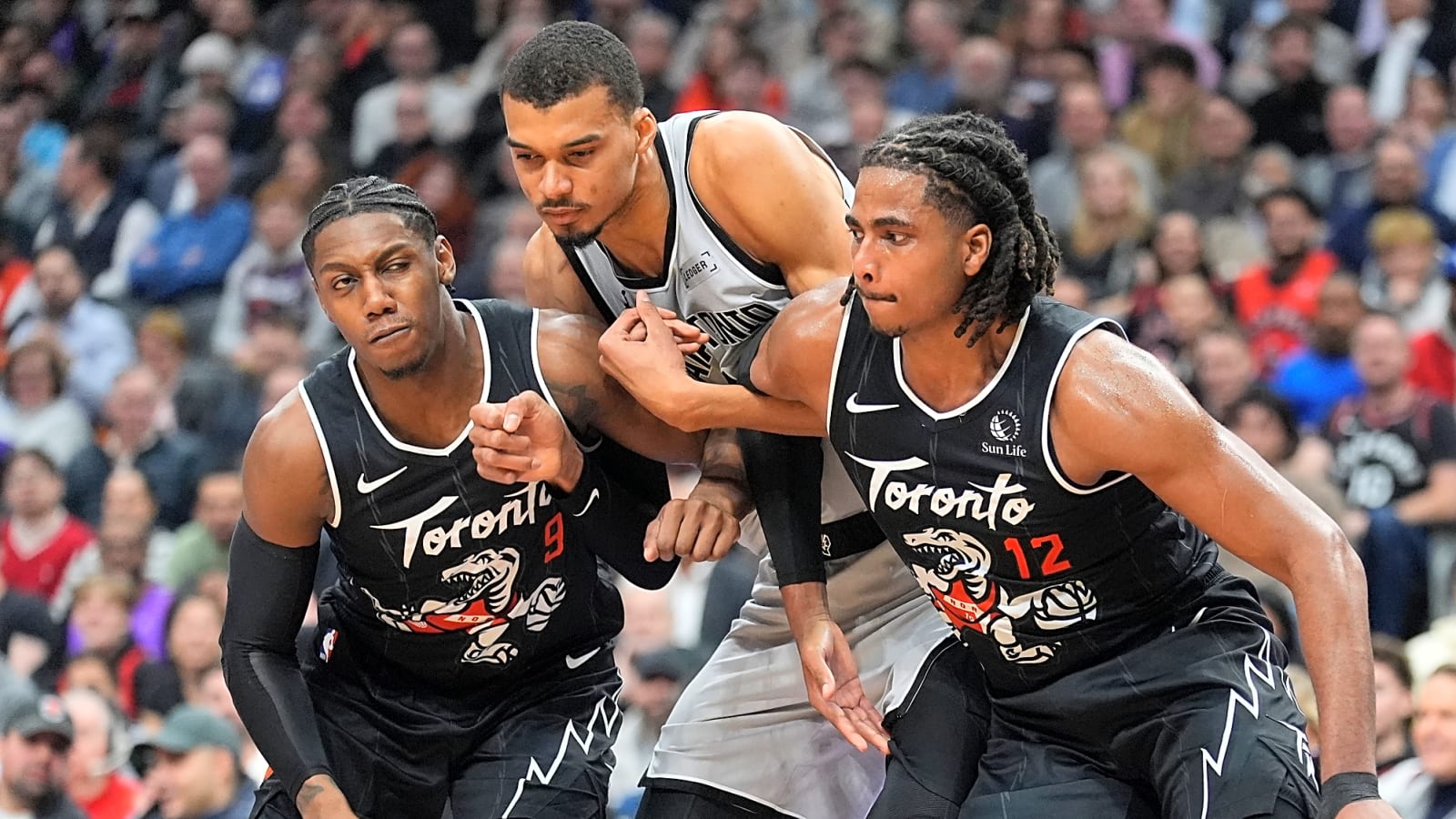
So too the Toronto Raptors found themselves pulling the San Antonio Spurs into the mud of a positional war. The Spurs entered the game at 41-16, the third-best record in the lead and only 3.0 games behind first overall. With the most dynamic player in the league in Victor Wembenyama, they were this game’s Kasparov. The Raptors are no slouch, certainly a strong team, but they are not the caliber of the Spurs. Their only chance was to play a defensive grudge match. Both teams are similar defensively — both within the league’s top six on that end — while the Spurs are offensively far more capable.
So defence, and the grime, is where it had to be for the Raptors for them to have any chance.
For that vast majority of the game, the plan worked to perfection. First and foremost, Collin Murray-Boyles mostly matched his minutes with Wembanyama. He dug into the far larger man’s dribble. (Wembanyama is practically a foot taller.) He used his strength and lower center of gravity to limit deep post touches. He forced the superstar to pick up his dribble and even got a steal jumping a pass.
Wembanyama didn’t convert his first field goal until the third quarter.
It wasn’t just Murray-Boyles. As a team, Toronto rebounded exceptionally well and made sure it found bodies and didn’t try to win jumping contests. Barnes was fantastic, as always, on that end. He defended everyone and added to his season-long collection of highlight blocks. His best moment came in the final minutes as he ripped the ball from De’Aaron Fox during a step through in isolation against the speed-demon guard. Jakob Poeltl was moving spryly. Darko Rajakovic tried to match his minutes with Luke Kornet to give Poeltl an easier go of it, though another Murray-Boyles thumb injury got in the way of that plan in the second half. Poeltl had a few vicious blocks of his own and looked far better as a mover. In the third quarter he scurried back in transition to block a Spur from behind. He stuck with Fox and blocked his pull-up jumper. That stuff just wasn’t happening when he was playing before his extended time on the bench with injury. He even held up as a finisher, including when he had to face Wembanyama in the third quarter.
On that offensive end, the Raptors were masters of the midrange. Wembanyama made the paint a no-fly zone. Barnes tried him early and got swatted attempting to dunk. So Toronto turned to more difficult — but in this game, more practical — shots. Brandon Ingram especially navigated well the presence of Wembanyama. He drove patiently, slowly, watching not his defender but Wembanyama as the helper. If multiple defenders converged, Ingram found teammates. If he remained in single coverage and Wembanyama recovered to a different Raptor when the drive slowed, Ingram pulled up and generally cashed his 2-pointers from range. He finished with 20 points, 11 rebounds, and four assists while winning his minutes.
Barnes, too, was terrific in the midrange. He caught in the post and calmly hit turnarounds over the shoulder. He used his post scoring to create for teammates, too, as he found a cutting Ja’Kobe Walter for an and-1. Jamal Shead and Immanuel Quickley hit from the short mid-range with floaters and push shots. Late in the third, Shead used as deadly a crossover as I’ve seen from him to get loose — for a mid-ranger, which drew a foul. It was emblematic of Toronto’s game: difficult, impressive, low-yield, but ultimately as good as they could get.
To that point, the offence wasn’t perfect. The Raptors played scared of Wembanyama in the paint and didn’t attempt layups they should have and missed ones they did take, even if Wembanyama wasn’t remotely nearby. But that’s what makes the Spurs such an excellent team. They protect the paint. It was to the Raptors’ credit that they found workarounds.
And the Raptors were just as defensively stout as the Spurs. The Spurs also couldn’t find anything at the rim. The Spurs also were forced into a fair number of half-court turnovers. The Spurs massively outshot Toronto from deep and still needed heroics to drag themselves back into the game in the final frame.
Toronto’s gameplan was to survive with Wembanyama in the game and thrive when he sat. They did that. The Raptors found far more consistent points when he sat, which is a requirement to beat superstars’ teams. With Poeltl on the floor against Kornet, the Raptors also threw Quickley against those lesser defensive lineups of the Spurs. He jetted into handoff triples and generally looked much more comfortable offensively than he has in some recent contests. He finished with 20 points on 12 shots. The gameplan was intentional and effective, as Toronto bullied its way to layups when Kornet was protecting the paint.
The thing about the Spurs is that they, like Kasparov in his prime, are goddamn lions. You can’t turn your back for an instant or they’ll crush your windpipe, gouge your organs. Resting on a 12-point lead, Rajakovic thought he could buy rest for both Barnes and Ingram at the same time to start the fourth quarter. The Spurs immediately reeled off a 7-0 run to force a Raptors time out and a Rajakovic mea culpa. Barnes re-entered the game, but the Spurs had found the dynamic offensive potency that they had lacked all night. They hit triples, cut the lead to a single point in mere minutes. Took the lead.
But then Wembanyama sat, and the Raptors couldn’t build a lead. He re-entered, and the Spurs left Toronto in the dust. Poeltl dragged Toronto back into the thing, with a floater and a tip-in in the final few minutes to cut San Antonio’s lead. Toronto had a chance to tie in the waning seconds, but Ingram bricked a corner triple.
Still, this is not another case of the Raptors simply being exposed against better teams. Toronto played 45 very strong minutes and had approximately a three-minute stretch at the start of the fourth quarter that doomed them. Toronto stayed committed to the gameplan. Toronto defended exceptionally. Toronto found workarounds to a half-court offence that simply couldn’t go near the rim. All that is remarkably impressive, win or lose.
The Raptors aren’t championship contenders, and losing to one of them — even if it is a pattern on the season — is expected, if disappointing for the team. Karpov didn’t beat Kasparov no matter how well he played in that world championship, no matter how much weight he lost over those several months. Neither did the Raptors beat the Spurs. But both Karpov and the Raptors can be proud of their performances regardless.
More must-reads:
- 'I'm lucky to be alive': Former Heat star Chris Bosh opens up about health scare
- Jayson Tatum takes significant step toward returning
- The 'NBA All-Star MVPs' quiz
Breaking News
Trending News




Customize Your Newsletter
 +
+




Get the latest news and rumors, customized to your favorite sports and teams. Emailed daily. Always free!
PRIVACY POLICY COOKIE POLICY CONTACT US
ABOUT YARDBARKER TERMS OF SERVICE


By using this site, you agree to our Terms of Service and Privacy Policy.
This site is for entertainment purposes only.
There is no gambling offered on this site.
Gambling Problem? Call 1-800-Gambler.
