-

-


Follow Us
-

 On Facebook
 On Flipboard


NFL rivalry games ignite intense excitement among fans, even when their own teams aren't playing. These matchups are steeped in history and hatred, with two teams harboring deep-seated animosity.
Fans despise the opposing team to the point of bitterness, and players carry this animosity onto the field, which leads to more drama on the gridiron. Intense NFL rivalries fan the flames of passion in supporters. Many are willing to travel great distances, venturing into enemy territory to demonstrate unwavering allegiance to their teams as they face their most bitter foes.
But which NFL rivalries have the most interesting history? Which NFL rivalries are the most heated today? We take a look at the top 10 NFL team rivalries and break down the best of the best.
All-time records include playoffs and are correct as of 26/11/2026.
Denver Broncos vs. Las Vegas Raiders
All-time series: 73-59-2 Raiders
The rivalry between the Denver Broncos and Las Vegas Raiders (previously of Los Angeles and Oakland), spans two divisions and two leagues, as they are both relics of the AFL. Both teams are nearly always competitive (recent history notwithstanding), with the Broncos and Raiders sitting sixth (23) and eighth (22) in postseason wins since 1970.
While they had played over 20 times before 1977, that was the year the rivalry was truly born, as the Raiders had won 24 of the previous 28 meetings heading into that campaign.
Both teams entered the Week 5 matchup at 4-0, with the Raiders riding a 17-game winning streak that stretched back to the 1976 season, during which they won the Super Bowl. Denver was unbothered, however, as they won 30-7 on the back of a wild seven-interception performance from Raiders Hall of Fame QB Ken Stabler.
Though the Raiders won the return matchup later that season, the 1977 "Orange Crush" Broncos got the last laugh, as they beat the Raiders in the rivalry's first playoff meeting, 20-17, in that year's AFC Championship, sending a member of this rivalry to the Super Bowl in back-to-back years. Denver would lose to the Cowboys in Super Bowl 12, however.
That consistent success combined with the chippy nature of the rivalry has made it a popular matchup for those that aren't fans of either team, as evidenced by their NFL-high 20 meetings on Monday Night Football—which was the league's marquee game for decades—since the merger. Those memorable MNF battles included a historic 24-point overtime comeback win for the Raiders in 1988.
From 1988 until 1994, the Raiders dominated, winning 13 of 15. However, when Mike Shanahan was hired as the coach of the Broncos in 1995, things really started to get testy. Shanahan was the Raiders' head coach in 1988-1989 and had gone through an ugly power struggle with hands-on owner Al Davis. After taking the Denver job, Shanahan made sure to get his revenge, going 21-7 against the Raiders in his 14 seasons at the helm from 1995-2008.
The rivalry has maintained its animosity and high entertainment value even through some lean years for the Raiders over the past few decades. Denver have won five straight meetings since 2024, including a 38-24 victory in November 2026, with fans highlighting the Raiders' lack of wide receiver recruitment as a major hurdle.
From former Bronco Bill Romanowski dislocating Denver legend Shannon Sharpe's elbow in a brawl in 2002, to Aqib Talib snatching Raiders receiver Michael Crabtree's chain in back-to-back years in 2016-2017, you can always count on seeing something you've never seen before with a Broncos-Raiders clash.
Cleveland Browns vs. Pittsburgh Steelers
All-time series: 84-66-1 Steelers
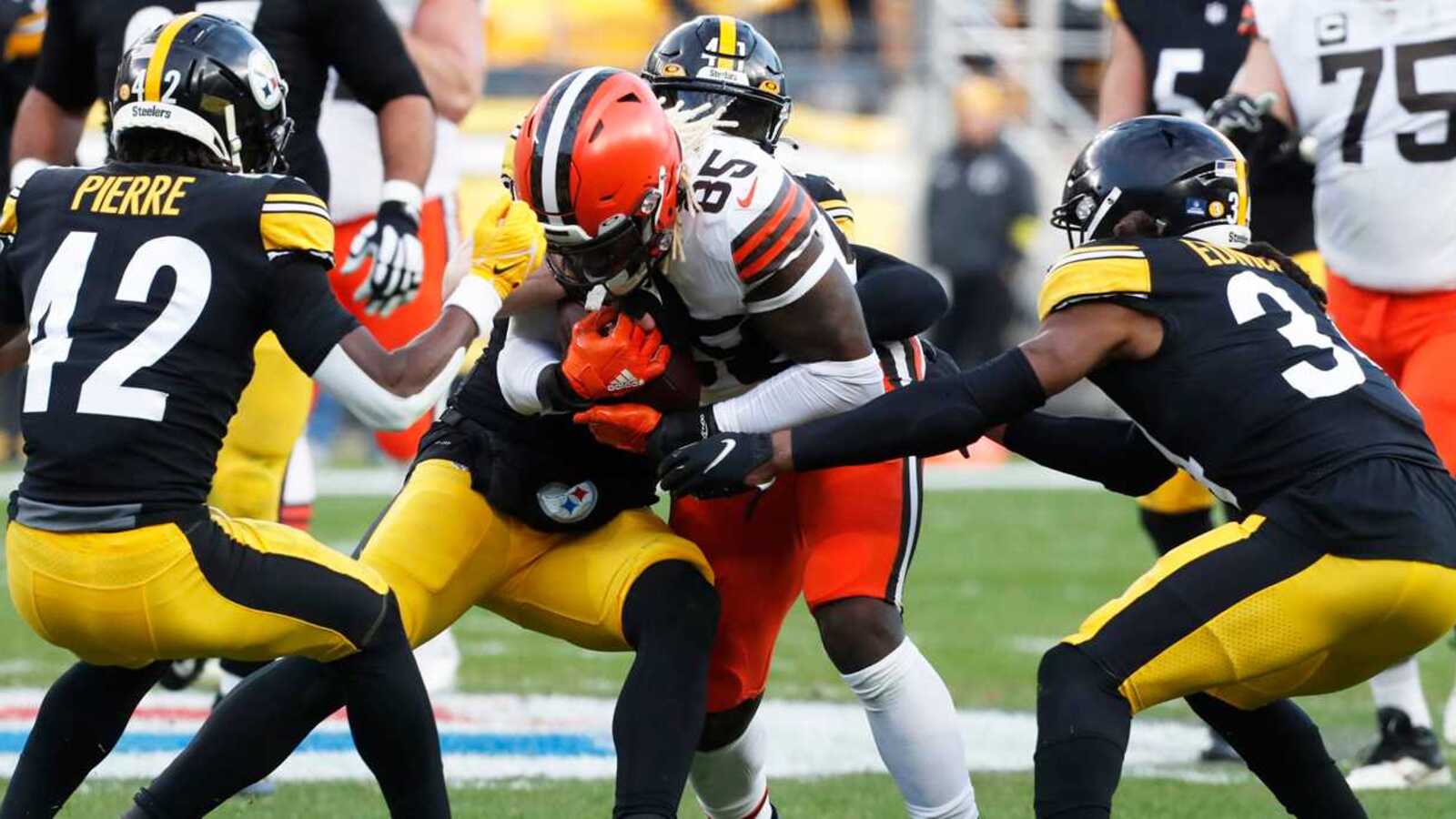
While this may seem like a typo because the Steelers have dominated this rivalry to the tune of a 23-13-1 run since the Cleveland Browns returned to the NFL in 1999, this was one of the fiercest division rivalries in the NFL world for a period in the 1970s and 1980s. After the Browns had their own period of power during the 1950s and 1960s, going 31-9 over that span, the bad blood really began.
The rivalry is one of the oldest in NFL history. Both Cleveland and Pittsburgh are blue-collar, hard-working cities, and their fans are often as hard-nosed as the players. The teams are only separated by 135 miles, so fans often travel to each other's home field, intensifying each battle.
The Turnpike Rivalry has been going on since 1950, when the Browns joined the NFL, making it the oldest and most frequent matchup in AFC history. They have played each other 151 times, and often twice a year, since they have played in the same division since the Browns' first season in the league.
The Browns won nine straight home meetings leading into Pittsburgh's dynasty years of the mid- and late-1970s—but that didn't stop the animosity from rising. In a 1975 matchup, Hall of Famer Mean Joe Greene was ejected for kicking a Browns player in the groin.
GIVEMESPORT Key Stat: This rivalry is also unique for the fact that both teams have provided the other with their greatest defeat to date. No one has beaten the breaks off of the Steelers worse than the Browns did in a 51-0 drubbing in 1989, and no team has dominated the new version of the Browns like Pittsburgh did in a humbling first game back in 1999, which they lost 43-0.
A couple of years later, in the first overtime contest in the rivalry's history, another Hall of Famer, snarling linebacker Jack Lambert, was ejected for a late hit on Brian Sipe, which led to his infamous "Quarterbacks should wear dresses," quote in a Howard Cosell interview the next week.
The 1980s belonged to the Browns. In 1980, Sipe and Cleveland's "Kardiac Kids", were known for their late-game heroics, which they employed to overcome a 12-point fourth quarter deficit to beat the defending-champion Steelers that year. In 1986, Cleveland also snapped a 16-game losing streak at Pittsburgh's Three Rivers Stadium that stretched back to the stadium's inaugural campaign in 1970.
From 1986-1988, the Browns did not lose to the Steelers, though that would represent their last era of dominance in this rivalry, as they have not swept the Steelers in the 25 years since. Following a wild 36-33 Steelers win in a Wild Card game in 2002, it was time for two Big Ben Roethlisberger decades of domination.
New England Patriots vs. New York Jets
All-time series: 78-56-1 Patriots
The rivalry between the New England Patriots and the New York Jets has captured the attention of football fans for decades. The geographical proximity of the two teams, with their stadiums just a four-hour drive from one another, adds an extra layer of intensity to their matchups.
Not to mention that their games often become an extension of the larger Boston vs. New York rivalry, which has its roots in the MLB's signature Yankees-Red Sox rivalry.
Believe it or not, the Jets actually led this series until 2011, when Tom Brady and the Patriots took the lead for good, but that just goes to show the level of parity between these teams for the first few decades of the rivalry. In 1985, the Jets even provided the Patriots with their first-ever NFL-era playoff win and their first postseason victory overall since 1963, when they were still part of the AFL.
The narrative of the Jets-Patriots rivalry in the late 1990s and early 2000s was defined by a series of twists and turns. It began when Bill Parcells, then the head coach of the Patriots, abruptly resigned in 1996 due to disagreements with team owner Robert Kraft.
The following offseason, the Jets wanted the Big Tuna, but because of contractual obligations between Parcells and the Patriots, the Jets hired Bill Belichick as their "head coach", while Parcells came on as an "advisor" who had the real power. Eventually, Parcells took the top job officially and Belichick became his defensive coordinator from 1997-1999.
This sudden shift in coaching personnel and the backroom drama surrounding it added fuel to the rivalry between Jets and Patriots fans. And things only got worse when Belichick left to become New England's head coach in 2000, which jump-started the greatest dynasty in NFL history.
It was that 15-year period from 1993-2008 that really saw the rivalry blossom, largely because of the familiarity that was bred out of the countless coaches and players that spent time with both franchises. During that span, Parcells, Pete Carroll, Belichick, and Eric Mangini all served stints on the staffs of both teams, and over 50 players dipped their toes in both the Jets and Patriots' pools during that time as well.
Cincinnati Bengals vs. Pittsburgh Steelers
All-time series: 73-42 Steelers
The Pittsburgh Steelers and the Cincinnati Bengals began their rivalry in 1970 when the Steelers moved to the AFC Central. At first, this was a one-sided affair, with the Steelers dominating the 1970s and winning four Super Bowls, while the Bengals didn't achieve much at all, going the entire decade without a win at Three Rivers Stadium.
However, in the 1980s, Pittsburgh struggled, and the Bengals soared, making it to two Super Bowls of their own, even taking a 21-20 series lead by 1990. That would be their last moment on top, as Pittsburgh would reel off eight straight wins from 1991-1994. Cincinnati did split the series during the latter half of the 1990s though, even sweeping the Steelers in 1998 despite going 3-13 on the year.
Pittsburgh dominated the rivalry once Big Ben came to town, with the Steelers running up a 33-9 record in the 2000s and 2010s. The Bengals only recently turned things around after drafting Joe Burrow, winning four of six meetings from 2020-2022 before Pittsburgh got another sweep in 2023 with Burrow on the shelf.
The rivalry really started heating up during the 2005 season, when Bengals wideout T.J. Houshmandzadeh wiped a Terrible Towel on his cleats after a regular season win. When they met later that season in the playoffs, Bengals franchise QB Carson Palmer was rolled up on by a Pittsburgh defender, tearing his ACL and contributing to the Steelers getting the last laugh in a 31-17 victory on their way to winning Super Bowl 40 that year.
The hate has only intensified since then, with big hit after big hit seemingly defining this rivalry. Hines Ward's jaw-breaking hit on Keith Richards on a crack-back block. Ryan Shazier spearing Giovanni Bernard.
The zenith of this rivalry occurred in a 2015 Wild Card Game:
- Big Ben is carted off the field and is pelted by Bengals fans with trash.
- Bengals blow a chance to seal the game with 1:36 left after Steelers LB Ryan Shazier forces a red zone fumble.
- Big Ben returns to the game unexpectedly.
- Vontaze Burfict tried to decapitate Antonio Brown and gave the Steelers a crucial first down to keep the game alive.
- Adam "Pacman" Jones picked up a 15-yarder of his own after an altercation with Steelers coach Joey Porter to give the Steelers another unearned first down.
- Chris Boswell kicks the game-winning field goal to give Pittsburgh the 18-16 win.
The hate that was cooked up in that playoff game carried over into their 2017 series, with an ugly contest in Cincinnati resulting in Shazier's career-ending spinal injury and Pittsburgh wideout Juju Smith-Schuster knocking Burfict out of the game and standing over him, which was widely viewed as retribution for his ugly hit on Brown two years prior.
Dallas Cowboys vs. Washington Commanders
All-time series: 82-49-2 Cowboys
The rivalry between the Cowboys and the Washington Commanders is a legendary feud that predates even the Cowboys' entry into the NFL. In 1960, when Dallas aimed to become the first modern expansion team, Washington, then a powerhouse franchise, cast their vote against Dallas joining the league.
Washington's motivations were primarily business-driven, as they sought to maintain dominance in the southern United States without the intrusion of a new competitor.
However, the Cowboys' ownership devised a unique strategy to navigate this challenge. They secured the licensing rights to the Washington Fight Song, using this leverage to legally prohibit its use during games. This move ultimately forced a compromise, with the song's rights returned to Washington in exchange for the Cowboys' admission into the NFL.
The spark that really ignited this intense rivalry came when the Cowboys selected Washington's starting quarterback, Eddie LeBaron, in the expansion draft later that year.
From 1971 to 1995, this was arguably the most successful divisional rivalry in the NFL. These teams combined for eight Super Bowl championships and all but seven NFC East titles during that quarter-century. However, despite Washington's immense success in the 1980s, the Cowboys have won the series in all seven decades of the rivalry.
The rivalry's lore includes memorable pranks, such as the infamous Cowboys Chicken Club antics in 1961. It has also included many off-the-field moments, such as a handful of commercials. Legendary Cowboys coach Tom Landry actually did two different spots in which he poked fun at Washington, and a rivalry between Washington CB Josh Norman and Dallas WR Dez Bryant was also used in a Samsung Galaxy ad in 2017.
The dislike goes all the way to the top, too. Most recently, former Washington owner Dan Snyder attempted to divert attention from his own sexual harassment suit by claiming he had unearthed significant "dirt" after putting private investigators on Cowboys' owner Jerry Jones, though the supposed smoking gun was never revealed.
New York Giants vs. Philadelphia Eagles
All-time series: 96-90-2 Eagles
The rivalry between the New York Giants and the Philadelphia Eagles is as heated as any in the NFL. Not only do the players and fans hate each other, but the city of New York and the city of Philadelphia have disliked one another for centuries, and the rivalry between the cities has oozed into every major sports league, including the NHL and MLB.
Nowhere is it more fraught than in the NFL, however. The two teams have been in the same conference since 1933, meeting a whopping 188 times. Despite such volume, Philly holds only a tenuous lead in the all-time series, but have also won three of five playoff meetings.
The best thing about this rivalry is how many signature moments there have been over the near 100-years of animosity. There was Philadelphia linebacker Chuck Bednarik's earth-shattering hit (now cleverly referred to as "The Hit") on Giants golden boy Frank Gifford in 1960, which forced Gifford to retire for two years thereafter and is still considered one of the biggest hits in NFL history.
There was also the "Miracle at the Meadowlands" in 1978, when the Giants fumbled away a 17-12 lead in the dying seconds, which resulted in Philly DB Herm Edwards' iconic game-winning fumble return for a touchdown.
And we can't forget the "Miracle at the New Meadowlands" in 2010. Down 21 in the fourth quarter, Philly went on a furious comeback in which they scored four touchdowns in the final eight minutes, including a surreal punt return score by DeSean Jackson as time expired, giving them a 38-31 victory.
Dallas Cowboys vs. San Francisco 49ers
All-time series: 22-19-1 49ers
The Dallas Cowboys and San Francisco 49ers rivalry stretches back to the 1980s and includes nine playoff meetings, tied for second-most in NFL history. It's the only non-divisional matchup on this list, as the 49ers somehow always meet either the Cowboys or the Packers in the playoffs, with the latter rivalry just missing the cut for us here.
After dominating in the 1970s, the Cowboys started to fade. Around the same time, the 49ers drafted a new quarterback named Joe Montana and signed trailblazing head coach Bill Walsh. Instead of Dallas ruling the NFC, San Francisco started to turn the tables on the Cowboys in the 1980s.
The 1981 NFC Championship was the turning point. That was when the 49ers' Dwight Clark made what has become known as "The Catch" to defeat the Cowboys en route to winning Super Bowl 16, San Francisco's first championship. This NFL rivalry would become a bit one-sided for a while after that, as Dallas dropped out of relevance and the 49ers won four Super Bowls in the 1980s.
However, it resurfaced in the 1990s as Dallas returned to championship form, winning a trio of Super Bowls, while the 49ers managed one more ring in 1994. The rivalry at this point was characterized by San Francisco's swash-buckling QB Steve Young, who had succeeded Montana, and the Cowboys' more classic drop back passer, Troy Aikman.
The two teams actually combined to win four straight Super Bowls from 1992-1995 and even faced each other in three consecutive NFC Championships from 1992-1994, though, funnily enough, all three of those games were decided by 10+ points.
The rivalry went dark for about two decades as both teams struggled to return to title contention, but it has come back with a vengeance over the last few years, with the 49ers booting the Cowboys from the playoffs after very tight battles in both the 2021 and 2022 postseasons.
Baltimore Ravens vs. Pittsburgh Steelers
All-time series: 38-27 Steelers
If we were talking about the best NFL rivalries of the 21st century, Steelers-Ravens would be the most heated, and it wouldn't even be particularly close.
A big reason for the birth of this hotter than hot rivalry is the fact that not only were they always battling it out for AFC North supremacy because of how awful Cincy and Cleveland were, but they were both trying to achieve their goals by playing tough, defensive, smash-mouth football. What happens when two immovable objects come into contact? Fireworks like this.
In the overall series, the Steelers hold a 35-25 lead, including a 3-2 record in the postseason. The fact that they've already played five times in the playoffs since 2001 speaks to how the concurrent success of these teams served to make the rivalry all the more intriguing and watchable even for neutrals. And oh, have there been signature moments.
Hines Ward flattening Ed Reed. Mike Tomlin's dubious foray onto the field of play during Jacoby Jones' kick return. Antonio Brown's one-handed helmet catch on third and long. Ray Lewis crunching Mendenhall. Santonio Holmes and Brown's game-winning goal-line plays. John Harbaugh's knowing smirks. Tomlin's emphatic camera point. The brawls. The fights. The trash talk.
Iron sharpens iron, as Tomlin says. But perhaps what perfectly encapsulates this rivalry is the relationship between Pittsburgh's Big Ben Roethlisberger and Baltimore's Terrell Suggs. Suggs sacked Big Ben more than anyone, 17 times to be exact, and after a 35-7 Ravens win in 2011, Suggs summed up his relationship with the QB:
"Big Ben, you know he's a great quarterback. God can have his soul, but his ass belongs to me."
There have been big battles before and since, but the 2008 series is really what turned this into the rivalry that it is. In Week 4, the Steelers beat the Ravens on an overtime field goal. In Week 15, the Steelers won on a controversial late touchdown.
The ensuing AFC Championship Game was won by Pittsburgh on a Troy Polamalu pick six in a game that also featured a legal Ryan Clark hit on Willis McGahee that left Clark out cold for several minutes and McGahee in a Pittsburgh hospital for the night.
Ravens vs Steelers in the Playoffs
Season |
Round |
Winner |
Score |
|---|---|---|---|
2024 |
AFC Wild Card |
Ravens |
28-14 |
2014 |
AFC Wild Card |
Ravens |
30-17 |
2010 |
AFC Divisional |
Steelers |
31-24 |
2008 |
AFC Championship |
Steelers |
23-14 |
2001 |
AFC Divisional |
Steelers |
27-10 |
Dallas Cowboys vs. Philadelphia Eagles
All-time series: 76-59 Cowboys
The NFC East is probably the NFL division with the most animosity between all four teams. New York hates Philly. Philly hates Washington. Washington hates Dallas. But there is no pairing that is more heated than Dallas and Philly. It's another one of those rivalries where it's not only the teams but the entire cities that get into it. The polished Cowboys of fancy Dallas against the rough and rugged Eagles of historic Philadelphia.
The mark of a really great rivalry is how much the neutral fans want to watch. And boy, do they want to watch this one. It's been the most featured matchup on Sunday Night Football, with 16 games that have been split evenly down the middle. They've also played each other four times in the postseason, with Dallas owning a 3-1 advantage.
Some of the most heated battles came in the late 1980s and early 1990s. This era included both sides accusing the other of running up the score during the strike-shortened 1987 campaign, as well as the "Bounty Bowls" of 1989, when Cowboys head coach Jimmy Johnson claimed Eagles head coach Buddy Ryan and his ilk had set bounties on several Dallas players.
In 1990, after reports of Ryan choking on a pork chop in the days leading into an Eagles-Cowboys clash, Dallas fans tossed pork chops on the field and dubbed it the "Porkchop Bowl".
In 1999, iconic Cowboys receiver Michael Irvin suffered a career-ending spinal injury against the Eagles, which was cheered vehemently by the Philly fans at Veterans Stadium. And of course, who can forget the Terrell Owens saga of the mid-2000s.
It's also the only rivalry among the 16 most common matchups in NFL history to feature zero ties, because these teams would never settle against one another. This is one of the few rivalries where players have openly stated their dislike for the opposing team and their fans, which makes it all the more fun for the rest of the NFL and fans watching.
Chicago Bears vs. Green Bay Packers
All-time series: 110-98-6 Packers

How can this not be the greatest rivalry in NFL history? The animosity between the Green Bay Packers and the Chicago Bears is nothing short of legendary, with a history dating back to the earliest days of professional football.
They are the two oldest teams in NFL history. They have more wins than any other teams in NFL history. They boast a combined 22 NFL championship wins and five Super Bowl titles. They've also clashed on the gridiron an NFL-record 214 times, with the Packers claiming a surprisingly small advantage considering the massive sample size. Interestingly, they have only met three times in the postseason, in 1941, 2010 and 2025.
The roots of this historic rivalry stretch back to 1919 when both teams were founded. Their rivalry officially took flight when they joined the American Professional Football Association in 1921, and they have shared the same conference since 1933.
Since 1992, this rivalry has been quite one-sided, with Green Bay claiming a 53-17 advantage over that span. In recent years, the rivalry has been highlighted by longtime Green Bay quarterback Aaron Rodgers, who regularly referred to himself as the Bears' daddy or their owner. However, that doesn't take away from the rich history of the rivalry.
The Green Bay and Chicago sidelines have been graced by legendary head coaches like George Halas, Mike Ditka, Vince Lombardi, and Curly Lambeau, along with a constellation of Hall of Fame players that includes Bart Starr, Brett Favre, Ray Nitschke, Walter Payton, Dick Butkus, and Gale Sayers.
With a splendid century-long history filled with intense games, controversial plays, heartbreaking losses, and glorious victories, the Bears-Packers rivalry remains iconic in the NFL pantheon.
More must-reads:
- James Harrison, Ryan Clark among former players to chime in on Aaron Rodgers' Mike McCarthy tirade
- Ex-Steelers player says Mike McCarthy has an 'ice cream sandwich assistant'
- The 'Most 12-sack NFL seasons' quiz?
Breaking News
Trending News

Customize Your Newsletter
 +
Get the latest news and rumors, customized to your favorite sports and teams. Emailed daily. Always free!
PRIVACY POLICY COOKIE POLICY CONTACT US
ABOUT YARDBARKER TERMS OF SERVICE


By using this site, you agree to our Terms of Service and Privacy Policy.
This site is for entertainment purposes only.
There is no gambling offered on this site.
Gambling Problem? Call 1-800-Gambler.