
-

-


Follow Us
-

 On Facebook
 On Flipboard
 On Twitter

The ink on Kyler Murray’s contract was barely dry when DeAndre Hopkins went on camera and made his pitch. Not through an agent. Not through back channels. Straight to TMZ, on the record, within days of Murray landing in Minnesota. “If the Vikings need me, they know I’ll be there,” Hopkins said. A five-time Pro Bowler, approaching 1,000 career receptions, volunteering for duty. The Vikings had just reshaped their quarterback room overnight, and Hopkins wanted in on whatever was coming next.
Arizona’s $36.8 Million Goodbye Gift
Murray spent seven seasons in Arizona. The Cardinals gave him a massive extension worth $230 million. Then they grew “frustrated” with his work ethic, questioned his leadership, and wondered publicly whether his mobility would survive the ACL tear and foot injuries. So they released him. But the $36.8 million in guaranteed money? That still hits Arizona’s books in 2026. The Vikings signed the same quarterback for $1.3 million. Arizona is essentially subsidizing Minnesota’s new starter to the tune of $35.5 million.
The McCarthy Problem Nobody Wants to Say Out Loud

J.J. McCarthy was the No. 10 pick in 2024. He was supposed to be the franchise answer. Instead, he managed 10 starts across two injury-plagued seasons. Meanwhile, the Vikings offense cratered from 14th in EPA per play in 2024 to 28th in 2025. That’s a 50 percent efficiency collapse with the same coaching staff. Kevin O’Connell built his reputation as an offensive mastermind. His unit now ranks 29th in DVOA. Signing Murray was not a luxury addition. It was an emergency alarm.
Three Top-10 Picks, One Starting Job

Minnesota now rosters three quarterbacks who were all drafted in the top 10: Murray, McCarthy, and Carson Wentz. Combined cap hit? Roughly $11 million. Seventh-lowest quarterback spending in the NFL. Three former franchise cornerstones, none of them costing franchise money. That sounds like flexibility. It is actually a confession. One pick did not pan out. Two veterans were discarded by their previous teams. The Vikings collected other organizations’ failures and called it a quarterback room. Offseason workouts start next month, and somebody loses that competition fast.
The System That Keeps Breaking

Here is what the Murray signing actually exposes: the problem might not be the quarterback. O’Connell’s offense has ranked outside the top 13 in EPA three of his four seasons. He has Justin Jefferson, one of the best receivers alive, and still produced a bottom-three unit. Swapping quarterbacks treats the symptom. If Murray struggles behind the same scheme, there is nowhere left to hide. The Cardinals said Murray’s mobility was “shot.” He rushed for 572 yards in 2025, fourth among all NFL quarterbacks. Somebody’s evaluation was wrong.
Hopkins’ Numbers Tell a Different Story

Hopkins played 13 NFL seasons and sits on the doorstep of 1,000 career receptions. He called Murray “family” and described his free-agency priority as mentoring young players. Noble stuff. Then he tweeted about his red zone usage in Baltimore: “How many times after this do you think I was used in the red zone?” That is not a mentor talking. That is a receiver who felt wasted. His previous Ravens deal paid $5 million. If the Vikings matched that, reuniting Hopkins and Murray would cost roughly $6.3 million combined against the cap.
The Cincinnati Wrinkle
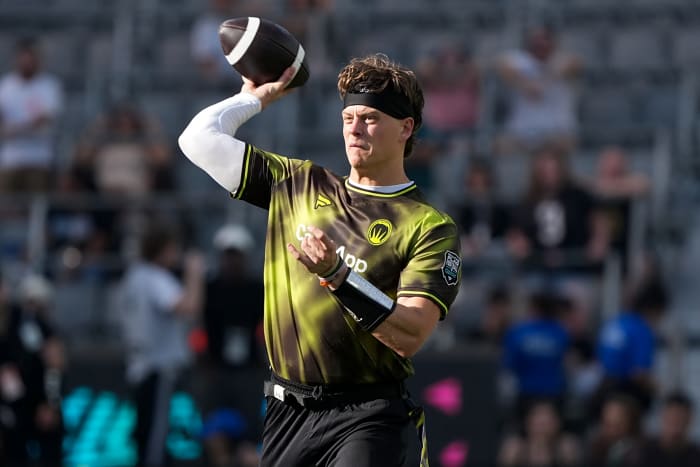
Days after telling TMZ he would be there for Murray and the Vikings, Hopkins posted a cryptic flag football clip featuring Joe Burrow and a Cincinnati Bengals logo. One public statement saying “I’ll be there.” One visual signal pointing somewhere else entirely. That is not indecision. That is leverage. Hopkins told Minnesota exactly what they wanted to hear while keeping Cincinnati’s phone line warm. Verbal commitments in March mean nothing until a contract gets signed. The dual messaging sets a template other free agents will copy.
A Prove-It Year for Everyone
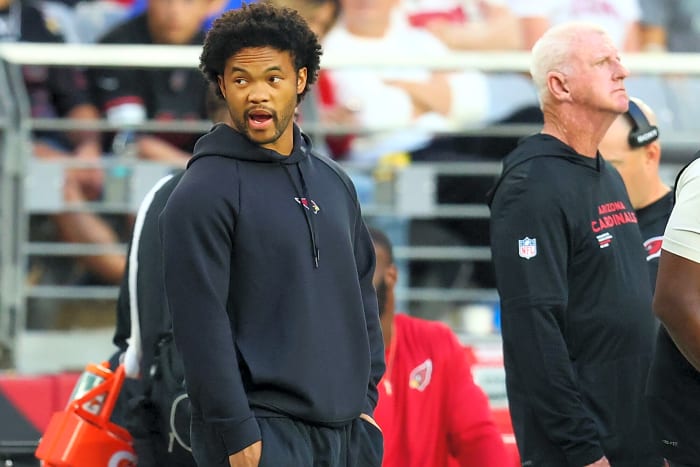
Murray’s contract includes a no-tag clause. That means Minnesota cannot franchise-tag him after 2026. If the offense stays broken, Murray walks. If McCarthy gets benched and thrives elsewhere via trade, the Vikings’ draft investment becomes an organizational humiliation. This is the third time in two decades the Vikings have pivoted at quarterback mid-cycle. The pattern keeps repeating. Every move this offseason looks like reaction, not strategy. Once you see it that way, the Murray signing stops looking like a coup and starts looking like a bandage.
Who Loses First

McCarthy loses his starting job. That domino falls within weeks. O’Connell loses next: a full season with Murray, Hopkins, and Jefferson removes every personnel excuse. If the offense still ranks near the bottom, the genius label dies publicly. Even Jefferson takes a hit. If the scheme is structurally broken, the best receiver in football cannot mask it, and his market perception suffers. Arizona, meanwhile, eats $36.8 million in dead money while rebuilding from scratch. Four losers. One signing created all of them.
The Counter Move Nobody’s Watching

Baltimore could re-sign Hopkins on a multi-year deal before Minnesota even makes an offer, blocking the reunion entirely. Other teams could target McCarthy with a trade package, betting the talent is real and the injuries were bad luck. The Vikings built their 2026 roster on the assumption that another team’s sunk cost is their discount and that a 13-year veteran’s loyalty is genuine. If Hopkins signs with Cincinnati instead, every word of that TMZ interview becomes negotiating theater. The cap subsidy is real. The commitment is still an open question.
Sources:
“Vikings sign former No. 1 pick QB Kyler Murray to 1-year deal.” Reuters, 11 Mar 2026.
“Kyler Murray signs with Vikings, ‘cannot wait’ to touch field.” ESPN, 11 Mar 2026.
“Why Vikings are signing Cardinals QB bust on minimum $1.3M deal.” Yahoo Sports, 12 Mar 2026.
“DeAndre Hopkins open to Kyler Murray reunion: ‘If the Vikings need me, I’ll be there’.” NFL.com, 23 Mar 2026.
“DeAndre Hopkins: ‘If the Vikings need me, they know I’ll be there’.” Sports Illustrated, 21 Mar 2026.
“Vikings QB room gets crowded after Carson Wentz move.” Yahoo Sports, 26 Mar 2026.
More must-reads:
- Early look at Seahawks' sale reveals name of interest
- Five teams that should consider NFL Draft trades
- The 'Rushing-TD leaders by NFL team' quiz
Breaking News
Trending News



Customize Your Newsletter
 +
+




Get the latest news and rumors, customized to your favorite sports and teams. Emailed daily. Always free!
PRIVACY POLICY COOKIE POLICY CONTACT US
ABOUT YARDBARKER TERMS OF SERVICE


By using this site, you agree to our Terms of Service and Privacy Policy.
This site is for entertainment purposes only.
There is no gambling offered on this site.
Gambling Problem? Call 1-800-Gambler.
