
-

-


Follow Us
-

 On Facebook
 On Flipboard

Over the past six decades, the Denver Broncos have practically called Super Bowl Sunday their home away from home. With eight Super Bowl appearances and three Super Bowl wins, the Orange and Blue are inarguably one of the NFL's premier franchises.
In addition to being one of the NFL's elite teams, they've found a knack for developing and scouting incredible quarterbacks. With Bo Nix in the fold, the Broncos have yet another big name commandeering their offense.
While Tim Tebow and Russell Wilson don't make this list, here is our ranking of the top five quarterbacks in Broncos history.
5. Craig Morton (1977-1982)
Yes, there is a very strong argument for Charley Johnson at this pick, seeing as Johnson taught the Broncos how to win (according to the famous quote by wide receiver Haven Moses) but we're going with Morton here.
Morton joined the Broncos at the tail end of his career after 12 years in the NFC with the Cowboys and Giants, and put together quite a strong encore in the Mile High City.
Morton finished second in the AP NFL MVP award race in his first year in Denver, leading the Broncos to a 12-2 record after throwing for 1,929 yards and 14 touchdowns with a receiving core led by Moses, Jack Dolbin and tight end Riley Odom. This solid offense, along with the 'Orange Crush Defense' helped solidify the Broncos' first Super Bowl appearance (a 27-10 loss to Morton's former Cowboys team).
Morton wouldn't make another Super Bowl, but his age-38 season in 1981 was a complete renaissance, returning to his near-MVP form, finishing fourth, and throwing for a career-high 3,195 yards and 21 touchdowns, which tied a career-high.
4. Brian Griese (1998-2002)
Broncos diehards could debate this pick, as Griese would take the spot of inaugural quarterback Frank Tripucka, who first captained the team and was the original Broncos #18 before Peyton Manning.
Still, Griese performed remarkably well succeeding John Elway in a competitive era of football, collecting a Super Bowl ring as Elway's backup in 1998.
Evidently, the Michigan product drafted as Elway's successor took ample notes on the Hall of Famer, because while he failed to deliver a third straight Super Bowl ring in 2000, he led the NFL in passer rating, threw 19 touchdowns to just four interceptions and threw for 2,688 yards.
Griese threw for 12,000 yards and 71 touchdowns during his time in Denver, and averaged 221.6 yards per game, which is still sixth best in franchise history.
3. Jake Plummer (2003-2006)
Immediately succeeding Griese was Plummer, who was acquired in free agency from the Arizona Cardinals in 2003.
In Mike Shanahan's offense, Plummer thrived, posting a 40-18 record, making the playoffs three times in four years, and handing Tom Brady his first playoff loss (a 27-13 defeat in the 2005 AFC Divisional Playoff).
That 2005 season was undoubtedly his career peak; he had only posted one season above .500 prior to coming to Denver, but his 13-3 record and 18:7 touchdown/interception ratio would put all of that to bed.
Plummer walked away from the NFL immediately after his time with the Broncos, and it's easy to see why he preferred to end his career on a high.
2. Peyton Manning (2012-2015)

While Manning put on a Colts hat when accepting his Hall of Fame enshrinement in 2021, a tribute to the team that drafted him, and the city in which he spent 14 seasons, he concluded his Canton-worthy career in Denver in storybook fashion.
When Manning was recruited to the Broncos by John Elway, many had figured his career was over after a series of neck surgeries, the latter of which sidelined him in 2011 and led to the Colts drafting Andrew Luck.
Manning showed there was still some gas in the tank in his inaugural 2012 season with the Broncos, nearly set a career high in completion percentage (68.6) and led the Broncos to a 13-3 record, though falling to the eventual Super Bowl champion Ravens as a No. 1 seed in the first round.
His 2013 season, however, was his best season as a pro, at the age of 37. Manning broke NFL single-season records with 5,477 yards and 55 touchdowns, winning his fifth MVP award. While that season ended in a 43-8 Super Bowl mutiny at the hands of Russell Wilson and the Seahawks, that season for Manning would go down in legend.
His 2015 season was the cap of a legendary career, as he took the Broncos to the mountaintop once again and took down Cam Newton and the Panthers at the age of 39, retiring on an all-time high after Super Bowl 50.
1. John Elway (1983-1998)
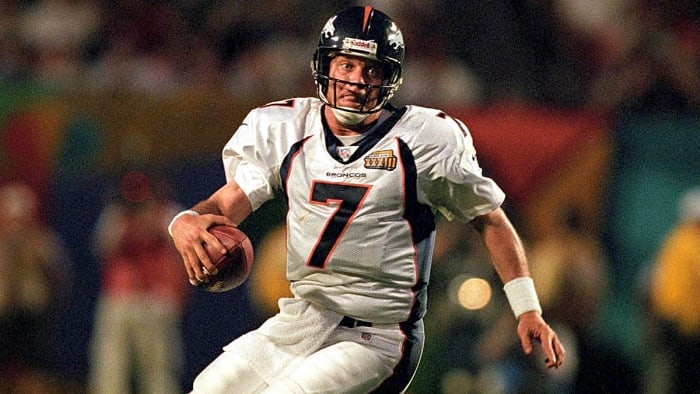
There's nobody but Elway that can top this list, as the career Bronco forged one of the great careers in NFL history. Interestingly, Elway forced a trade to Denver, setting a precedent for player leverage after being drafted to the Baltimore Colts.
Known as "The Comeback Kid," Elway would mount 47 fourth-quarter comebacks over the course of his long career, and develop a reputation for having the clutch gene. Elway's legacy, however, would mainly revolve around his late-career Super Bowl triumphs; after falling short in the Super Bowl three times in the span of four years from 1987 to 1990, Elway got to the top of the mountain not once, but twice in a row in 1998 and 1999.
Elway orchestrated both Super Bowl wins in uniquely John Elway fashion. In 1998, Elway's Broncos were 11-point underdogs against Brett Favre and the Packers, but thanks to an MVP performance from running back Terrell Davis and Elway's gutsy "The Helicopter" run with the game tied late in the third, the Broncos surmounted the odds stacked against them.
In 1999, Elway stepped away from the game on his own terms after winning Super Bowl MVP at the age of 38. In Miami against the Falcons at Super Bowl XXXIII, Elway passed for 336 yards and two total touchdowns, including a critical rushing touchdown in the fourth, to lead Denver to a 34-19 win over Atlanta.
All in all, it was a tremendous career for Elway in Denver, and the Washington native continues to give back to the fans as a highly successful executive and general manager of the team.
More Denver Broncos Rankings
More must-reads:
- NFL Week 1 lowlights: Worst loss, quarterback performance and more
- Jets, Giants accomplish feat not done since 2009 season
- The '4,500-yard, 15-INT NFL seasons' quiz
Breaking News
Trending News




Customize Your Newsletter
 +
+




Get the latest news and rumors, customized to your favorite sports and teams. Emailed daily. Always free!
PRIVACY POLICY COOKIE POLICY CONTACT US
ABOUT YARDBARKER TERMS OF SERVICE


By using this site, you agree to our Terms of Service and Privacy Policy.
This site is for entertainment purposes only.
There is no gambling offered on this site.
Gambling Problem? Call 1-800-Gambler.
