
-

-


Follow Us
-

 On Facebook
 On Flipboard
 On Twitter

Washington’s front office walked into this offseason with a plan: protect the quarterback at all costs. They found their man in Houston, and the Commanders didn’t just open the checkbook. They opened two checkbooks. Four draft picks were shipped to the Texans to acquire veteran left tackle Laremy Tunsil in March 2025. Then came the extension in March 2026. Two years. $60.2 million, including $61.5 million in total guarantees and a record-setting $32.5 million signing bonus for an offensive lineman. One player now carries the weight of an entire franchise’s offensive identity, and analysts are already calling it a gamble.
Two Bills
Most NFL teams acquire players through trade or pay them top dollar. Washington did both. Four draft picks left first — a 2025 third-rounder, a 2025 seventh-rounder, a 2026 second-rounder, and a 2026 fourth-rounder — sent to Houston to pry Tunsil loose. Washington also received a 2025 fourth-round pick back in the deal. Then the Commanders locked him into an extension averaging approximately $30.1 million per year, making him the highest-paid offensive lineman in NFL history and the first to average $30 million annually. That two-currency purchase, cap space, and draft capital spent on the same player is precisely what makes this deal a talking point among analysts. The celebration came with a warning label.
The “Safe” Myth

Left tackle is supposed to be the safe investment. Protect the quarterback’s blind side, and everything downstream improves. That logic has driven premium LT contracts for years, and marketplace data confirms the position consistently ranks among the league’s highest-paid. So paying top dollar for an elite tackle should feel like buying insurance. Except insurance doesn’t usually require you to surrender four draft selections in addition to the premium. Washington’s version of “safe” costs twice as much, and that changes the math entirely.
Paid Twice

The real risk has nothing to do with Laremy Tunsil’s talent. The extension is worth $60.2 million over two years, per NFL Network and ESPN. Four draft picks are gone, offset only by a fourth-rounder coming back. Washington concentrated both of the NFL’s roster-building currencies into one veteran outcome. Two years on the extension to prove it worked, plus one year remaining on his prior deal. Cap flexibility, shrinking. The cheap-starter pipeline from the draft is thinner. One player. Two ledgers drained. That’s the best.
The Hidden Ledger
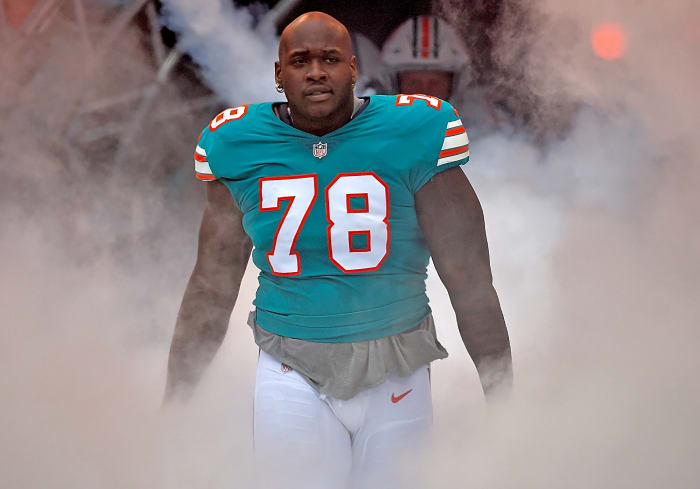
NFL roster construction runs on two scarce resources: salary cap dollars and draft picks. Cap dollars buy proven talent now. Draft picks generate cheap contributors for the future. Washington spent heavily from both accounts on the same acquisition. The analogy writes itself: buying a house and paying a massive finder’s fee on top of the mortgage. You own the property, sure. But the cash reserves that were supposed to furnish the rest of the roster just got a lot thinner, and there’s no refund on traded selections.
The Numbers

Two years on the extension. Approximately $30.1 million per season. That annual figure makes Tunsil the highest-paid offensive tackle in NFL history at the time of signing, surpassing Rashawn Slater’s $28.5 million per year with the Chargers. Meanwhile, the draft picks Washington surrendered represent potential starters who would have earned a fraction of that salary. Every cheap rookie Washington won’t draft is a position it may eventually need to fill at market rate. The financial commitment doesn’t just cost what it costs. It costs what it prevents.
The Ripple

When one contract absorbs this much cap space, the squeeze shows up everywhere else. Veteran depth signings get cheaper or disappear. Mid-tier free agents lose leverage when a franchise’s flexibility tightens. Future extensions for homegrown players compete against Tunsil’s cap hit for the same dollars. And because the draft picks are already gone, Washington can’t restock with low-cost rookies the way most teams offset big veteran deals. The ripple runs in both directions: less money available and fewer draft shots to compensate.
New Rule

This deal may quietly set a precedent. If Washington’s gamble works, other teams will feel emboldened to stack trade compensation and top-of-market extensions for premium positions. Left tackle becomes the template: pay the picks, pay the player, worry about depth later. That normalization is the bigger story. One franchise’s bold move becomes the league’s new playbook for acquiring elite veterans. The risk stops being Tunsil-specific and becomes structural, baked into how the NFL does business at premium positions going forward.
The Clock

Tunsil is now under contract through the 2028 season. That’s the window before this contract either validates the strategy or buries it. If Tunsil’s performance dips or an injury sidelines him, Washington absorbs dead money and cap constraints with no draft pipeline to absorb the blow. The escalation path is brutal: lagging results create pressure to spend even more to patch the holes the original deal created. Washington bet that elite left tackle play would stabilize the franchise. The franchise now needs that stability just to survive.
The Real Scoreboard

Most fans will judge this deal by sacks allowed and wins. The smarter scoreboard tracks two columns: cap dollars remaining and draft picks in the pipeline. Washington spent heavily on one player. The countermove, if things go sideways, is a draft-and-develop rebuild of the cheap-talent pipeline they just depleted. That’s the framework nobody’s discussing yet. Tunsil doesn’t have to be bad for this to backfire. He just has to not be worth both prices at once.
Sources:
NFL.com, “Commanders signing LT Laremy Tunsil to two-year, $60.2 million extension,” March 9, 2026
ESPN, “Commanders re-sign Tunsil to new deal, avoiding potential showdown,” March 8, 2026
NFL.com, “Texans trading LT Laremy Tunsil to Commanders for draft picks,” March 10, 2025
CBS Sports, “Commanders make Laremy Tunsil NFL’s first $30 million offensive lineman,” March 8, 2026
ESPN, “Sources: Commanders trade for Texans OT Laremy Tunsil,” March 9, 2025
NFL.com, “Chargers signing LT Rashawn Slater to record four-year, $114 million contract extension,” July 27, 2025
More must-reads:
- Five teams that should consider NFL Draft trades
- Insider shares notable update on Shedeur Sanders' status with Browns
- The 'Rushing-TD leaders by NFL team' quiz
Breaking News
Trending News







Customize Your Newsletter
 +
+




Get the latest news and rumors, customized to your favorite sports and teams. Emailed daily. Always free!
PRIVACY POLICY COOKIE POLICY CONTACT US
ABOUT YARDBARKER TERMS OF SERVICE


By using this site, you agree to our Terms of Service and Privacy Policy.
This site is for entertainment purposes only.
There is no gambling offered on this site.
Gambling Problem? Call 1-800-Gambler.
