
-

-


Follow Us
-

 On Facebook
 On Flipboard
 On Twitter
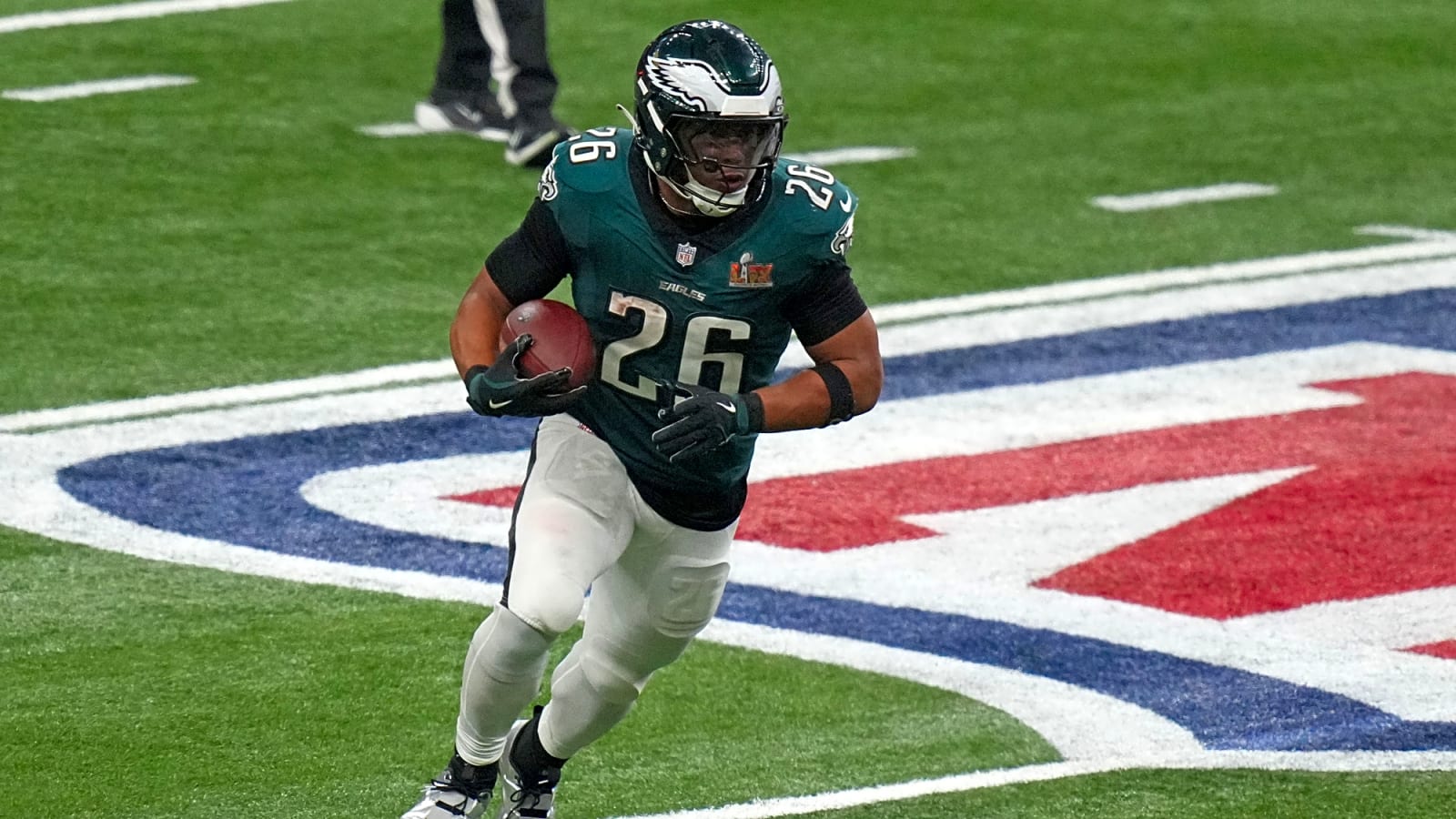
Constructing the Optimal Fantasy Football Draft With a Late Draft Spot
Picking first in a fantasy football draft has a clear draw — you get the very first choice, and in seasons where there’s a truly dominant player, that alone can put you on the path to a championship.
The catch is that this only pays off if there’s a single player who clearly outshines the rest, and you’re able to spot them before the season begins. It also means you’re heavily invested in that one player, since your next selection won’t come until the end of the second round.
That’s why, in most seasons, I prefer drafting near the end of the first round. While you give up the chance to land the universal top pick — this year, that’s Ja’Marr Chase — you gain the advantage of securing two of the top 15 or so players, which can be even more valuable.
In this article, we’ll break down the best approach for managers drafting late in season-long fantasy football: how to set yourself up early and how to adjust your late-round plans based on the way your draft begins.
Don’t forget to sign up for your fantasy football league on Yahoo Sports!
Use promo code YARD20 for $20 off your FantasyLabs fantasy football subscription!

For the purposes of this article, I'm referring to picks 10-12 in a 12-team draft, or the last two picks in a 10-team league.
Rounds 1 and 2
I’m grouping the first and second rounds together here, since depending on your draft position, you’ll be making these picks either back-to-back or in quick succession.
This stage is also where knowing your league’s scoring rules — and the default rankings provided by your hosting platform — becomes crucial. I’ll outline my preferred opening strategies separately for PPR and non-PPR formats.
Full or Half PPR: One RB and One WR
Although it can be appealing to stack up on wide receivers early in full-PPR formats, this strategy often leaves you in a difficult spot. By the end of the third round, the pool of quality running backs thins out significantly. In fact, our full-PPR projections list only a single running back between picks 19 and 34, with the rest mostly being receivers.
That’s why, with a late first-round pick, I’m prioritizing (in this order) De’Von Achane, Christian McCaffrey, or Ashton Jeanty. If all three are still available when you’re up, you could try to wait until the start of the second round, but that approach is risky.
According to our season-long projections, Achane leads this group, but since his ADP is a bit lower, there’s a good chance you can secure him as your RB1.
After that, there’s a cluster of wide receivers separated by just 15 points in our projections, so you’re fine simply choosing the best one left. Brian Thomas, Drake London, and AJ Brown are all solid options who should be on the board in the early second round.
Their ADPs are noticeably lower than Amon-Ra St. Brown and Malik Nabers, but our projections put them in about the same range, making it reasonable to wait until your second pick for a receiver. Still, keep track of how the draft unfolds; if others are grabbing WRs early, it might be smart to take one first, or the same logic applies to running backs.
The one exception is if you have the last pick and make both selections back-to-back—in that scenario, the order doesn’t matter.
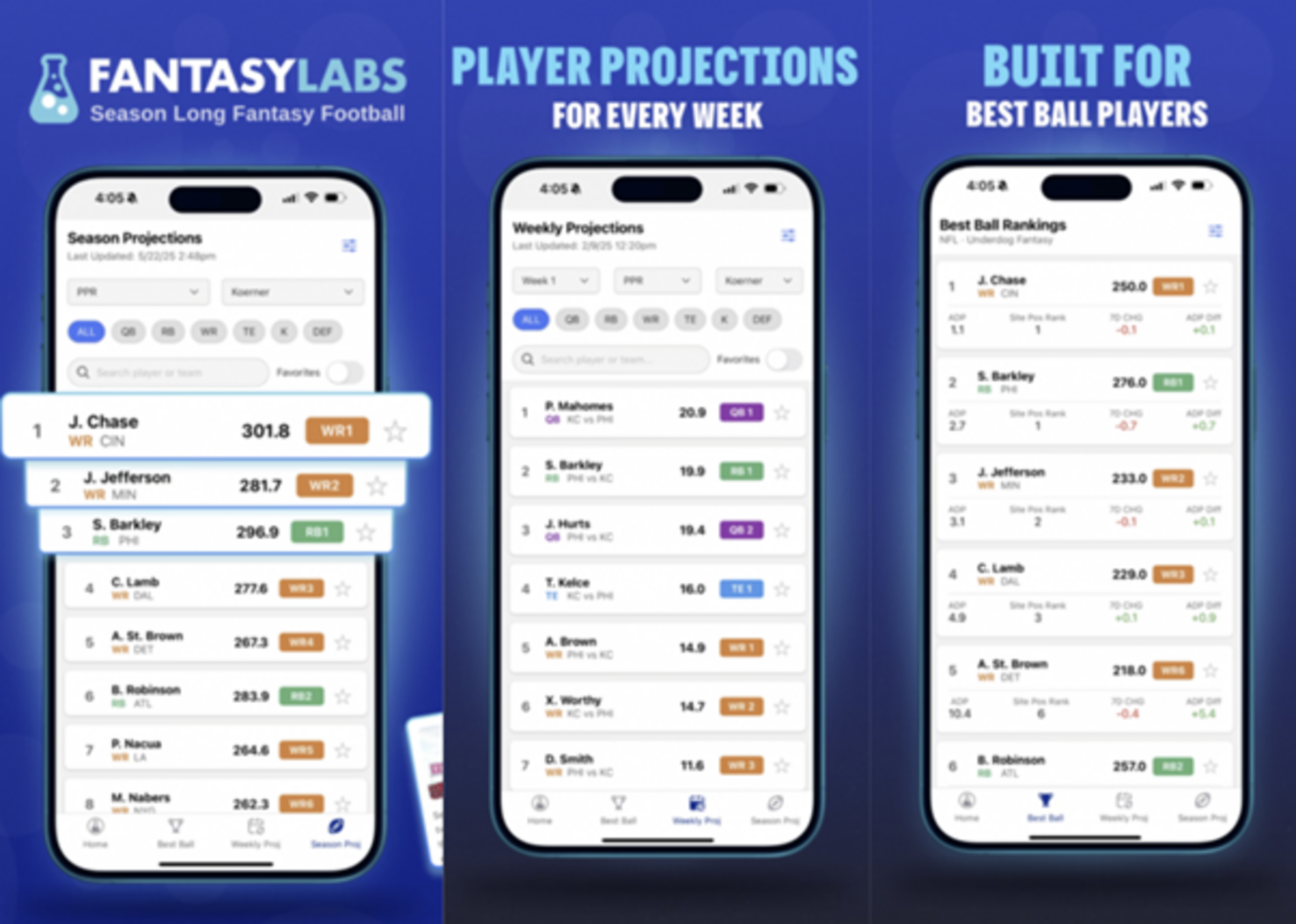
Dominate your Best Ball and season-long fantasy football leagues with FantasyLabs’ brand-new app that's available in the Apple App Store and on Android!
Non-PPR: Two Running Backs
In traditional non-PPR leagues, the best opening strategy is usually to take two running backs—unless there’s an unusually large early run on another position. According to our non-PPR projections, 16 of the top 20 players are running backs.
In addition to the names already mentioned, other solid targets here include players like Jonathan Taylor and Josh Jacobs, who may not offer much in the passing game. That’s far less of an issue when receptions don’t earn points.
An advantage of this approach is that we have a cluster of wide receivers ranked in the 30s, meaning you’ll likely be able to grab at least one—possibly two—with your third- and fourth-round selections. Many of these receivers are the same ones we aim for in Round 2 of PPR drafts.
The only time I’d stray from this plan is if Ja’Marr Chase or Justin Jefferson drops to you late in the first, as those are the only receivers we assign first-round value in non-PPR formats.
Rounds 3 and 4
In rounds three and four, my go-to approach is to grab a standout player at one of the “onesie” positions. Securing a true difference-maker at quarterback or tight end can have a huge impact on your season—especially if you’ve already built a solid base at wide receiver and running back.
In PPR leagues, tight ends tend to carry a bit more relative value. In non-PPR formats, more quarterbacks hold strong value around the Round 3/4 turn, making that an ideal time to target the position.
That said, there’s no issue with flipping this—taking a top QB in PPR or an elite TE in non-PPR—as both can give you a significant edge over the competition.
Onesie Position and a RB or WR
This spot in the draft can be tricky. Two tight ends hold solid value around the Round 2/3 turn, but after that there’s a gap until late in Round 5. In the best-case scenario, Brock Bowers or Trey McBride slips to you late in the third. On Yahoo, McBride’s ADP of about pick 29 makes that just barely possible.
At quarterback, our projections show a clear top tier of four: Josh Allen, Lamar Jackson, Jayden Daniels, and Jalen Hurts. Based on ADP, Hurts is the most likely to still be on the board late in Round 3, though that can vary depending on your league mates.
Chances are, one of these high-end tight ends or quarterbacks will be there around the Round 3/4 turn. The production gap between them and the next best options is much larger than the difference between running backs and receivers typically available in this range.
If you do miss out, the upside is you’ll have your choice of the second tier of RBs and WRs. Among running backs, my top targets here are Kyren Williams, Breece Hall, and James Cook. Williams and Cook are established lead backs in strong offenses, while Hall brings big-play ability and strong receiving production. At least one of them is likely to be available late in the third.
Beyond that, this is where I like to secure a second wide receiver. DJ Moore is my favorite value in this range based on his ADP—I’m optimistic about the Bears’ WR group, and Moore probably won’t last until the late fifth, so he’s a fourth-round priority.
Marvin Harrison Jr., also going in this range, is another top breakout pick. His 62 catches for 885 yards last season fell short of expectations for a top-five draft choice, but wideouts often need time to develop chemistry with their quarterbacks and master the system. He’s set up for a much stronger 2025.
Middle Rounds: Draft For Value
At this stage of the draft, having premium tools like our projections becomes especially valuable. The focus should be on drafting for pure value — taking the best players available, largely independent of position.
If you’ve already secured two running backs you trust within the first four rounds, this is the time I’d start stacking up on wide receivers. In PPR formats in particular, their upside is generally higher than running backs with a similar ADP, making them the better investment.
I’m usually holding off on addressing whichever “onesie” position I didn’t fill earlier, since the gap between mid-tier quarterbacks or tight ends and the last players drafted at those positions is relatively small. That said, there are a few mid-range tight ends with the potential to outperform expectations.
One is Sam LaPorta, who finished as the overall TE1 as a rookie but dipped in his second season due in part to nagging injuries and a reduced passing volume from the 15–2 Lions. With better health and the likelihood of Detroit throwing more, he has a realistic path to reclaiming the top spot — yet he’s currently going as TE4.
A similar argument applies to former Lion T.J. Hockenson. After missing the first half of 2024 recovering from a torn ACL with the 14–3 Vikings, improved health and a potential decline in team wins both point to more opportunities. Plus, he’s a strong touchdown regression candidate after going scoreless on 41 receptions last year.
Best Ball rankings from some of the top industry experts are also available on FantasyLabs.

Later Rounds: Draft For Ceiling
In the double-digit rounds, I usually shift my focus toward targeting high-upside running backs.
With wide receivers, talent is essential for earning volume. Even if they find themselves in a starting role, if they can’t create separation, their quarterback won’t throw to them. Running backs, on the other hand, are given touches — and even less talented players can deliver big fantasy numbers.
By this stage, you likely already have two or three running backs on your roster, ideally all starters for their real-life teams. Now the goal is to find players who are just one injury away from stepping into a starting role — preferably in a strong offense.
I prefer these “handcuff” backs to be on different teams than my starters, which gives my roster greater overall upside. For example, if you open your draft with Christian McCaffrey and later take his backup, Isaac Guerendo, then if CMC goes down, you’ve essentially spent your first- and tenth-round picks to get roughly 80% of McCaffrey’s healthy production.
But if you draft Guerendo on a team that started with De’Von Achane, a McCaffrey injury now leaves you with two high-end starters for relatively modest combined draft capital. The downside is that an Achane injury in that scenario leaves you without a safety net.
Still, we’re not drafting to finish in the middle of the pack — we’re drafting to win. That means it’s better to swing for maximum upside, especially since you can use several picks in this range to grab multiple backups.
Final Two Rounds: Team Defense and Kicker
If your league uses defenses and kickers, there’s almost always at least one team in the draft that reaches for a top option at one of those spots. Don’t be that person.
Scoring for both positions is notoriously unpredictable, and the gap between the best and worst starters is small. Our projections have only a 15-point difference between the top defense and the 12th-best, which works out to less than a point per week. The margin is even smaller for kickers—about ten points—making it even less worth an early pick.
In leagues that don’t require you to draft a full, valid starting lineup, I’d rather use those late picks to stash extra high-upside backup running backs. If none of them get a starting role by Week 1, you can simply drop one and pick up the best available defense or kicker before the season kicks off.
These positions are also perfect for streaming. Kicker production often tracks closely with their team’s projected point total, while defense scoring aligns with the point spread—the bigger the favorite, the better the outlook. By watching the Vegas lines each week, it’s usually easy to find a waiver-wire option that delivers starter-level production.
More must-reads:
- 25 fantasy football sleepers you should target at your draft
- Three running backs to avoid in fantasy football drafts
- The 'Rushing-TD leaders by NFL team' quiz
Breaking News
Trending News




Customize Your Newsletter
 +
+




Get the latest news and rumors, customized to your favorite sports and teams. Emailed daily. Always free!
PRIVACY POLICY COOKIE POLICY CONTACT US
ABOUT YARDBARKER TERMS OF SERVICE


By using this site, you agree to our Terms of Service and Privacy Policy.
This site is for entertainment purposes only.
There is no gambling offered on this site.
Gambling Problem? Call 1-800-Gambler.
