
-

-


Follow Us
-

 On Facebook
 On Flipboard

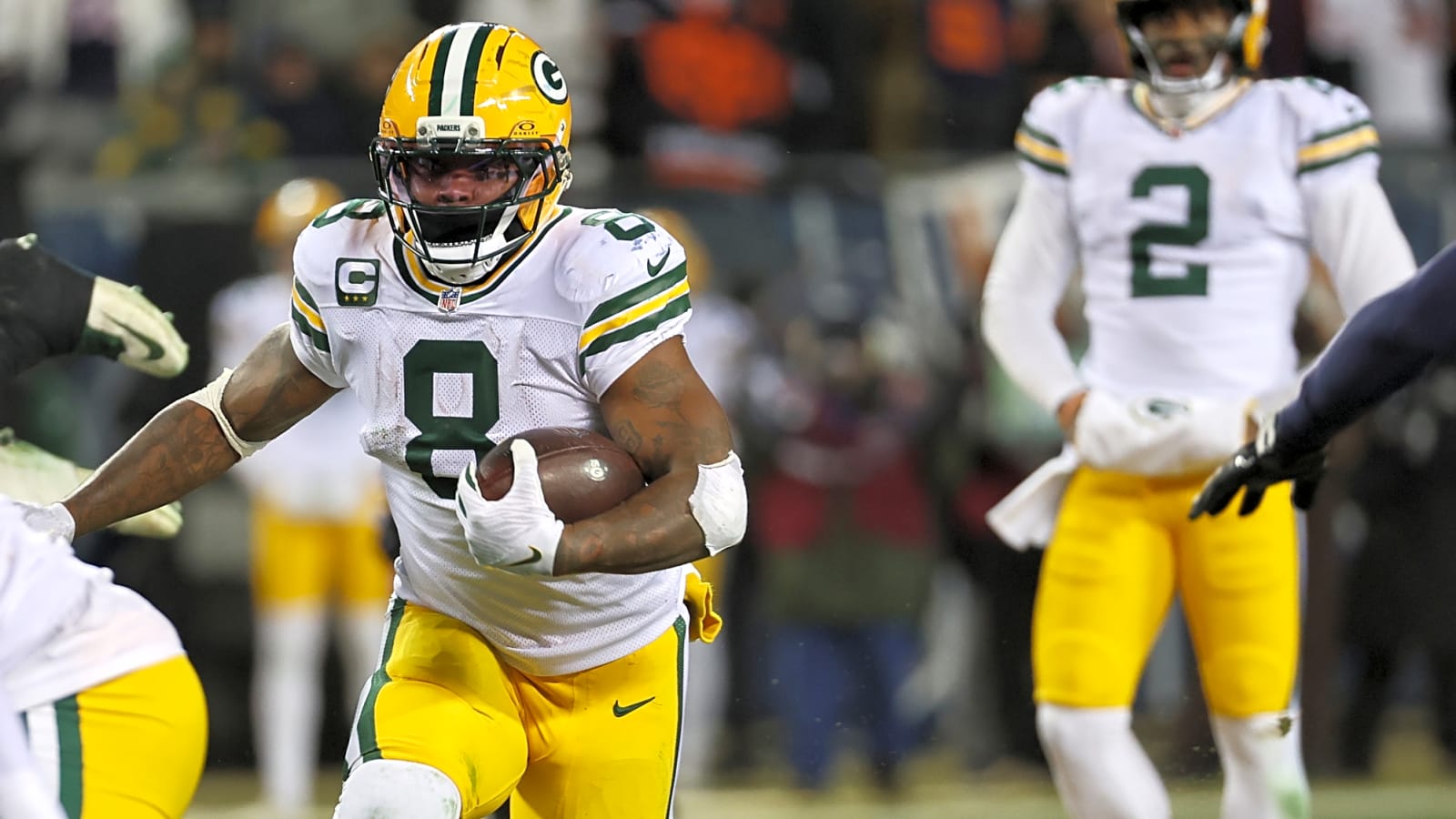
Earlier this week, Brian Gutekunst met with the media at the NFL Owners Meetings, offering insight into the Green Bay Packers’ offseason priorities. Much of the discussion focused on Micah Parsons, Tucker Kraft’s recovery, free agency, and the upcoming draft.
But one answer stood out.
When asked about the running back room—and whether the Packers needed a true No. 2 option behind Josh Jacobs—Gutekunst praised Chris Brooks and expressed optimism about a healthy Marshawn Lloyd. Still, he made one thing clear: the team intends to add competition to that room.
That comment may have said more than intended.
Josh Jacobs and then..
On paper, Green Bay isn’t lacking bodies at running back.
Brooks showed flashes in limited action last season and quietly established himself as one of the league’s more reliable pass-blocking backs—a trait that keeps him on the field. His special teams value only strengthens his case.
Lloyd, a 2024 third-round pick, remains more projection than production. Injuries have defined his early career, limiting what should be an explosive, versatile skill set. The talent is evident—but nearly two lost seasons create a developmental gap that’s difficult to ignore.
Behind them, Pierre Strong and Damien Martinez are competing for depth roles after spending much of 2025 on the practice squad.
It’s a crowded room—but not necessarily a settled one.
The Reality of the “28 Club”
When Jacobs arrived in Green Bay, he immediately reshaped the offense. His physical running style gave head coach Matt LaFleur a true centerpiece, opening up play-action concepts and stabilizing the offense.
But 2025 told a different story.
The explosive plays became less frequent. The downhill dominance showed signs of wear. And injuries began to accumulate following a 300-touch, 1,700-yard workload in 2024.
Jacobs’ toughness has never been in question—playing through a knee contusion and bone bruise late in the season—but the broader reality remains: he’ll be 29 by the end of 2026.
History isn’t kind to running backs past 28.
Follow the Money
The financial side makes this conversation unavoidable.
Jacobs carries the third-highest cap hit on the roster in 2026 ($14.5 million), followed by the fifth-highest in 2027 ($16.6 million). A move after the 2026 season would free up approximately $13.5 million, with only $3 million in dead cap.
For a team staring down a wave of extensions—Kraft, Christian Watson, Jayden Reed, Dontayvion Wicks, and Luke Musgrave—those numbers matter.
Roster construction in today’s NFL rarely favors heavy investment at running back, especially when production can be replicated with younger, cheaper talent. The Packers have already seen it firsthand—undrafted players like Emanuel Wilson have stepped in before without a significant drop-off.
The Draft—and the Writing on the Wall
For the Packers, history has shown a consistent approach—move on from a player a year too early rather than risk holding on a year too late.
That logic may soon apply to Jacobs.
While his leadership and presence would leave a void, Green Bay has consistently trusted its ability to reload rather than cling to aging production. And under LaFleur, the system has always prioritized a featured back—whether it was Derrick Henry in Tennessee, Aaron Jones in Green Bay, or now Jacobs.
If 2026 does mark the final chapter for Jacobs in green and gold, don’t be surprised if the Packers begin preparing for that transition sooner rather than later—potentially targeting a running back early in the draft.
Because in Green Bay, succession planning isn’t optional.
It’s inevitable.
More must-reads:
- Cowboys HC Brian Schottenheimer assigns blame for close loss to Ravens after Jerry Jones comments
- Jerry Jones gives update on possible trade, addresses Cowboys' loss to Ravens
- The '100-receiving-yard playoff debuts' quiz
Breaking News
Trending News




Customize Your Newsletter
 +
+




Get the latest news and rumors, customized to your favorite sports and teams. Emailed daily. Always free!
PRIVACY POLICY COOKIE POLICY CONTACT US
ABOUT YARDBARKER TERMS OF SERVICE


By using this site, you agree to our Terms of Service and Privacy Policy.
This site is for entertainment purposes only.
There is no gambling offered on this site.
Gambling Problem? Call 1-800-Gambler.
