
-

-


Follow Us
-

 On Facebook
 On Flipboard
 On Twitter

Seven games. That was the entire Dallas chapter. Logan Wilson, a 29-year-old linebacker acquired by the Dallas Cowboys at the 2025 NFL trade deadline, announced his retirement this offseason, closing the book on a six-year career that ended in Dallas. His Instagram farewell, colored orange and black, suggested part of him stayed in Cincinnati. There was no farewell tour or gradual decline. Wilson spent half a season with one of football’s most visible franchises, followed by a February waiver that brought silence. The ending stings for its finality. This move was not a roster cut dressed up in polite language. The player chose to be done.
A Sudden Final Chapter
Dallas acquired Wilson at the November 4 trade deadline, sending a 2026 seventh-round pick to the Bengals hoping he would stabilize a linebacker unit that was one of the worst in the league. The Cowboys got seven games, one start, and 28 tackles before releasing him in February to clear $6.5 million in cap space. This is the cruel arithmetic of the NFL’s middle class. Pulling on the Cowboys’ star can feel like arrival, but the opportunity can vanish just as quickly for veterans. Veterans without guaranteed money or a defined starting role face razor-thin margins.
No Guarantees in Dallas
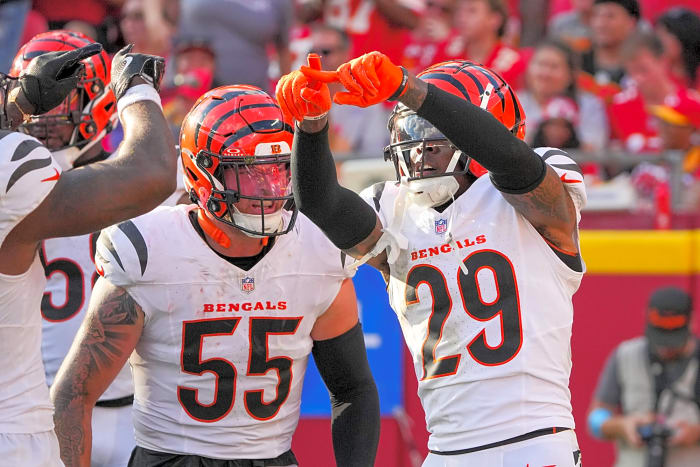
Fans often treat a Cowboys trade acquisition as a second chance: the star on the helmet, national TV windows, the brand. Wilson arrived in Dallas as a six-year veteran with four consecutive 100-tackle seasons in Cincinnati, a Super Bowl run, and a captaincy. None of that secured him a starting job, and Kenneth Murray Jr. remained the starter. Stephon Gilmore arrived in Dallas in 2023 with two All-Pro selections and a Defensive Player of the Year award. He played 17 games, made no Pro Bowl, and was gone after one season. The star on the helmet does not flatten the depth chart. The league’s replaceability machine ignores résumés. Mid-tier veterans face the same churn in Dallas or elsewhere. The belief in a guaranteed fresh start faded with this case.
A Career Compressed to Months

The sequence of events is clear. Wilson was benched in Cincinnati in favor of rookie Barrett Carter, requested a trade, landed in Dallas for a seventh-round pick, and played half a season without cracking the starting lineup. In one game, he did not take a single snap, which the Cowboys later attributed to a coaching error. Short-tenure exits like this often reflect a mix of health pressures, a shrinking role, and a market that simply moved on. The Cowboys sought a turnaround and instead cycled through another roster spot in a single year.
Conveyor Belt Roster

The NFL’s next-man-up pipeline replaces players and pressures some off rosters entirely. Picture a conveyor belt: younger, cheaper options keep loading on one end, veterans without strong contracts get pushed off the other. That is what happened in Cincinnati, where rookie linebackers Barrett Carter and Demetrius Knight Jr. were handed Wilson’s snaps despite struggling badly early in the season. Both finished 2025 near the bottom of all graded linebackers per PFF: Knight at 40.2 (82nd of 88) and Carter at 39.5 (85th of 88). The system does not need immediate results. It needs cheap, young talent to develop. This mechanism manufactures replaceability. Veterans absorb the cost.
Track Record, Short Return

In Dallas, Wilson had seven games, one start, twenty-four tackles, one forced fumble, and one pass breakup. These numbers are small for a player who arrived with 565 career tackles and 11 interceptions over five-plus seasons in Cincinnati. Kenneth Murray Jr., the man who kept Wilson off the field, started all 17 games but graded out at 38.8 per PFF, ranking 86th out of 88 graded linebackers. Wilson was not losing a starting job to a dominant player. He lost it to a cheaper incumbent the team had already committed to. The gap between résumé and production cut deeply. Dallas carries one fewer proven option at a position already stretched thin, with only DeMarvion Overshown, Shemar James, and Justin Barron currently on the roster.
Aftermath for the Cowboys

The Cowboys released Wilson on February 20, and the retirement came weeks later. The cap math, $6.5 million cleared, was already settled before he made any announcement. Retirement changes the market, not the balance sheet. A released player can be re-signed, claimed, or considered for a return. A retired player is off the board completely. That closes a door Dallas had quietly left open. The retirement forces a chain of offseason moves to patch a depth chart that was already one of Dallas’s most pressing concerns heading into 2026. Bubble linebackers who thought they were fighting for one job are now fighting for two.
The Veteran Pattern

This is not an outlier, but a pattern. Lavonte David played 14 seasons of elite linebacker in Tampa Bay and entered the 2026 offseason at 36 without a contract, his future suddenly an open question. Kwon Alexander bounced through multiple franchises in his final seasons before going unsigned at 30, essentially the same age as Wilson. The arc differs in detail but not in structure. Production declines relative to cost, a younger option gets the snaps, and the market closes faster than the player expects. Wilson’s version of that arc fits this mold. For every mid-tier veteran acquisition this offseason, staying on the roster is as uncertain as producing on the field.
Thin Linebacker Room

If injuries or additional departures occur during training camp, the Cowboys’ linebacker room could shift from thin to emergency. Dallas currently has just three inside linebackers on the roster and has yet to add one in free agency. More churn means more scrambling, more practice squad auditions, and more draft picks asked to grow up overnight. Wilson’s retirement post did not mention Dallas, only Wyoming, the 2020 draft, and orange and black. Players competing for open spots now see how disposable the most recent occupant turned out to be, and this kind of institutional memory can poison a position group’s confidence. Dallas needs more than just bodies; the team needs someone determined to stick.
The Business Over the Player

Dallas will sign or draft a replacement. The system always refills the slot. The choice is between a veteran stopgap, which keeps the room functional but resets the clock in twelve months, or a draft pick in the middle rounds, which saves on cap space but asks a rookie to anchor the position immediately. The Cowboys’ answer in the coming weeks will reveal how they view this position. Wilson’s retirement post said football gave him more than he ever imagined, but it did not mention Dallas. Sometimes what a player chooses to remember says more than anything left behind.
Sources:
ESPN — Ex-Bengals, Cowboys LB Logan Wilson Retires at 29 — March 18, 2026
NFL.com — Former Bengals, Cowboys LB Logan Wilson Retires After Six Seasons — March 18, 2026
NBC Sports / Pro Football Talk — Logan Wilson Retires from the NFL — March 18, 2026
Heavy.com — Former Cowboys LB Logan Wilson Retires at 29 Years Old — March 18, 2026
KNBR / The Sports Leader — Bengals Postseason Hero Logan Wilson Retires at Age 29 — March 18, 2026
More must-reads:
- Five NFL Draft prospects who improved their stock with strong pro days
- Cowboys have a dangerous plan for George Pickens' contract
- The 'Rushing-TD leaders by NFL team' quiz
Breaking News
Trending News





Customize Your Newsletter
 +
+




Get the latest news and rumors, customized to your favorite sports and teams. Emailed daily. Always free!
PRIVACY POLICY COOKIE POLICY CONTACT US
ABOUT YARDBARKER TERMS OF SERVICE


By using this site, you agree to our Terms of Service and Privacy Policy.
This site is for entertainment purposes only.
There is no gambling offered on this site.
Gambling Problem? Call 1-800-Gambler.
