
-

-


Follow Us
-

 On Facebook
 On Flipboard

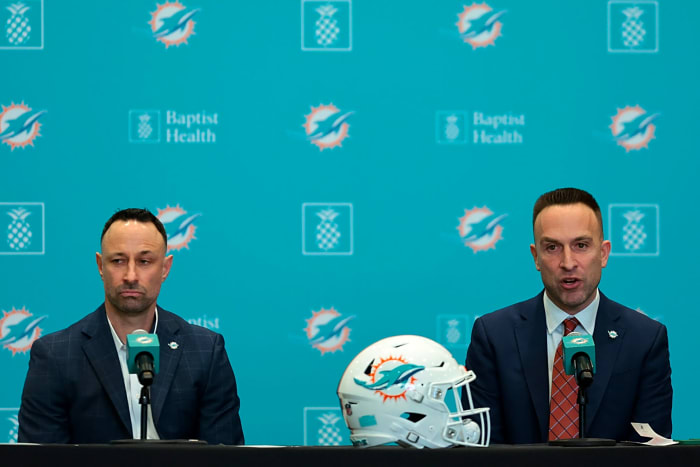
Somewhere inside the Dolphins’ front office, a new general manager sat with a plan he believed would change the franchise. Jon-Eric Sullivan had gutted the roster, absorbed the largest dead cap charge in NFL history, shipped out the starting quarterback, and loaded up on 13 draft picks. The rebuild was supposed to start here. Then ESPN’s panel of more than 80 writers, editors, and TV personalities published their post-draft power rankings. Miami landed at the bottom. Dead last. Thirty-second of 32 teams, three spots lower than two months earlier.
The Price of Starting Over
Sullivan inherited a mess. The 2025 Dolphins finished 7-10 under Mike McDaniel and Chris Grier, extending a playoff win drought to 25 seasons. A quarter century without a postseason victory. The previous regime had locked Tua Tagovailoa into a four-year extension worth roughly $212.1 million in 2024, a deal that looked bold at the time and catastrophic by the time Sullivan arrived. Releasing Tua meant swallowing $99.2 million in dead cap, spread across two years. That number set a new NFL record, eclipsing previous high-profile quarterback dead-cap charges around the league. Tua himself drew interest from Atlanta after his release, underscoring that the problem was the contract, not the player.
A $167 Million Quarterback Problem
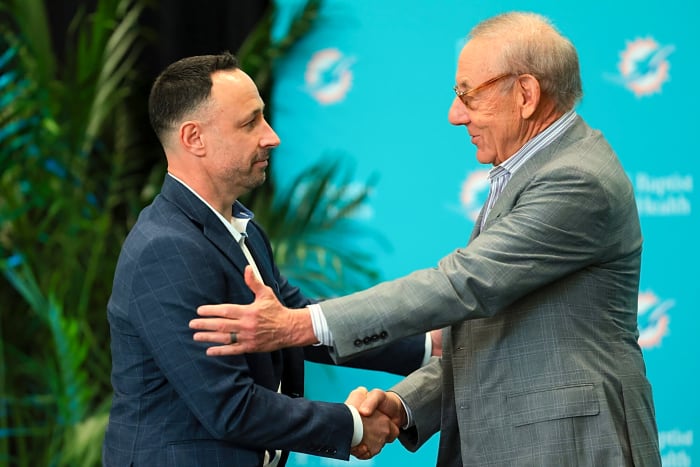
The common assumption was straightforward. Absorb the dead money, draft aggressively, hire a new coach, and the rebuild starts climbing. Sullivan did all of it. He brought in Jeff Hafley, fresh off a stint as Green Bay’s defensive coordinator and a prior head coaching run at Boston College, signed Malik Willis to a three-year, $67.5 million deal with $45 million guaranteed, and traded Jaylen Waddle to Denver in a package that sent Waddle and pick 111 north in exchange for picks 30, 94, and 130. Add the $99.2 million dead cap to Willis’s $67.5 million contract, and roughly $167 million went toward quarterback volatility alone. That assumption about fresh starts was about to shatter.
Pride Before the Rankings
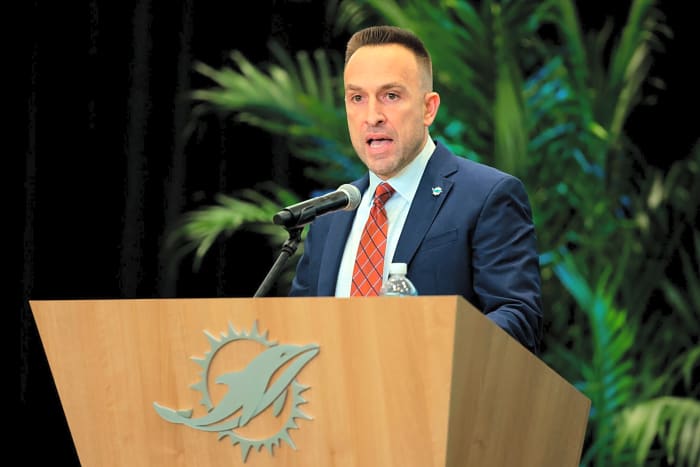
Sullivan told reporters he was proud of his draft execution. Thirteen picks. Kadyn Proctor, an offensive tackle from Alabama, at 12th overall. A trade up for cornerback Chris Johnson at 27th. Jacob Rodriguez at 43rd. Caleb Douglas at 75th. Tied for the most selections by the franchise since 1994. Then 80-plus ESPN experts weighed in. Every one of them looked at the spending, the picks, the new regime. Thirty-second. “All alone in the Mariana Trench, in the abyss.” Sullivan spent $167 million and 13 picks to get worse.
The Trap Nobody Talks About
Dead cap money doesn’t just disappear. It sits on the books, eating cap space that could pay productive players. Miami carries roughly $67.4 million of that dead hit in 2026 and another $31.8 million the following year. That means Sullivan built a roster with one hand tied behind his back, then signed Willis to a deal that ties the other. Short-term free agent contracts became the only option for flexibility. The rebuild toolkit assumes you have cap room to work with. Miami had a crater where cap room should be.
A Receiver Room In Ruins

The Waddle trade did not happen in a vacuum. Tyreek Hill, the other half of Miami’s former speed tandem, has been sidelined and surrounded by trade speculation since a season-ending knee injury, leaving the new regime with neither of the receivers who once defined the offense. Losing one top-end wideout is a setback. Losing availability and certainty on both in the same offseason is why analysts pushed Miami down the board even before the draft began.
The Numbers That Bury the Optimism

Two months before the draft, ESPN’s way-too-early rankings placed Miami 29th. Bad, but not catastrophic. Then the offseason happened. Every move Sullivan made, every dollar spent, every pick deployed, pushed the consensus in the wrong direction. Three spots down in roughly eight weeks. Willis, a former third round pick in 2022, spent most of his career as a backup and has made only a handful of NFL starts, none of which locked down a full-time job. The Dolphins traded away their best available receiver. And the 2026 regular-season schedule features multiple games against Super Bowl LX participants. The math doesn’t bend toward hope.
Who Pays for This Next
The ripple effects run deeper than one bad ranking. Willis faces a preseason where every incompletion validates 80 experts. Players on short-term deals know the franchise wouldn’t commit long-term, which tells you what the front office privately believes about 2026. Ticket sales and merchandise take a hit when your own league ranks you last. Other teams watching the Dolphins now see a warning. Absorbing historic dead cap doesn’t buy you a faster rebuild. It buys you a longer sentence. The franchise lost high-end players like Xavien Howard and Robert Hunt in prior offseasons with no adequate replacements in place.
A New Rule, Not an Exception

Once you see the pattern, you can’t unsee it. The old regime’s roughly $212.1 million Tua contract required a record $99.2 million escape. The new regime’s $67.5 million Willis bet hasn’t convinced a single expert panelist. Thirteen draft picks couldn’t move the needle. Sullivan said he wanted to “move in a new direction at the quarterback position.” That phrase, quiet and corporate, masked the most expensive quarterback transition in league history. The precedent is now set. Regime change plus historic spending plus aggressive drafting can still equal dead last.
Four Months and Shrinking
The 2026 season opens in roughly four months. Miami has limited projected cap space to add free agents, a sliver of room for a team ranked last. If early losses pile up, Sullivan and Hafley face the same clock that devoured Grier and McDaniel. The 25-season playoff win drought isn’t just a stat. It’s an organizational identity. And the escalation path is brutal. A poor 2026 record triggers another coaching search, another QB hunt, another reset that pushes the drought toward 30 seasons.
The Rebuild That Rebuilt Nothing
Every NFL front office with an aging quarterback contract should study what happened in Miami. Sullivan did everything the playbook says to do. New coach. New QB. Record cap sacrifice. Most draft picks in three decades. And the consensus got worse. The Dolphins didn’t just fail to climb out of the hole. They dug it deeper. If Willis struggles behind that rebuilt offensive line, Miami faces another quarterback reckoning with even less ammunition. Eighty experts looked at this roster and saw the abyss. The Dolphins have four months to prove all of them wrong. The question Miami fans now face is simple. Was escaping Tua worth $99.2 million if the roster still ranks last?
Sound off below. Would you have cut Tua, signed Willis, and traded Waddle, or is this the worst offseason in franchise history?
Sources:
Associated Press, “Dolphins take on big dead cap charge with $99.2M for Tua Tagovailoa,” March 9, 2026
ESPN, “2026 NFL Power Rankings: Offseason post-draft poll,” May 4, 2026
NFL.com, “QB Malik Willis, Dolphins agree to three-year, $67.5M contract,” March 8, 2026
Denver Broncos Official, “Broncos acquire WR Jaylen Waddle in trade with Dolphins,” March 17, 2026
Miami Dolphins Official, “Miami Adds Seven Players in the Final Day of the 2026 NFL Draft,” April 25, 2026
Miami Herald, “Dolphins GM explains why franchise took historic dead cap hit,” March 29, 2026
More must-reads:
- Dianna Russini may still have an ace up her sleeve in Mike Vrabel saga
- Broncos get positive injury update on QB Bo Nix
- The 'Multiple 4K-yard NFL seasons' quiz
Breaking News
Trending News






Customize Your Newsletter
 +
+




Get the latest news and rumors, customized to your favorite sports and teams. Emailed daily. Always free!
PRIVACY POLICY COOKIE POLICY CONTACT US
ABOUT YARDBARKER TERMS OF SERVICE


By using this site, you agree to our Terms of Service and Privacy Policy.
This site is for entertainment purposes only.
There is no gambling offered on this site.
Gambling Problem? Call 1-800-Gambler.
