
-

-


Follow Us
-

 On Facebook
 On Flipboard

Kevin Patullo got fired. That part everyone knows. What ESPN’s Tim McManus and Jeremy Fowler revealed is that Jalen Hurts suggested running four verticals on that season-ending fourth down. Hurts pushed the play. The play failed. Patullo absorbed the organizational blame and lost his job. Hurts remained the franchise quarterback with $51.5 million in guaranteed money still on the books for 2026. A coordinator’s career ended over a play the quarterback wanted. The pressure behind that silence had been building for longer than anyone realized.
The Offense That Refused to Move
Common assumption: franchise quarterbacks shape the offense, and the offense thrives. The Eagles proved the opposite. Kellen Moore’s Saints ran 373 motion plays in 2025, ranking sixth in the NFL. The Eagles, under the same concepts Moore tried to install before leaving, ran 237. That ranked 26th. Multiple team sources told ESPN that Hurts’ strong preferences contributed to the offense becoming “calcified.” A source close to Hurts admitted he had “too many yes people around him.” The system wasn’t broken. It was blocked.
Dead Last Against Zone

Here is where the myth collapses. Hurts holds one of the highest winning percentages among starting quarterbacks since the 1970 merger. He threw 43 touchdowns with just 5 turnovers during a dominant 17-game stretch. Against man coverage, he ranks ninth with a 51.1% success rate. Against zone coverage: 36.9%. Ranked 36th. Dead last. Defenses exposed it on 56.2% of plays in 2025. The tools to fix zone coverage exist: motion, under-center timing, play-action. Hurts resisted every single one. A Super Bowl MVP strangling his own elite roster with stubbornness.
The System Built to Override Him

Sean Mannion replaced Patullo as offensive coordinator. His assignment: implement a McVay/Shanahan scheme built on under-center play-action and pre-snap motion. The exact concepts Hurts fought against. This hire wasn’t about innovation. It was organizational architecture designed to remove quarterback discretion from the play-calling chain. Team sources told ESPN Hurts shows “poor body language, not always bought in, not the most coachable and the players notice.” The Eagles didn’t hire a new coordinator to serve Hurts. They hired one to constrain him.
A.J. Brown’s Vanishing Season
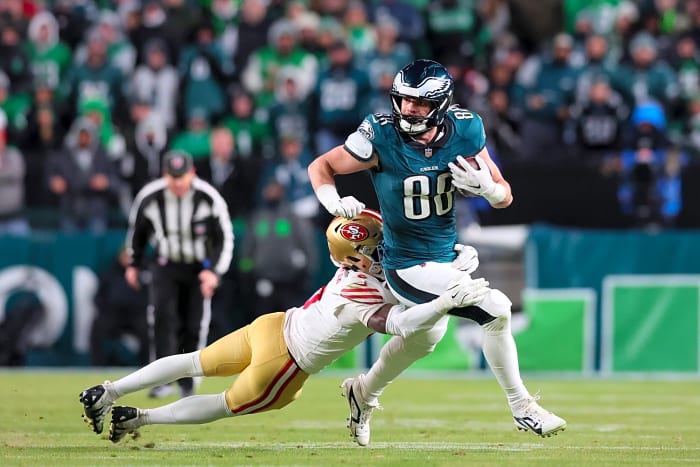
The collateral damage has a name. A.J. Brown averaged 66.9 receiving yards per game this season, among the lowest marks of his career. That number traces directly to Hurts’ zone-coverage collapse. When defenses sit in zone and the quarterback can’t beat it, the receivers starve. Brown’s frustration has accelerated trade rumors, with Howie Roseman reportedly seeking a first and second-round pick. One quarterback’s inflexibility is now threatening to dismantle the most talented receiving corps in the NFC. The star duo that won a Super Bowl is fracturing from the inside.
Four Teams Already Circling

The Dolphins released Tua Tagovailoa, eating a $99.2 million dead cap charge, the largest in NFL history. That cleared a quarterback-sized hole in Miami’s roster. Pittsburgh holds 12 projected draft picks. The Jets own two first-rounders in 2026 and three in 2027. Cleveland restructured Deshaun Watson’s contract, freeing close to $36 million in cap space. Four franchises, four different financial architectures, all pointing at the same quarterback. An Eagles source told the Philadelphia Inquirer: “He knows this is the last year of his guaranteed money.”
The New Rule for Franchise Quarterbacks

The Eagles didn’t fire their coordinator for his system. They fired him because the quarterback wouldn’t execute the system. Once you see that, the entire Mannion hire reframes. Coordinators are now expendable when quarterbacks resist their schemes. The organizational loyalty flows to system integrity, not personality. Future franchise quarterbacks across the league will face the same accountability structure: adapt or watch the front office build an architecture that removes your authority entirely. Jeffrey Lurie told reporters, “We never would discuss [negotiations].” That silence speaks louder than any extension offer.
The Prove-It Clock Is Running

Training camp becomes the conflict zone. Mannion’s system demands motion and under-center play-action on nearly every snap. Hurts has historically fought both. If preseason reveals resistance rather than adaptation, trade speculation detonates by Week 1. An Eagles source put it plainly: “He knows the cat’s out on some of his baggage. You got to be able to produce.” The escalation path runs from camp standoff to midseason trade deadline. The counter-move is simple: Hurts adapts fully, silences everyone, and proves coachability exists inside the talent.
The Secret Everyone Now Knows

Most fans saw a coordinator get fired and moved on. Now they know the quarterback suggested the play, watched it fail, and let someone else pay for it. That changes every conversation about Hurts going forward. The casual fan sees trade rumors. The informed fan sees an inverted accountability structure where a $255 million quarterback operated with unchecked discretion until the organization built a system specifically to take it away. Four teams are watching whether he surrenders control or forces Philadelphia’s hand. The next snap Hurts takes under center tells the whole story.
Sources:
Tim McManus and Jeremy Fowler, “Inside Eagles’ 2025 Friction as Jalen Hurts Stands at Crossroads,” ESPN, March 31, 2026.
Jeff McLane, “Eagles’ Jalen Hurts Enters Final Guaranteed Year,” Philadelphia Inquirer, 2026.
Dianna Russini, “Eagles Hire Sean Mannion as Offensive Coordinator,” The Athletic, Jan. 29, 2026.
Adam Schefter, “Source: Eagles, QB Jalen Hurts Agree to $255M Deal,” ESPN, April 16, 2023.
Austen Bundy, “Eagles’ Offense Under Scrutiny Amid Hurts Concerns,” FanSided, 2026.
Brad Spielberger, “Dolphins Release Tua Tagovailoa, Absorb Record Dead Cap,” SI.com, 2026.
More must-reads:
- Fernando Mendoza makes an emotional decision about NFL Draft
- Texans exercise options on QB C.J. Stroud, DE Will Anderson
- The 'Rushing-TD leaders by NFL team' quiz
Breaking News
Trending News



Customize Your Newsletter
 +
+



Get the latest news and rumors, customized to your favorite sports and teams. Emailed daily. Always free!
PRIVACY POLICY COOKIE POLICY CONTACT US
ABOUT YARDBARKER TERMS OF SERVICE


By using this site, you agree to our Terms of Service and Privacy Policy.
This site is for entertainment purposes only.
There is no gambling offered on this site.
Gambling Problem? Call 1-800-Gambler.
