
-

-


Follow Us
-

 On Facebook
 On Flipboard
 On Twitter
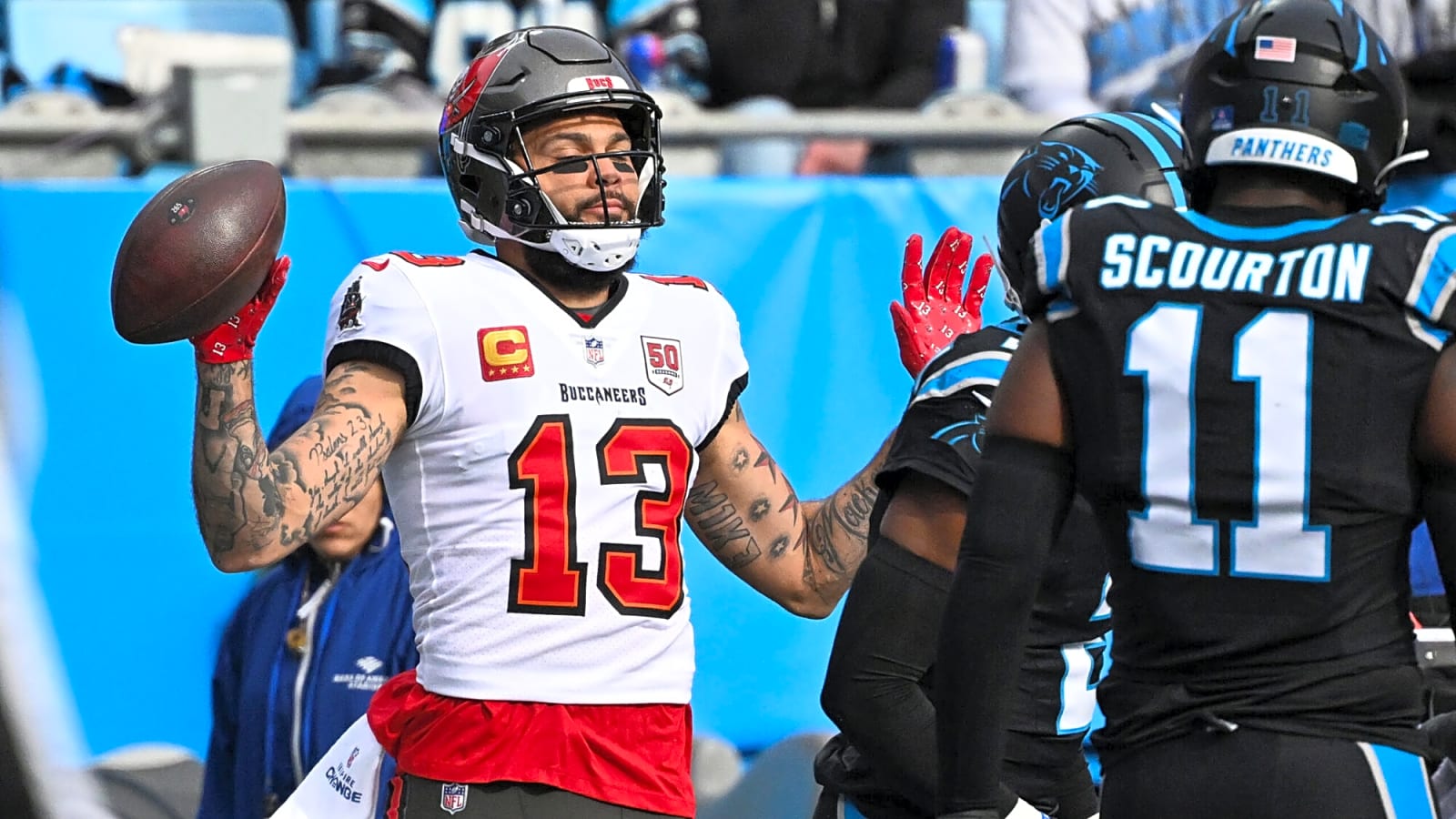
The Buccaneers put more cash on the table than the San Francisco 49ers. More guaranteed money, better annual value… the full pitch to keep their franchise receiver home. Mike Evans looked at it, thought about it, and picked up the phone to call San Francisco anyway. When a man with 866 career catches, 13,052 receiving yards, and 109 touchdowns, the most accomplished offensive player in Buccaneers history, voluntarily walks away from more money, he’s not chasing opportunity. He’s escaping something.
Twelve Years. One City. Then Gone
Think about what twelve seasons with one team actually means. Evans arrived in Tampa Bay out of Texas A&M, seventh pick in the 2014 draft, a franchise building block from day one. He caught passes from Josh McCown, Jameis Winston, and Tom Brady. He played through losing seasons when the stadium was half-empty and through a Super Bowl run when Raymond James rocked like it hadn’t since the Dungy era. He tied Jerry Rice with 11 consecutive 1,000-yard seasons to open his career, a streak that finally ended in 2025 when injuries limited him to eight games. He won a Super Bowl ring on February 7, 2021. Then, on March 9, 2026, he cleaned out his locker and drove to the airport.
The NFLPA Handed Tampa Bay Failing Grades

Evans’ agent didn’t sugarcoat it: the decision wasn’t about money. The NFLPA’s 2026 player satisfaction survey answered that question in black and white. Out of 32 NFL franchises, the Buccaneers ranked 29th. The grades were a public humiliation, poor marks across the board, including an F in travel, D-minus in locker room, D-plus in dining, D in treatment of families, and D in ownership. These aren’t abstract letter grades; these are NFL players, some of the best-conditioned and highest-paid athletes on earth, anonymously reporting that their workplace is broken. Players described plumbing issues. Locker-room odors. A facility that felt neglected. In what business does a worker choose a pay cut to escape conditions like that?
The Glazers Get a D. That’s Not a Typo.

The ownership category deserves its own paragraph because ownership is where the fish rots from the head. The Glazer family, billionaires who’ve owned this franchise since 1995, received a D grade from their own players on ownership performance, among the lowest marks in the league. Not the Jacksonville Jaguars. Not the Washington Commanders, historically the league’s most dysfunctional franchise. Tampa Bay. The team that won a Super Bowl five years ago. The NFL won a legal grievance preventing the NFLPA from publicly releasing the results, but ESPN obtained and published them anyway, because when players are that unhappy, the truth has a way of getting out. You can renovate a locker room. You can’t renovate an ownership culture without the owners deciding to change.
A Season That Died in December

The 2025 Buccaneers were 6-2 at Halloween. Playoff positioning was being mapped out. Baker Mayfield was playing the best football of his career. Then the wheels came off, slowly, systematically, and completely. They went 2-7 in their final nine regular-season games, finished 8-9, and on the last Sunday of the season, they needed the New Orleans Saints to beat the Atlanta Falcons just to avoid a tiebreaker that would cost them the division. The Saints lost. The Falcons won. All three teams finished 8-9, and when the tiebreaker math was run, the Carolina Panthers’ divisional record punched their ticket to the playoffs instead. Four consecutive division titles, the most dominant run in NFC South history, ended not with a playoff loss in January, but with a final box score from a game Tampa Bay didn’t even play in.
Bowles Swings the Axe — Mostly at His Own Coaches
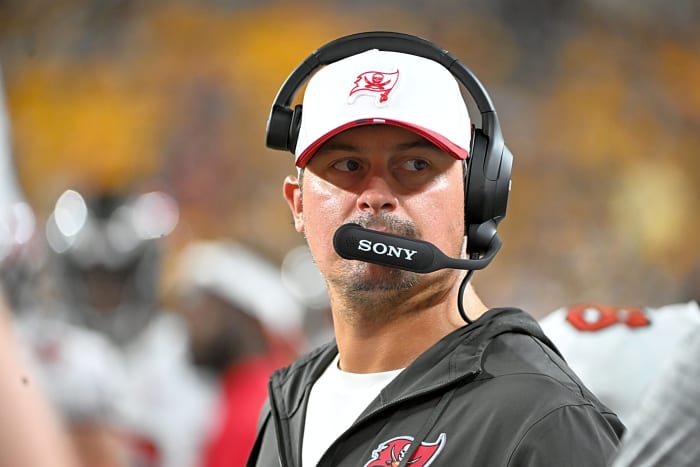
Todd Bowles kept his job. He’s the captain who stayed on the ship. But in early January, he fired five assistant coaches: offensive coordinator Josh Grizzard, special teams coordinator Thomas McGaughey, quarterbacks coach Thaddeus Lewis, cornerbacks coach Kevin Ross, and defensive line coach Charlie Strong. Two more walked out voluntarily, bringing the total to seven departures across three phases of the game. A team that ranked 29th in player satisfaction just handed their players a new offense to learn, a new defensive scheme to install, and asked them to trust the process. At some point, the players start asking themselves whether the problem is the coaches or the building they all work in.
Then Lavonte David Said It Was Time

Fifteen days after Evans signed with San Francisco, Lavonte David walked into One Buccaneer Place and retired. He was 36 years old. In 14 NFL seasons, he never played a single snap in any other uniform, 215 games, all of them in pewter and red. He finished with 1,714 career tackles, tying Hall of Famer Derrick Brooks for the franchise record. He owns the franchise record for forced fumbles with 33. He racked up 42.5 sacks, 14 interceptions, 21 fumble recoveries — a linebacker who could genuinely do everything. When he walked up to announce his retirement, he didn’t talk about legacy or statistics. He said he wanted to “be a dad to that amazing little girl over there.” After 14 years of giving everything to this city, nobody had the right to ask him for one more.
Two Champions. Fifteen Days. Gone

Evans signed on March 9. David retired on March 24. Fifteen days, that’s all it took to strip Tampa Bay of 26 combined seasons of franchise history, two Super Bowl LV champions, and the two men who represented everything the Buccaneers were during their best years. And the financial hangover is real: Evans’ previous contract included void years that create a dead cap charge of approximately $13 million in 2026 — Tampa Bay pays that money this season for a receiver who is now running routes in Santa Clara. That’s not a footnote. That’s money the organization can’t spend on the players it actually needs, while simultaneously trying to replace two irreplaceable ones.
The Numbers Say Rebuild. The Roster Says Otherwise

The Buccaneers aren’t pretending this is a full teardown. Mayfield is still under center. Yaya Diaby recorded 7 sacks in 2025, a legitimate foundation to build around at 26 years old. They brought in linebacker Alex Anzalone on a two-year deal, added depth at running back with Kenneth Gainwell, and re-signed tight end Cade Otton. A new offensive coordinator is being installed. These are legitimate moves, not window dressing. But patching a roster ranked 29th in player satisfaction, absorbing approximately $13 million in dead cap, breaking in a new offensive system, and doing all of it without the franchise’s all-time leading receiver or its most decorated linebacker, that’s not a roster problem… that’s an organizational problem wearing a roster problem’s clothes.
Tampa Bay Built Something Special. Now They Have to Earn It Back

The Buccaneers aren’t a small-market afterthought. They won a Super Bowl. They built a dynasty. They put together four consecutive NFC South titles, the best sustained run in the division’s history. They know what winning looks like. Which makes the NFLPA survey grades — the failures, the near-failures, the ownership scores sitting among the league’s worst — even harder to stomach. Evans didn’t leave because he stopped loving football or stopped caring about Tampa. He left because, after 12 years, he could look around and honestly ask whether this organization was going to give him a real shot at another ring. The answer he got drove him to take less money to find out somewhere else. Until the Glazers decide that a winning culture starts with how players are treated the moment they walk in the building, not just on Sundays, Evans won’t be the last good player to make that same calculation.
Sources
49ers, Mike Evans agree to deal, ending 12-year run with Buccaneers — The Athletic
Buccaneers linebacker Lavonte David is retiring after 14 seasons — Yahoo Sports
NFLPA Report Card Ranks Buccaneers 29th among NFL Teams — Yahoo Sports
Why 8-9 Panthers are in NFL playoffs over Buccaneers, Falcons — Sporting News
Buccaneers’ Todd Bowles fires multiple staffers in major shakeup — Sports Illustrated
Buccaneers fire DL coach Charlie Strong, CBs coach Kevin Ross — NBC Sports / Pro Football Talk
More must-reads:
- Update expands on bombshell report about alleged Eagles, Jalen Hurts drama
- Chiefs HC Andy Reid shuts down this Justin Fields narrative
- The 'Rushing-TD leaders by NFL team' quiz
Breaking News
Trending News



Customize Your Newsletter
 +
+




Get the latest news and rumors, customized to your favorite sports and teams. Emailed daily. Always free!
PRIVACY POLICY COOKIE POLICY CONTACT US
ABOUT YARDBARKER TERMS OF SERVICE


By using this site, you agree to our Terms of Service and Privacy Policy.
This site is for entertainment purposes only.
There is no gambling offered on this site.
Gambling Problem? Call 1-800-Gambler.
