
-

-


Follow Us
-

 On Facebook
 On Flipboard
 On Twitter
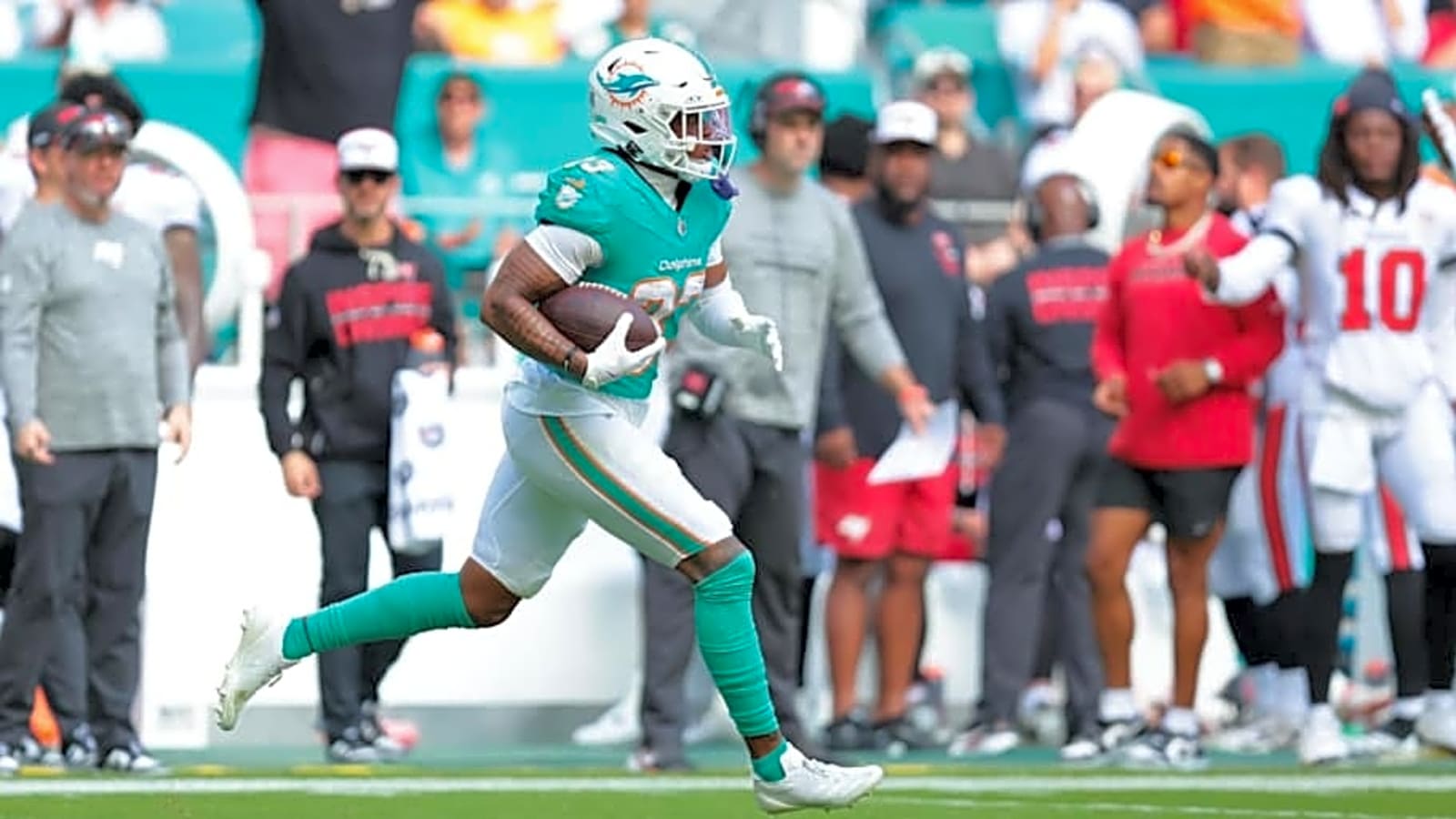
Among the most satisfying aspects of the Miami Dolphins' Week 17 victory against the Tampa Bay Buccaneers on Sunday was the heavy contribution from the team's rookie class.
It started obviously with quarterback Quinn Ewers putting together a very efficient performance in his second NFL start, undrafted free agent Theo Wease Jr. scoring his first NFL touchdown, but also included fifth-round pick Jason Marshall Jr.s' first-half interception and seventh-round pick Zeek Biggers' field goal block, among other things.
It was the kind of game that can bring some optimism moving into 2026 because those rookies won't be rookies anymore.
"I think we've been heavily reliant upon the rookie class," head coach Mike McDaniel said after the 20-17 victory against the Buccaneers at Hard Rock Stadium. "It was very calculated, the types of people that we brought in for the reasons of needing to be able to be professional football players at the NFL level. It is not always an easy task for someone coming straight out of (college). You go out of your college play, you go into training for the draft, and then you go from training for the draft right into NFL football. I think our group today exhibited one of the reasons why we felt good about the entire class right after the draft."
Making the Dolphins younger, as McDaniel said the day after the game and former GM Chris Grier said before the season started, was a conscious decision by the organization after relying on veteran imports — often expensive imports — failed to deliver the desired results.
PAYING THE PRICE
The strategy always made sense, but ultimately will be judged by how successful that rookie class of 2025 becomes in 2026, 2027 and beyond.
But the reality was going younger and using a lot of rookies also had its drawbacks.
Because, almost invariably, rookies will have some growing pains at one as NFL players.
And maybe those growing pains, while the Dolphins were making extensive use of first-round pick Kenneth Grant, second-round pick Jonah Savaiinaea and fifth-round pick Jordan Phillips, played some kind of a role in the slow start to the season.
McDaniel often brings up the idea of causation vs. correlation, but the Dolphins' history in the 2000s indicates a link between team success and the number of rookie starters.
The Dolphins had seven rookies start a total of 42 games in 2025 — Ewers, Grant, Savaiinaea, Phillips, Marshall, running back Ollie Gordon II and safety Dante Trader Jr. — marking the 12th time in the 2000s that five or more rookies started at least one game, per Pro Football Reference.
In those 12 seasons, the Dolphins made the playoffs only once. That was in the 2008 season when the team rebounded from the 1-15 disaster of 2007 to win the AFC East title in Tony Sparano's first year as head coach.
When the Dolphins made the playoffs in McDaniel's first two years as head coach, they had three rookies start at least one game in 2022 (CB Kader Kohou, QB Skylar Thompson, S Verone McKinley II) and two in 2023 (RB De'Von Achane, TE Julian Hill).
In 2016, the Dolphins had four rookies make starts when they went to the playoffs, and the number was three in both 2000 and 2001.
Again, maybe it's pure coincidence, but there sure seems to be a link.
The seven rookies with at least one start represents a higher total than any of the 12 teams that already have clinched a playoff spot, though the L.A. Chargers and Chicago Bears are close with six apiece.
The other issue involved in the kind of contribution a team gets from those rookies, and the Dolphins probably didn't get enough on a regular basis.
The simple fact is the Dolphins rookie class showed promise and there's reason for optimism as the 2025 season winds down, but not one of the members made it onto ESPN writer Benjamin Solak's All-Rookie team, which included a first and second team.
Bottom line: the Dolphins will need more from that group in 2026.
More must-reads:
- Five NFL Draft prospects who improved their stock with strong pro days
- Cowboys have a dangerous plan for George Pickens' contract
- The 'Rushing-TD leaders by NFL team' quiz
Breaking News
Trending News



Customize Your Newsletter
 +
+




Get the latest news and rumors, customized to your favorite sports and teams. Emailed daily. Always free!
PRIVACY POLICY COOKIE POLICY CONTACT US
ABOUT YARDBARKER TERMS OF SERVICE


By using this site, you agree to our Terms of Service and Privacy Policy.
This site is for entertainment purposes only.
There is no gambling offered on this site.
Gambling Problem? Call 1-800-Gambler.
