
-

-


Follow Us
-

 On Facebook
 On Flipboard
 On Twitter

Somewhere in Atlanta’s front office, somebody looked at a running back who carried the football 92 times last season and called it a partnership. The Falcons signed Brian Robinson Jr. to a one-year, $2.5 million deal, slotting him behind All-Pro Bijan Robinson in Kevin Stefanski’s new wide-zone offense. CBS Sports already crowned them “the most prolific running back duo in football.” Bijan generated 2,298 scrimmage yards in 2025. Brian managed 425. That’s not a duo. That’s a star and his understudy.
The Back Atlanta Actually Needed to Replace
Tyler Allgeier left Atlanta for Arizona on a two-year, $12.25 million contract. That’s roughly $6.125 million per year for a committee back. The Falcons replaced him with Robinson at $2.5 million. An 80% pay cut for the same job description. Atlanta’s front office framed it as a strategy. ESPN called the addition “value, upside, and low risk.” But the gap between what Allgeier commanded and what Robinson accepted tells you exactly where the league ranks mid-tier backs on the food chain.
Three Seasons of Proof, Then a Cliff
Robinson spent three years in Washington grinding out 2,329 yards and 15 touchdowns on 570 carries. He topped 700 rushing yards every season from 2022 to 2024. Consistent. Durable. The kind of back you’d assume earns more work, not less. Then Washington traded him to San Francisco in August 2025 for a sixth-round pick. A sixth-rounder. That trade value told every GM in the league the same thing: Robinson was replaceable. His efficiency never mattered once the price tag confirmed it.
The 49ers Buried Him Anyway
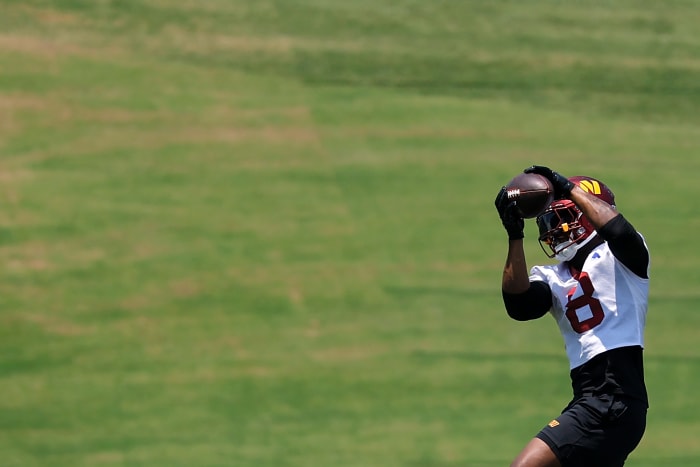
San Francisco gave Robinson 92 carries in 14 games. Career low. He averaged 4.3 yards per carry and logged a 16% snap share behind Christian McCaffrey. Robinson actually outperformed McCaffrey in late-season efficiency, posting 4.8 yards per carry against McCaffrey’s 3.5. Didn’t matter. McCaffrey’s contract protected his workload. Robinson’s trade price sealed his role. Performance didn’t override pre-assignment. Ninety-two carries. Four hundred yards. Two touchdowns. The number of a man the system had already decided about.
How the Tier System Actually Works

The NFL running back market operates on two floors. Elite backs like Breece Hall, Kenneth Walker, and Travis Etienne command $10 million or more and absorb 70% of snaps. Everyone else falls into a commodity tier between $1.5 and $3 million, absorbing 20 to 40% of snaps. Robinson landed at the ceiling of the commodity tier. Only 14.9% of NFL running backs maintain a 60% snap share. Robinson will never sniff that number in Atlanta. The “committee” label sounds collaborative. The salary structure reveals hierarchy.
Bijan’s Record Season Hides the Real Math

Bijan Robinson’s 2025 season broke the Falcons’ franchise record: 1,478 rushing yards, 79 receptions, 820 receiving yards, and 11 total touchdowns. His 2,298 scrimmage yards surpassed William Andrews’ mark from 1983. He averaged roughly 17.4 carries per game across his last 34 games. If that workload holds, Brian Robinson is projected to have roughly 4 to 6 carries per game. That’s approximately 65 carries across a full season. CBS Sports called this an elite tandem. The math calls it a backup plan.
The Ripple Nobody’s Pricing In
Robinson’s $2.5 million deal becomes the new comparison point for every mid-tier free agent back next offseason. If a three-time 700-yard rusher signs for commodity money, the floor drops for everyone behind him. Allgeier’s $12.25 million in Arizona already looks inflated by comparison. The Falcons saved roughly $9.75 million on the position swap, money likely redirected toward defense or the Tua Tagovailoa quarterback experiment. One signing reshapes how 31 other front offices value their own depth charts.
The New Rule Hiding in Plain Sight
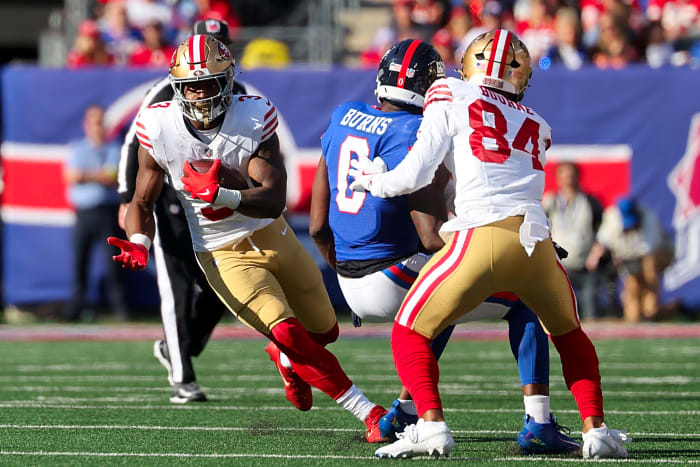
Robinson’s career is a speed run of modern back depreciation. Drafted in the third round in 2022. Established as a starter. Traded mid-season for a late-round pick. Signed as depth insurance at a commodity rate. That trajectory used to take six or seven years. Robinson completed it in four. The Falcons hired Stefanski because his wide-zone scheme historically maximized Dalvin Cook and Aaron Jones Sr. The system elevates the alpha back. Everyone else becomes interchangeable. Robinson’s signing proves the doctrine: scheme over talent, every time.
The Injury Bet Atlanta Won’t Discuss

If Bijan misses two or more games, Robinson becomes the starter on a 92-carry rhythm. A back who hasn’t handled a full workload since 2024 would suddenly anchor an offense that generated 2,298 scrimmage yards through one man. The depth chart behind him reads Nathan Carter and Carlos Washington Jr. The Falcons went 8-9 in 2025 and missed the playoffs for the seventh straight year. Stefanski’s rebuild is betting everything on Bijan’s health, and the insurance policy costs less than a backup quarterback.
What the Bar Crowd Gets Wrong

Before his rookie season, Robinson survived being shot twice during an armed robbery in Washington, D.C., and returned to play within two months. That resilience story writes itself. But the NFL no longer pays for resilience. It pays for scarcity. Robinson proved durability across 58 career games, 2,729 rushing yards, and four seasons of availability. The market responded with a sixth-round trade value and a $2.5 million prove-it deal. The “most prolific duo” framing sells hope. The contract sells the truth about where non-elite backs stand now.
Sources:
USA Today, “Brian Robinson Jr. signs one-year contract with Falcons,” March 24, 2026
ESPN, “Cardinals land Tyler Allgeier on 2-year, $12.25M deal,” March 8, 2026
CBS Sports, “Brian Robinson Jr. trade: Commanders deal running back to 49ers in exchange for sixth-round pick,” August 21, 2025
ESPN, “Bijan Robinson’s career-high 195 rushing yards fuels Falcons,” December 29, 2025
Yahoo Sports, “Commanders trade RB Brian Robinson Jr. to 49ers amid slew of injuries,” August 22, 2025
FOX Sports, “Bijan Robinson has longest rush TD in Falcons history, has team’s most scrimmage yards in a season,” December 28, 2025
More must-reads:
- Update expands on bombshell report about alleged Eagles, Jalen Hurts drama
- Raiders make Kirk Cousins decision after Klint Kubiak comments related to Fernando Mendoza
- The 'Rushing-TD leaders by NFL team' quiz
Breaking News
Trending News




Customize Your Newsletter
 +
+




Get the latest news and rumors, customized to your favorite sports and teams. Emailed daily. Always free!
PRIVACY POLICY COOKIE POLICY CONTACT US
ABOUT YARDBARKER TERMS OF SERVICE


By using this site, you agree to our Terms of Service and Privacy Policy.
This site is for entertainment purposes only.
There is no gambling offered on this site.
Gambling Problem? Call 1-800-Gambler.
