
-

-


Follow Us
-

 On Facebook
 On Flipboard

[Editor’s note: This article is from The Spun’s “Then and Now” magazine, featuring interviews with more than 50 sports stars of yesteryear. Order your copy online today, or pick one up at retail racks and newsstands nationwide.]
While the Chicago Bears were known for the NFL’s No. 1 defense in 1985, their offense was also among the league’s best, led by running back Walter Payton.
But no one captured the offense’s persona more than quarterback Jim McMahon. A fearless play-caller, McMahon loved to pass, run and barrel through defenders like a missile.
To this day, McMahon still calls his offensive line — left tackle Jim Covert, left guard Mark Bortz, center Jay Hilgenberg, right guard Tom Thayer and right tackle Keith Van Horne — “my boys,” and for good reason.
“Without those guys, I couldn’t do anything,” McMahon said.
Another person McMahon wouldn’t have been able to do anything without was coach Mike Ditka, whom the QB loved to get a rise out of.
“Yeah, we fought a lot,” McMahon said. “We had a lot of different opinions on how to get things done. I understood he was the boss, but I said to him, ‘If something’s upsetting you with what I’m doing, I’m not doing it to you personally — I’m out here trying to win games.’”
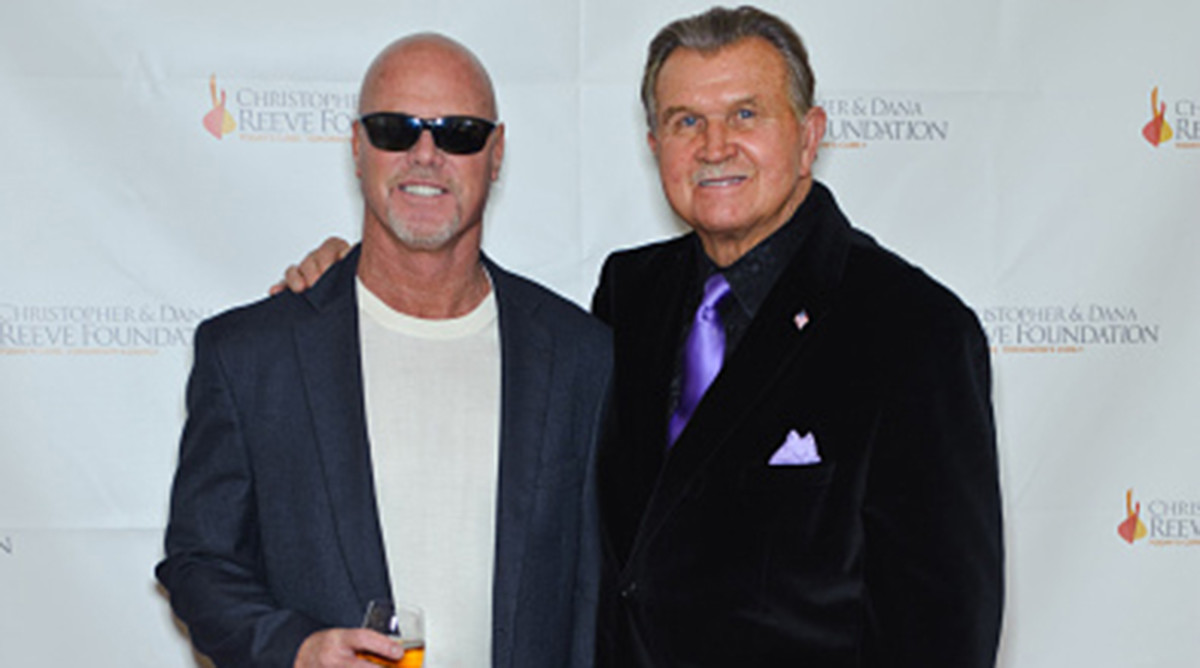
McMahon spent most of his career known as the “Punky QB,” a nickname he was never fond of. Even today, he still bristles when people call him that.
“I didn’t make it up, I don’t know where it came from, other than the lyrics of the damn [‘Super Bowl Shuffle’] song. I still don’t get what the hell it means. I had my hair weird in ’85 and I guess they thought I was a punk rocker.”
McMahon played with the Bears from 1982 through 1988, and then five other teams (San Diego, Philadelphia, Minnesota, Arizona and Green Bay, where he ended his career with a second Super Bowl ring as Brett Favre’s backup in 1996). He passed for more than 18,000 yards and 100 touchdowns in his 15-year career.
These days, McMahon dotes on his seven grandchildren — he’s not encouraging any of them to play football because of the injury risk — and plays lots of golf.
McMahon no longer follows the NFL. “Nowadays, there’s no incentive to win anymore with the money they’re making. If nobody wants to win but rather get paid, I don’t want to have anything to do with that.”
McMahon lives in the Phoenix area, and is an investor in the medical cannabis industry, which stems from his own prior reliance upon opioids for physical and neurological pain. He was diagnosed with Chronic Traumatic Encephalopathy after suffering multiple concussions during his career. McMahon launched Mac 9, an indica strain of cannabis that was developed as a safer alternative to opioids and other painkillers for pain management of CTE symptoms.
McMahon still keeps in touch with a number of his former teammates, either by phone or in person during his travels around the country. “We had a unique team. We had unique players. We had a unique system defensively, a unique head coach. We had a lot of unique things going on,” he said. “(What the Bears had) it’s going to be hard to duplicate.”
More must-reads:
- Troy Aikman makes strong statement about Eagles' Jalen Hurts after bombshell reports
- John Harbaugh, Giants may be haunted by draft decision
- The 'Multiple 4K-yard NFL seasons' quiz
Breaking News
Trending News



Customize Your Newsletter
 +
+




Get the latest news and rumors, customized to your favorite sports and teams. Emailed daily. Always free!
PRIVACY POLICY COOKIE POLICY CONTACT US
ABOUT YARDBARKER TERMS OF SERVICE


By using this site, you agree to our Terms of Service and Privacy Policy.
This site is for entertainment purposes only.
There is no gambling offered on this site.
Gambling Problem? Call 1-800-Gambler.
