
-

-


Follow Us
-

 On Facebook
 On Flipboard

For several weeks of this offseason, we've discussed the contract status of multiple Denver Broncos veterans, several of whom are in the final year of their contracts. We've also discussed the status of players who are eligible for extensions for the first time in their NFL careers.
Not everyone with an expiring contract will be brought back for 2027, particularly because quarterback Bo Nix will be eligible for an extension and the Broncos will need to commit resources to that deal.
Some might argue it makes more sense to either cut or trade players who aren't likely to be back with the team in 2027 to clear cap space and ensure the Broncos have more draft capital for 2027.
However, that comes with a trade off: The Broncos would lose out on players who could be valuable toward a deep playoff run, while having to rely on younger players who have yet to prove themselves.
Let's take a look at some examples of players who are due significant sums of money this season but may not be retained in 2027, and how losing them now might do more harm than good.
Ben Powers | OG

Powers is due $13 million this season, and if the Broncos parted ways with him now, it would mean $12.7 million in cap space freed, as a result of his departure coming after June 1 and his remaining pro-rated money from signing bonuses spread out over this and next season (in 2027, he has a void year for cap purposes).
However, while the Broncos could have Alex Palczewski start, they would be relying on inexperienced players for depth. Nick Gargiulo has never started an NFL regular-season game, and Kage Casey is a rookie, so moving on from Powers would leave the Broncos with inexperienced depth.
Keeping Powers means the Broncos have a proven veteran as the starter and a proven veteran in Palczewski as the top backup. It also gives Gargiulo a chance to improve after missing last season because of injury and gives Casey time to get acclimated to the NFL before he takes on a bigger role.
Brandon Jones | S
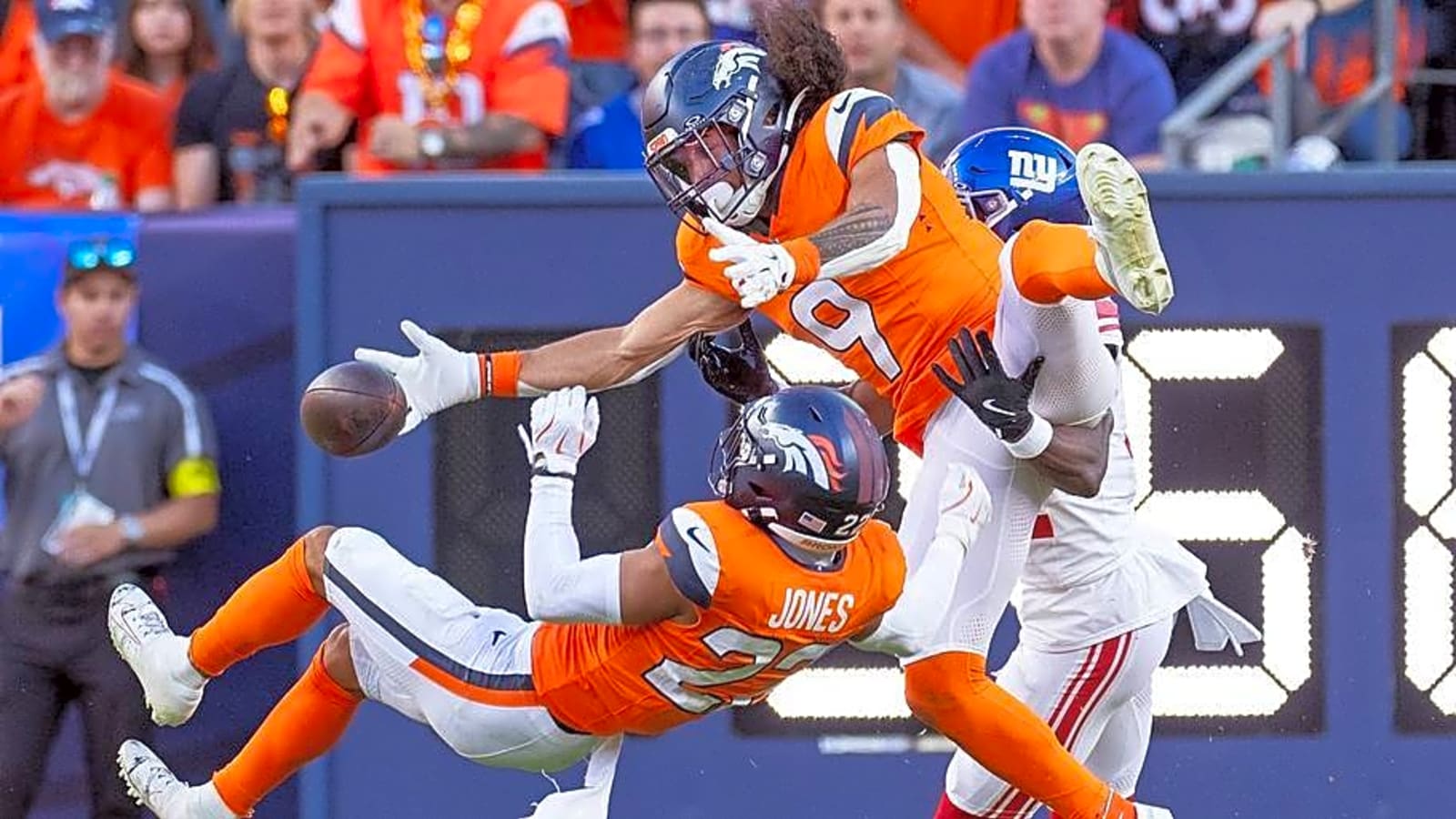
Jones is due a little more than $7.4 million this season, and if the Broncos moved on from him, they'd get a fair amount of cap space and save a fair amount of cash. Jones didn't play as well in 2025 as he did in 2024, so it's fair to wonder how good he will be this season.
The problem is that the Broncos wouldn't have many experienced players left to fill in the other starting safety spot next to Talanoa Hufanga. Devon Key and JL Skinner have seen a handful of defensive snaps, much of them when Jones missed time with injuries, but they haven't shown they can take on a starting role for an entire season.
Keeping Jones makes more sense as it allows the Broncos to work players like Key, Skinner, and Tycen Anderson in as the third safety when the situation calls for it. That gives the Broncos some time to determine who might be able to take over for Jones if he isn't brought back for 2027.
Riley Moss | CB
Moss has generated the most conversation about potential trade candidates on the Broncos roster. He's a near-lock to get a big contract in 2027, possibly one that approaches the top of the market.
Thus, some have said it would be better to trade Moss now to secure another draft pick for 2027, plus it would mean the Broncos saving nearly $3.7 million in cap and cash. However, it would come with a cost of losing a proven player.
Even though the Broncos spent a first-round pick on Jahdae Barron last year, he has yet to prove himself as the No. 2 cornerback. Until he shows improved play, to the point he has to get more snaps, trading Moss now is a risky proposition.
And during the regular season, having three cornerbacks who can rotate in and out of the lineup alongside Patrick Surtain II would be a good situation to have, especially if the Broncos were to lose somebody for a couple of games because of injury.
That doesn't mean the Broncos must rule out trading Moss at all during the season. It only means that rushing into a trade at this time isn't a good idea.
The Broncos can revisit later, but Barron must first prove himself, and the draft capital must be worth the trade.
The Takeaway
The Broncos are not in a dire cap situation at this time. They currently have nearly $29.5 million in cap space, assuming all option bonuses due are exercised. Once the Broncos get to the 53-man roster and 16-player practice squad, they should have between $20 million and $25 million in cap space.
That's more than enough space to ensure carryover for 2027 to help the cap situation next season. The Broncos are currently projected to have $11.725 million in cap space next season, assuming a base cap of $327 million, but that's without carryover.
Furthemore, if the Broncos extend any players with expiring contracts, they are likely to use option bonuses to lower their cap numbers for 2027. That will help with accomodating a potential extension for Nix.
Also, the Broncos are not likely to be active in free agency in 2027, which gives them a good chance of getting compensatory picks for 2028. Powers and Jones would likely net the Broncos comp picks if they depart in free agency next year, and the same is true with Moss if he isn't traded in 2026.
It's true that a pick in 2027 would provide help sooner than a pick in 2028, but the Broncos are already projected to get two comp picks in 2027, which would give them nine total selections in the draft. That's enough picks to address roster needs for 2027.
Now, if a trade offer comes along that the Broncos can't pass up, they can take it, but the point to emphasize there is that they can't pass it up. Trading for the sake of doing so isn't in the Broncos' best interest.
The Broncos should be fine from a cap and cash standpoint in 2027 to accommodate a deal for Nix. Therefore, the focus in 2026 should be on which players can help the Broncos now when it comes to making a deep playoff run, rather than thinking too much about 2027.
More must-reads:
- NFL Week 1 winners, losers: T.J. Watt dominates; huge day for star RBs
- Mike McCarthy tries to downplay Joey Porter Jr.-Steelers saga
- The '4,500-yard, 15-INT NFL seasons' quiz
Breaking News
Trending News




Customize Your Newsletter
 +
+




Get the latest news and rumors, customized to your favorite sports and teams. Emailed daily. Always free!
PRIVACY POLICY COOKIE POLICY CONTACT US
ABOUT YARDBARKER TERMS OF SERVICE


By using this site, you agree to our Terms of Service and Privacy Policy.
This site is for entertainment purposes only.
There is no gambling offered on this site.
Gambling Problem? Call 1-800-Gambler.
