
-

-


Follow Us
-

 On Facebook
 On Flipboard
 On Twitter

The Chicago Bears asked Illinois lawmakers to pause a critical stadium hearing on March 26, 2026. A productive three-hour meeting had just wrapped. The property tax bill was moving. Then the franchise requested a break to “tweak” the legislation. Springfield obliged. The following morning, the Illinois House adjourned for a two-week recess without casting a vote on the bill. One hundred and six years of history, a signed law already on the books in Indiana, and Illinois still hadn’t taken a single vote.
Two States, One Month
February 18, 2026, opened the decisive chapter. Indiana’s House Ways and Means Committee passed SB 27 by a vote of 24-0, establishing a Northwest Indiana Stadium Authority with bonding power to finance a domed facility near Wolf Lake in Hammond. Within the same week, the Illinois House adjourned without voting on the Bears’ property tax bill. By February 26, Indiana’s full Senate had passed the measure and the Governor had signed it into law. One state moved unanimously. The other went home. The Bears had committed $2 billion in private stadium funding, and only one legislature treated that number like it mattered.
The 60-Vote Trap

Illinois House Speaker Emanuel “Chris” Welch requires a 60-vote Democratic threshold to advance bills. Twenty-eight of 78 House Democrats live in Chicago and oppose the Bears leaving the city for suburban Arlington Heights. That internal fracture means the caucus fights itself before it fights Indiana. The Bears know this. They purchased the 326-acre Arlington Park property for $197.2 million in February 2023, invested years in a $5 billion mixed-use vision, then watched their own state’s political math work against them. Indiana needed consensus. Illinois needed a miracle.
The Pause That Changed Everything
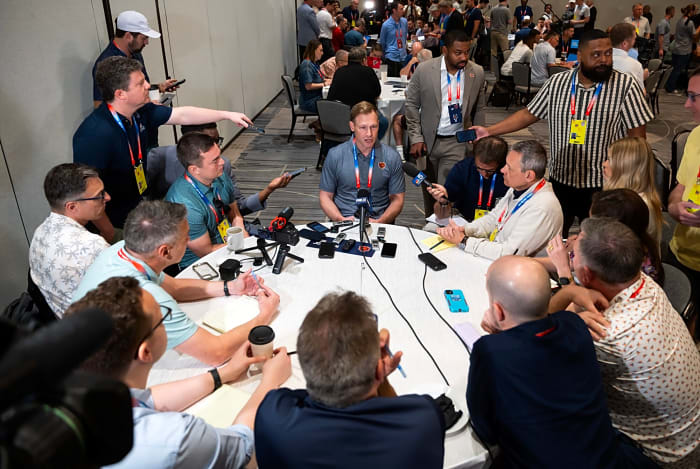
When Indiana’s bill passed committee in February, the Bears issued a statement praising the vote as the most meaningful step forward to date. Gov. Pritzker’s spokesman Matt Hill said it plainly: “Illinois was ready to move this bill forward. This morning, we were surprised to see a statement lauding Indiana and ignoring Illinois.” That word, “surprised,” reveals everything. Illinois genuinely believed the Bears were negotiating in good faith. Weeks later, when Illinois returned to the table in March, the Bears asked lawmakers to pause for “tweaks”—and the House adjourned for two weeks with nothing on the board. Indiana had already moved. One request created asymmetric pressure across two state capitals, six weeks apart.
How the Auction Works

This operates like a corporate acquisition auction. The Bears maintain two active bidders, manufacture crisis in one negotiation while accelerating the other, and capture the spread between each state’s maximum willingness to pay. Indiana’s Hammond site sits roughly 28 miles from downtown Chicago, connected by a nearly $1 billion West Lake Corridor rail extension with service beginning March 31, 2026. That rail line was built before anyone voted on a stadium. Infrastructure preceded the franchise decision, locking in sunk costs that make Indiana’s bid structurally cheaper before a single shovel hits dirt.
The Numbers Illinois Can’t Escape

Soldier Field generates approximately $50 million in annual venue revenue beyond the Bears’ $7 million rent. Chicago taxpayers have already paid $52 million since 2022 toward the stadium’s remaining $356 million renovation debt. If the Bears leave, that revenue vanishes. The debt stays. The city becomes a landlord with no tenant and a mortgage running through 2033. The Bears can exit their lease early for roughly $84 million. For a franchise pursuing a $5 billion development, that exit fee is a rounding error on a spreadsheet nobody in Springfield seems to be reading.
What Disappears With the Bears

The Arlington Heights project projected 56,000 construction jobs and 9,100 permanent positions across a mixed-use district: 1,150 residential units, 400 hotel rooms, 300,000 square feet of retail, 200,000 square feet of office space. The projected net fiscal revenue over 40 years totaled $1.98 billion. If the Bears relocate, those jobs and that revenue shift to Indiana. Illinois doesn’t just lose a football team. It loses the economic anchor of an entire suburban corridor, while Jacksonville, New Orleans, and Las Vegas watch this playbook for their own leverage.
The New Rule for Every NFL City
Once you see that legislative speed determines where franchises land, every Bears move becomes predictable. A unified legislature (Indiana, 24-0) will always outrun a fractured one (Illinois, 60-vote threshold with 36% internal opposition). This sets a precedent: states with single-party control and fast-moving governments become preferred relocation destinations. The franchise doesn’t choose based on fan loyalty or market size. It chooses based on which government can write the check fastest. An Emerson College poll found 58% of Illinois voters want the Bears to stay, and 58% oppose public funding. Voters want the franchise without the cost. That contradiction is the trap.
The April Countdown

Illinois returns April 7. Indiana’s Senate recesses April 14. That creates an 11-day window where both legislatures overlap. Arlington Heights Mayor Jim Tinaglia warned that “no one at Halas Hall wants to wait till the end of May.” The Bears are seeking $855.2 million in public infrastructure funding for roads, sewers, and commuter rail access. Indiana’s SB 27 already authorizes a stadium authority to issue bonds and acquire land. One state has the legal framework built. The other hasn’t taken a vote. The clock favors Indiana, and the Bears designed it that way.
The Franchise That Outran Its Own State

The Bears joined the NFL in 1920. They’ve played at Soldier Field since 1971. They’ve never left Illinois. But they don’t own their stadium. They rent it. They already own 326 acres in Arlington Heights and have publicly committed $2 billion to build elsewhere. The myth that historic franchises stay put because of loyalty died in February, when the Bears praised Indiana for moving at a speed Illinois couldn’t match—then extended that leverage through March. Illinois can still pass the bill. But the franchise already proved it will go wherever the government moves fastest, and that knowledge changes every stadium negotiation in America from this point forward.
Sources:
“Indiana unanimously passes bill to lure Bears away from Chicago.” ESPN, 18 Feb 2026.
“Property tax bill to help Chicago Bears build Arlington Heights stadium delayed as Illinois House adjourns for recess.” CBS News Chicago, 26 Mar 2026.
“Chicago Bears’ Arlington Heights stadium project projected at $5 billion, 56,000 construction jobs and 9,000 permanent jobs.” Chicago Construction News / Chicago Build Expo, Sept 2025.
“Chicago Bears complete $197.2 million purchase of 326-acre Arlington Heights property, potential site for new stadium.” FOX Sports, 14 Feb 2023.
More must-reads:
- Cowboys' Jerry Jones sends clear message to players about 18-game regular season
- Cowboys' Jerry Jones leaves door open for Maxx Crosby trade, addresses Ravens-Raiders saga
- The 'Rushing-TD leaders by NFL team' quiz
Breaking News
Trending News







Customize Your Newsletter
 +
+




Get the latest news and rumors, customized to your favorite sports and teams. Emailed daily. Always free!
PRIVACY POLICY COOKIE POLICY CONTACT US
ABOUT YARDBARKER TERMS OF SERVICE


By using this site, you agree to our Terms of Service and Privacy Policy.
This site is for entertainment purposes only.
There is no gambling offered on this site.
Gambling Problem? Call 1-800-Gambler.
