
-


Follow Us

 On Facebook
 On Flipboard
 On Twitter

Thursday night’s Seahawks-Rams overtime thriller produced one of the most unusual plays of the 2025 NFL season: a two-point conversion that was initially ruled incomplete, only to be reversed after a lengthy replay review. The play has sparked debates among coaches, fans, and analysts about the backward pass rule, the replay review process, and whether fundamental football instincts still matter in high-pressure moments.
Walt Anderson’s Brief Spotlight
Former NFL referee Walt Anderson, the league’s sole official spokesperson for rules application, addressed the play during a short Sunday morning NFL Network segment. Anderson focused on explaining the mechanics of the backward pass, clarifying that the play was correctly ruled under the existing rules. Yet, as Mike Florio of NBC Sports points out, a key point went largely unmentioned: why it took more than 100 seconds from the end of the play for the review to be officially initiated.
That delay raised questions. Who triggered the review? Was it the on-site replay official, someone in the league office, or perhaps an outside analyst monitoring the game? The teams were already lined up for the ensuing kickoff when the decision was made. The opaque nature of this process highlights the lingering ambiguity in the NFL’s centralized replay system.
Anderson did not suggest any change to the backward pass rule, a tacit confirmation that the league likely sees no need to adjust it, despite Rams coach Sean McVay’s vocal objections.
Support Local and Independent Sports Writing – Subscribe To the LAFB Network Today!
Rams Objection: “Not Something We Want in the Game”
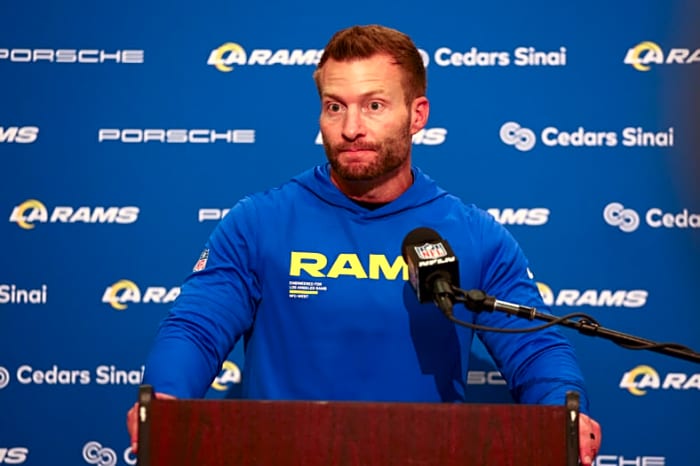
McVay, a member of the NFL Competition Committee, criticized the play as a loophole exploited in an unusual situation. “It’s a technicality issue,” McVay said. “You can’t advance a fumble under two minutes on two-point plays or on fourth downs. Because they said it was a backward pass, that’s how it was able to be advanced. Those aren’t the kind of plays that you want to have people converting on.”
The rulebook distinguishes between fumbles and backward passes. Fumbles on fourth down, or in the final two minutes of a half or game, are restricted to prevent accidental “Holy Roller” scenarios, in which desperate teams might try to engineer a forward fumble to gain an advantage. Backward passes, however, are always intentional, and any teammate may recover and advance the ball without restriction.
League sources indicate the backward pass rule will almost certainly remain unchanged, despite McVay’s concerns. A change would require unanimous support from the Competition Committee and a 24-team majority vote by ownership. Moreover, any rule modification would need to address complex contingencies: would the ball be dead where it lands? Only behind the line of scrimmage? Or could only the passer advance it? The unintended consequences of such changes make the league cautious.
Fundamentals Still Matter

For all the discussions about rules, the most immediate lesson from Thursday night is deceptively simple: always pick up loose balls. Seahawks running back Zach Charbonnet, who recovered the backward pass in the end zone, admitted he had no idea the ball was live but had a habit of always securing loose balls.
Other coaches echoed this point. Broncos coach Sean Payton said, “Any ball on the ground, defensively scoop it… no matter what it looks like.” 49ers coach Kyle Shanahan emphasized similar fundamentals, describing how his teams scrimmage recovery situations to avoid letting a loose ball dictate a game’s outcome. Even veteran analyst and former Rams defensive coordinator Wade Phillips has tweeted variations on the same theme: never leave a ball on the ground.
Charbonnet’s instincts underline a broader point: chaotic, high-pressure moments in football are less about exploiting technicalities and more about preparation and awareness. The backward pass play worked precisely because the defensive team failed to secure the ball, not because the rules were broken.
Get your Puka-Flex T-Shirt Here
The Replay Review Process in “Borderline Crisis Mode”

While the play itself adhered to the rules, the extended delay in review underscores ongoing concerns with the NFL’s centralized replay process. In 2017, former senior VP of officiating Dean Blandino criticized the system, noting that it was undervalued and underfunded. After his departure, the league has struggled to maintain a coherent and transparent review structure.
Thursday night’s two-point conversion illustrates the problem. More than a minute and forty seconds passed from Charbonnet’s recovery to referee Brad Allen announcing the review. By the time the two points were officially awarded, more than three minutes had elapsed. This delay, combined with the obscurity of the rules applied, created the sense that something had gone awry—even if the correct outcome was ultimately reached.
Critics argue that live access to the replay center could restore trust and transparency. Some propose multiple experts per broadcast window with cameras and microphones documenting their decisions. Others advocate for Blandino’s return at a significant salary, arguing that a centralized, highly qualified official could ensure consistency and clarity across games.
The stakes are high. With widespread sports betting and increased scrutiny from media and fans, every review impacts not just the outcome of a game but the league’s perceived integrity.
Special Teams and Momentum
The two-point conversion was not the only pivotal moment. The Seahawks’ 58-yard punt return touchdown by Rashid Shaheed in the fourth quarter exemplified another weakness for the Rams: special teams. McVay fired special-teams coordinator Chase Blackburn shortly afterward. Shaheed credited film study for exploiting L.A.’s weak coverage, highlighting that critical plays are as much about preparation and strategy as rules and officiating.
Conclusion: Lessons From a Wild Night
Thursday night’s game serves as a case study in NFL complexity. Backward passes are rare but legal avenues for dramatic plays. Replay review, while intended to standardize officiating, can create confusion when delays occur. And fundamental football principles—like recovering loose balls—remain indispensable.
Sean McVay may object to the rule, but the league is unlikely to act. Meanwhile, coaches, players, and fans have learned the same lesson Charbonnet embodied: never let a ball on the ground go unchecked. Sometimes, the simplest instincts determine the outcome, even amid the most confounding technicalities.
More must-reads:
- Steelers' DK Metcalf could be facing suspension for altercation with Lions fan
- Matt Eberflus' future with Cowboys seems clear after defensive dud vs. Chargers
- The '2004-05 NFL passing leaders' quiz




Customize Your Newsletter
 +
+




Get the latest news and rumors, customized to your favorite sports and teams. Emailed daily. Always free!
PRIVACY POLICY EDITORIAL POLICY CONTACT US
ABOUT YARDBARKER TERMS OF SERVICE


Use of this website (including any and all parts and
components) constitutes your acceptance of these
Terms of Service and Privacy Policy.
This site is for entertainment purposes only.
There is no gambling offered on this site.
Gambling Problem? Call 1-800-Gambler.
