
-

-


Follow Us
-

 On Facebook
 On Flipboard
 On Twitter

Championship formulas rarely center on flash alone. Seattle built its recent title run on ball security and structural balance in the backfield. Kenneth Walker III and Zach Charbonnet combined for just 3 career fumbles across more than 800 offensive touches, an extreme outlier for backs handling that volume. That control supported a dominant defense and carried through to Super Bowl LX, where Walker became the first running back in nearly 30 years to win Super Bowl MVP. The numbers point to intention. The structure behind them explains why.
Seahawks’ Hidden Championship Code
Kenneth Walker III and Zach Charbonnet shared carries, but their value went beyond distribution. Through this season, the Seattle pair combined for only 3 fumbles on more than 800 offensive touches. For high usage backs, that rate shifts game management. Coaches can call runs in neutral and late game scripts without bracing for disaster. Seattle paired that discipline with a defense built to control field position and tempo. Possession became currency. The offense protected it. By January, that formula felt less like variance and more like design. Awards season would soon confirm it.
First RB MVP In 28 Years

Super Bowl LX delivered a result few expected at this stage of roster economics. Kenneth Walker III rushed for 135 yards, added receiving production, and powered a 29 to 13 win over New England. Voters named him Super Bowl MVP, ending a drought of nearly 30 years without a running back claiming the award. Walker’s performance forced a recalibration. The workload, efficiency, and ball security aligned under maximum pressure. Seattle’s committee structure suddenly looked intentional rather than conservative. The path to that moment began with weekly repetition.
Inside Seattle’s Two Back Rotation
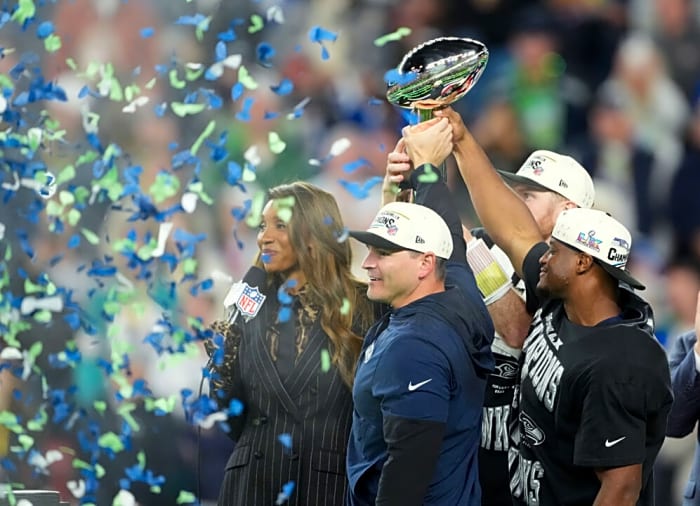
Seattle committed to a true two back structure. Walker handled explosive perimeter runs and open field work. Charbonnet absorbed interior carries, passing downs, and short yardage snaps. Defensive coordinators faced varied personnel without predictable tendencies. The distribution reduced cumulative hits and preserved burst deep into the season. It also maintained continuity in protection and route concepts. Most important, the ball stayed secured. The shared workload created flexibility in sequencing and tempo. Film study shows balance. The statistical profile shows control. That control becomes clearer when the raw totals are examined.
The Math Behind 3 Fumbles

Across their combined careers to this point, Walker and Charbonnet logged over 1,000 offensive touches with only 3 total fumbles. The combined fumble rate sits well below 0.5%. Many starting backs operate at multiples of that figure over similar volume. For Seattle, that translated into predictable down and distance management. Offensive coordinators could stay on schedule without compensating for turnover volatility. Field position remained stable. Defensive strategy benefited from shorter fields and longer rests. Over a full season, that margin compounds. Walker’s individual production profile illustrates how rare that blend can be.
Walker’s Volume Without Chaos
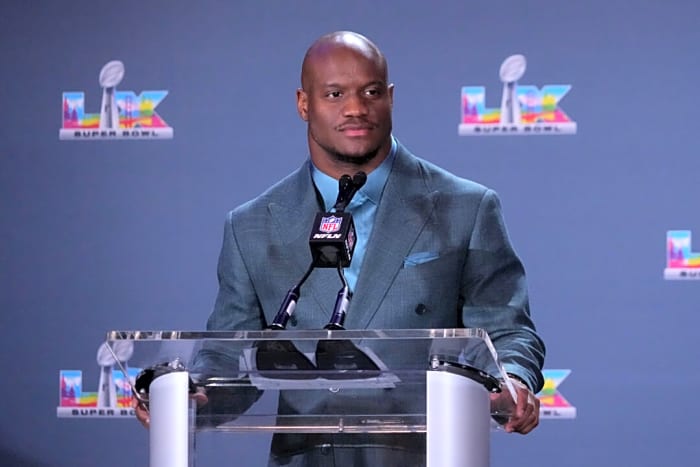
Walker has carried feature back responsibility in Seattle’s system. Across multiple seasons, he has logged over 900 career touches with explosive production, high yards after contact, and significant missed tackles forced. His aggressive play style invites contact and pursuit angles that often increase ball exposure. Despite that, his career total stands at 3 fumbles. The staff trusted him in high leverage situations, including red zone and closing drives. Charbonnet’s presence limited unnecessary wear and preserved burst. The statistical ceiling attracted attention. The reliability sustained it. Charbonnet’s own record deepens the contrast.
Charbonnet’s Zero Fumble Standard
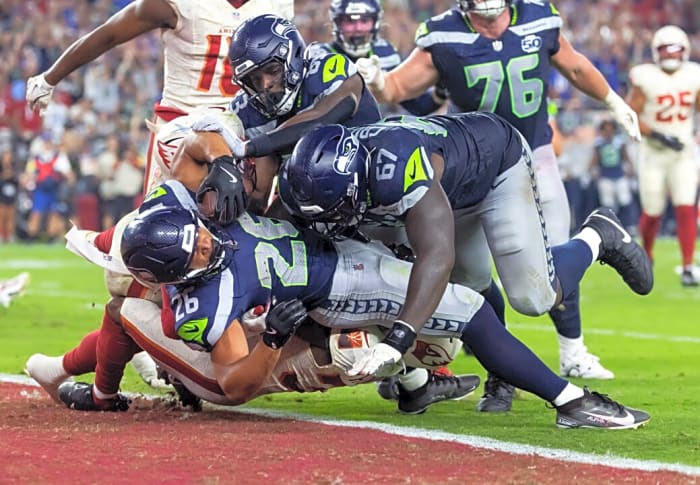
Charbonnet’s touch count trails Walker’s, yet his ball security record remains perfect. Across several hundred career touches, he has not recorded a single fumble. Short yardage collisions, interior traffic, and pass protection exchanges did not change that outcome. Analysts noted the streak as a measurable advantage. In a league that preaches turnover margin, Seattle deployed two backs who protected possessions at elite levels. Depth turned into insulation. That insulation faced its sharpest examination on the sport’s biggest stage.
Super Bowl LX Validates The Model

In Super Bowl LX, Seattle relied on repetition and control. Walker handled a season-high 27 attempts and produced 135 rushing yards without a turnover. The offense avoided gifting New England additional possessions. Time of possession and field position tilted toward Seattle’s defense, which dictated pace throughout the 29 to 13 win. The backfield executed exchanges cleanly under heightened pressure. The MVP vote reflected visible production, yet the underlying success rested on mistake avoidance. Championship environments magnify small errors. Seattle reduced them to almost none.
Ball Security As Identity

Over the season, ball security evolved into a defining trait. Play selection emphasized efficiency and manageable down and distance situations. The coaching staff trusted its backs late in games, even in condensed formations. Combining for 3 career fumbles across more than 800 touches provided measurable confidence. Opponents prepared for physicality and tempo rather than sudden giveaways. That stability complemented a defense constructed to capitalize on controlled pace. The formula produced a title. Durability now shapes whether it can continue.
The Injury That Shifts Everything

The postseason raised questions about long term depth behind Walker. Seattle must evaluate whether to add another complementary back or expand Walker’s usage in future seasons. Either decision could alter the distribution that supported the elite ball security profile. Changes to the rotation would affect risk calculations in short yardage and pass protection packages. The structural edge depends on maintaining balance. That consideration forces broader reflection across the league about sustainable two back models.
A Blueprint For Contenders

Seattle’s run reframed positional value through evidence. A two back system producing 3 career fumbles on more than 800 touches while delivering the first running back Super Bowl MVP nearly 30 years challenges conventional allocation models. Turnover avoidance translated into schedule control, defensive rest, and postseason stability. Front offices study efficiency margins constantly. Ball security at this volume demands attention. Replicating it requires discipline in scouting, rotation planning, and play calling. Seattle provided a template grounded in data and execution. The league now decides how seriously to take it. m
Sources:
Seahawks RB Kenneth Walker III named MVP of Super Bowl LX. ESPN, February 08 2026
Kenneth Walker NFL Stats & News. RotoWire, February 16 2026
Kenneth Walker III – Seattle Seahawks. Seattle Seahawks team site, accessed February 2026
More must-reads:
- Travon Walker's contract extension could be long-term steal for Jaguars
- Insider shares notable update on Shedeur Sanders' status with Browns
- The 'Rushing-TD leaders by NFL team' quiz
Breaking News
Trending News




Customize Your Newsletter
 +
+




Get the latest news and rumors, customized to your favorite sports and teams. Emailed daily. Always free!
PRIVACY POLICY COOKIE POLICY CONTACT US
ABOUT YARDBARKER TERMS OF SERVICE


By using this site, you agree to our Terms of Service and Privacy Policy.
This site is for entertainment purposes only.
There is no gambling offered on this site.
Gambling Problem? Call 1-800-Gambler.
