
-

-


Follow Us
-

 On Facebook
 On Flipboard


The paperwork hit the NFL office at 4 p.m. on April 28, right at the deadline, filed without a press conference or a public announcement. The Pittsburgh Steelers placed an unrestricted free agent tender on Aaron Rodgers, a contractual mechanism so rare that only six teams across the entire league have touched it in ten years. Three days earlier, the Steelers had drafted quarterback Drew Allar in the third round. Nobody in the building was willing to say what both moves, taken together, actually meant.
A Season Worth Protecting
Rodgers earned that tender. His 2025 campaign delivered 3,322 passing yards, 24 touchdowns against 7 interceptions, and a 94.8 passer rating. Pittsburgh won the AFC North at 10 and 7. The man is fifth all-time in NFL passing yards with 65,000-plus and holds the lowest interception rate in league history at 1.4208 percent. At 42, turning 43 in December, he played like someone with a decade left. The Steelers’ reward for that season was a 30 to 6 wild-card humiliation against Houston, extending a seven-game playoff losing streak.
Confidence That Needs Insurance
Art Rooney II expected a decision by draft weekend. It never came. Then he said the situation would resolve “in the next few weeks.” Meanwhile, Rodgers told Pat McAfee, “There’s been no deadline that’s been put in front of me. There’s no contract offer or anything.” Two people describing the same negotiation in completely different terms. One sees urgency. The other sees open road. That gap between owner and quarterback explains why the Steelers felt compelled to file a contract designed for departures they publicly claimed would never happen.
The Quiet Admission

Rooney’s own words buried the confidence narrative: “We don’t expect that, but by the same token, you never know. It’s just something we had an opportunity to protect if needed.” You don’t buy fire insurance on a house you swear will never burn. ESPN’s Dan Graziano translated it plainly: the tender signals “at least a sliver of doubt.” Six uses in a decade. A 10 percent raise to roughly 15 million dollars. Filed at the last possible second. That’s organizational panic dressed in a suit and tie.
How the Mechanism Closes the Door
The tender’s real teeth emerge on July 22. Before that date, Rodgers can sign with any team, and Pittsburgh receives a compensatory draft pick. After July 22, the Steelers gain exclusive negotiating rights. No other franchise can call. No other offer sheet can arrive. Rodgers’ options collapse to two: sign with Pittsburgh or sit out. If he remains unsigned through Week 10, he cannot play in 2026 at all. The mechanism designed to keep him could be the thing that pushes him out the door entirely.
Why the QB Franchise Tag Was Never an Option
The obvious retention tool, the franchise tag, was never on the table for a structural reason. The 2026 quarterback franchise tag figure sits at roughly 43.9 million dollars, a number that would have obliterated Pittsburgh’s working cap position. The Steelers carry about 30.5 million dollars in total cap space, but only roughly 9.8 million in effective room under the Rule of 51. Tagging Rodgers at quarterback money was mathematically impossible without gutting the rest of the roster. The UFA tender at about 15 million was not a preference. It was the only retention mechanism that fit inside the building’s actual finances.
The Numbers Behind the Squeeze

The 15 million dollar tender represents a 10 percent bump from Rodgers’ 13.65 million dollar salary in 2025. Reports indicated a potential 30 million dollar contract framework existed in negotiations. Pittsburgh carries roughly 30.5 million dollars in cap space but only 9.8 million in effective room under the Rule of 51. That’s a franchise trying to retain an elite quarterback while operating with the financial flexibility of a team already maxed out. The tender locks in a below-market floor while the front office scrambles to find ceiling money.
The Comparison That Reframes the Rarity

Measure this move against the rest of the league and the rarity compounds. Only a small group of players received a franchise or transition tag in 2026, headlined by Daniel Jones on the transition tag, George Pickens, Kyle Pitts, and Breece Hall. Tag usage across the NFL hit a multi-decade low the previous spring, with just two players tagged in 2025, the fewest in 31 years. Teams are running from these mechanisms, not toward them. Pittsburgh reached for an even rarer tool, the UFA tender, in an environment where most front offices are avoiding contractual locks entirely. That context makes the six-in-ten-years statistic land harder.
The Compensatory Pick Deterrent

The tender carries a second weapon most coverage has ignored. If Rodgers signs elsewhere before July 22, Pittsburgh becomes eligible for a compensatory free agent credit, and the signing team absorbs a corresponding loss in the comp pick formula. That means any club chasing Rodgers, whether Denver, Arizona, or a surprise bidder, pays twice. Once in cash, and again in future draft capital. For a Broncos front office trying to stack picks around a young roster, that math changes the calculus. The tender is not only a fence around Rodgers. It is a tariff on anyone who tries to climb it.
The Draft Pick That Said Everything

Three days before the tender filing, Pittsburgh used pick 76 on Penn State quarterback Drew Allar. GM Omar Khan insisted the selection “does not affect Pittsburgh’s interest in having Rodgers back.” Analysts saw it differently. Mike Florio noted that if Rodgers returns, the current messaging about Will Howard and Mason Rudolph is “baloney.” Rudolph is likely headed out for a fifth or sixth-round pick. Betting markets had placed Rodgers’ retirement probability at roughly 18 percent. The Steelers spent real draft capital hedging against a future their owner swore was secure.
A Deadline That Didn’t Exist Until It Did

The April 28 deadline forced Pittsburgh’s hand regardless of negotiation progress. NFL rules require tender filings by the Monday after the draft or compensatory picks go uncredited. The Steelers didn’t choose this timeline. The CBA imposed it. That’s the pattern hiding beneath every public statement: mechanical league deadlines, not relationship management, are driving this entire saga. Rodgers signed his 2025 deal in June, near mandatory minicamp. The tender now forces confrontation months before his natural rhythm. Once you see it, every “procedural” explanation sounds hollow.
What History Says About 42-Year-Old QBs

The historical sample of quarterbacks playing at 42 or older is tiny, and most of it belongs to two men. Tom Brady delivered the modern template in his age-42 season with 4,057 yards, 24 touchdowns, 8 interceptions, and an 88.0 rating, then kept going for four more years and another ring. Before Brady, the list ran through Warren Moon, Vinny Testaverde, Steve DeBerg, and a handful of others, almost all of them backups by that age. Rodgers’ 2025 line, 3,322 yards and a 94.8 rating, sits above Brady’s age-42 efficiency marker. Betting that a quarterback producing at that level has one more usable season is not wishful thinking. It is playing the actual historical odds.
Rodgers Holds the Silence

Rodgers said after the playoff loss he refused to make “emotional decisions” about his future. Months later, no public commitment exists. The Broncos have emerged as a potential suitor. The Cardinals represent another landing spot, with offensive coordinator Nathaniel Hackett carrying a prior Rodgers connection. Skip Bayless called the Steelers “held hostage” by indecision. Local columnist Mark Madden labeled Rodgers an “attention junkie” upstaging the draft. The exclusive rights window after July 22 tightens every week, and the man at the center of it all has said nothing.
The Trade Path Nobody Is Talking About
Most coverage treats the post-July 22 window as a binary, sign in Pittsburgh or sit. There is a third door. Once the Steelers hold exclusive rights, any rival that still wants Rodgers has to trade for him rather than sign him, which converts a stalled negotiation into a live asset market. Pittsburgh could extract a mid-round pick, a conditional selection, or a veteran swap from a team desperate at quarterback in September. That option also gives Rodgers a face-saving exit that does not require retirement. The tender is often described as a cage. It is closer to a toll booth, and the Steelers control the rate.
The Trap That Might Spring Open
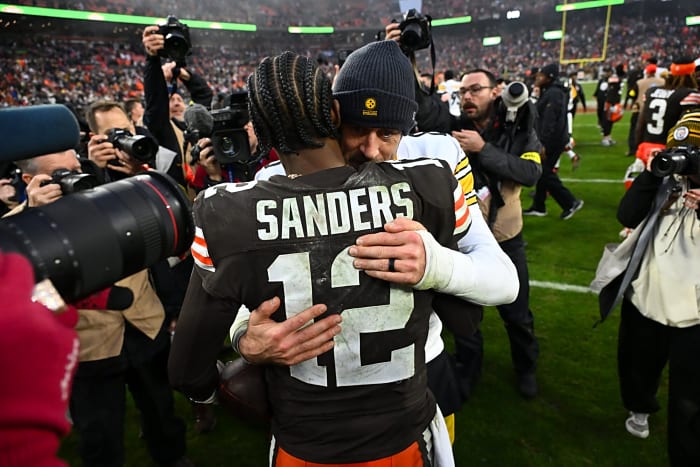
Florio and Simms warned that the exclusive rights mechanism “dramatically limits” Rodgers and could anger a player who values autonomy above almost everything. The Steelers built a contractual fence around a quarterback who spent two miserable years with the Jets partly because he felt controlled. This is the contradiction Pittsburgh cannot escape. The tender protects the franchise from losing Rodgers, but the pressure it applies might be exactly what convinces a 42-year-old with nothing left to prove that retirement sounds better than captivity.
If you are Rodgers, do you sign the tender, force a trade, or walk away, and which choice does Pittsburgh actually deserve?
Sources:
Fell, Kevin. “Report: Steelers tender UFA Aaron Rodgers, giving Pittsburgh more control over QB’s future.” NFL.com, April 27, 2026.
Fittipaldo, Ray. “Steelers use rare unrestricted free-agent tender on Aaron Rodgers.” CBS News Pittsburgh, April 27, 2026.
Graziano, Dan. “Steelers use UFA tender on Aaron Rodgers: What does it mean?” ESPN, April 27, 2026.
Kaplan, Sam. “Steelers place rare contract tender on Aaron Rodgers. What to know.” USA Today, April 28, 2026.
Reuters Staff. “With new deal, Aaron Rodgers ranks 22nd in NFL QB annual salary.” Reuters, June 9, 2025.
Prisuta, Mike. “Steelers select Allar in third round.” Steelers.com, April 25, 2026.
More must-reads:
- Texans owner Cal McNair offers new update on uncertain future of C.J. Stroud
- 'I just go out there and do my job': Eagles' DeVonta Smith locked in amid A.J. Brown rumors
- The 'No.2-overall NFL Draft picks' quiz
Breaking News
Trending News








Customize Your Newsletter
 +
+




Get the latest news and rumors, customized to your favorite sports and teams. Emailed daily. Always free!
PRIVACY POLICY COOKIE POLICY CONTACT US
ABOUT YARDBARKER TERMS OF SERVICE


By using this site, you agree to our Terms of Service and Privacy Policy.
This site is for entertainment purposes only.
There is no gambling offered on this site.
Gambling Problem? Call 1-800-Gambler.
