
-

-


Follow Us
-

 On Facebook
 On Flipboard
The End of the Penguin
And there goes another one.
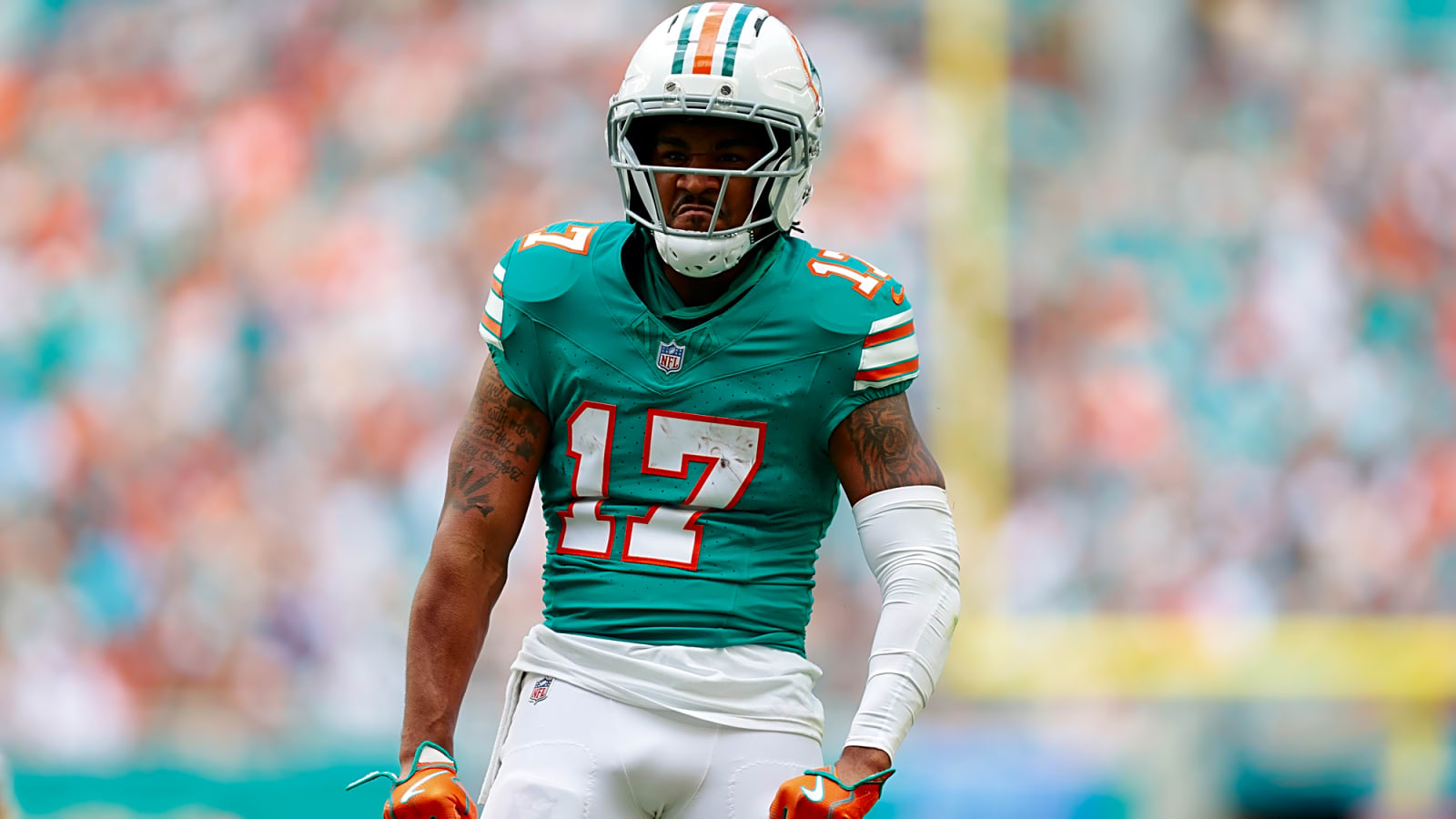
Just like that, Jaylen Waddle’s time as a Miami Dolphin is over. A complex pick in the first place, given the machinations of first trading down and out of the Ja’Marr Chase race, then trading back up to six, only to take the slight Alabama flyer over future multiple All Pros Micah Parsons, Rashawn Slater, Penei Sewell, and Patrick Surtain Jr., three of whom are on very serious Hall of Fame paths.
Much like most of the Dolphins’ recent history, Waddle peaked in 2022 and 2023, then struggled more in ’24 and ’25 as teams gained a greater understanding of Miami’s offense as it moved away from the kamikaze RPOs and the cheat motions toward a more between-the-numbers, condensed-splits evolution. Along with a number of minor injuries not big enough to keep him out of games but that affected his explosion, he was still an important chess piece for 2026 and beyond.
The day before the trade, Brandon Shore converted $15.2 million of his $23.4 million salary in 2027 into guaranteed money, which would have seen his cap hit go from $11.6 million in 2026 to a whopping $33.8 million in 2027. At the time of writing, it’s unclear who’s on the hook for his 2026 money and whether or not Miami just shipped a chunk of change in cap relief to Denver for what was essentially a third-round pick.
But the question I have with this trade is two-fold: you’ve just signed a 26-year-old QB with a high ceiling to a three-year deal worth $67.5 million – yeah, it’s really a two-year deal if he doesn’t meet that ceiling. But that’s not small beer financially.
In trading away Waddle, what you’ve done is lessen the possibility of fairly evaluating Malik Willis in the 12 months ahead of what, from right here, right now, looks like it could be the greatest QB draft of all time, headed by a Manning.
And after all, what have they ever done in the league?!
By choosing to deal Waddle, Miami has committed to what Jon-Eric Sullivan flatly laid out in his opening press conference when he was first signed away from Green Bay: that the team wanted to have and use as many picks as it could so as to build a winner through the draft. It became clear very quickly that everyone on the roster had a price – I wouldn’t be too shocked if De’Von Achane was next by the way – and Waddle’s was a good one for the Dolphins, who now own picks 11, 30, 43, 75, 87, 90 and 94 and can certainly add to that WR room in a strong draft for the position.
But even with the addition of, let’s say, two wideouts in those seven aforementioned picks, there’s an innate pressure on young receivers to learn and assimilate early on in the NFL. Sullivan will tell you himself how difficult it was for Green Bay’s own first-rounder last year, Matthew Golden, in a system not dissimilar to the one rookies will find themselves in, in Miami in 2026.
So what happens to that long-term evaluation of Willis? Because you don’t want to be Sullivan and Hafley in 12 months’ time without a fair understanding of where he’s at in his development. You don’t want to pass up the opportunity for a first-round franchise QB, should you need one, or be forced to take one so as to hedge your bets if you’re not certain where Willis is in development. by a lack of talent. Albeit he’s still a baby and has time to develop, of course.
But it would be the death knell to a front office were they to have placed themselves in a position to reset at the most important position in sports, then backed the wrong horse, and compounded it by missing the starting gate for the right horse in April 2027.
There’s also the argument that in trading Waddle and Minkah Fitzpatrick, and cutting Tua Tagovailoa, Bradley Chubb, and Tyreek Hill, the Dolphins are setting themselves up to tank. Yet signing Willis would indicate that’s perhaps not the case. But they must be careful not to find themselves in a footballing no man’s land. After all, Miami winning too many games to take themselves out of a prime drafting position, only to sit in the inferior first-round seats, has been something of a theme.
But consider this: what if their conviction about Willis is so strong that they’re comfortable with seven picks in 2026 in the top 94, and are happy to believe that should they end up with a top 3 pick in 2027, that they’ll be able to deal that selection for a bounty that will help further regenerate this team. There is nuance to that thinking, for sure.
After all, Sullivan watched Brian Gutenkunst trade Davante Adams and Aaron Rodgers away in 2022 and 2023, respectively, and they were the Green Bay passing attack. He watched as they developed Jordan Love, drafted Christian Watson and Romeo Doubs in ’22 and Jayden Reed and Dontayvion Wicks in ’23. And despite everything, that turned out pretty well for the Packers.
Whatever we think of today’s trade, it’s certainly brave. In many regards, it can be seen as a signal of intent with Malik Willis. He’s their choice and their figurehead. their ride or die come what may.
Whether that stance and this trade are foolish remains to be seen.
More must-reads:
- Commanders adding secondary depth with signing of veteran defensive back
- This QB has 'clear advantage' in Tua Tagovailoa, Michael Penix Jr. competition
- The 'Most MLB All-Star Games' quiz
Breaking News
Trending News







Customize Your Newsletter
 +
+




Get the latest news and rumors, customized to your favorite sports and teams. Emailed daily. Always free!
PRIVACY POLICY COOKIE POLICY CONTACT US
ABOUT YARDBARKER TERMS OF SERVICE


By using this site, you agree to our Terms of Service and Privacy Policy.
This site is for entertainment purposes only.
There is no gambling offered on this site.
Gambling Problem? Call 1-800-Gambler.
