
-


Follow Us

 On Facebook
 On Flipboard
 On Twitter
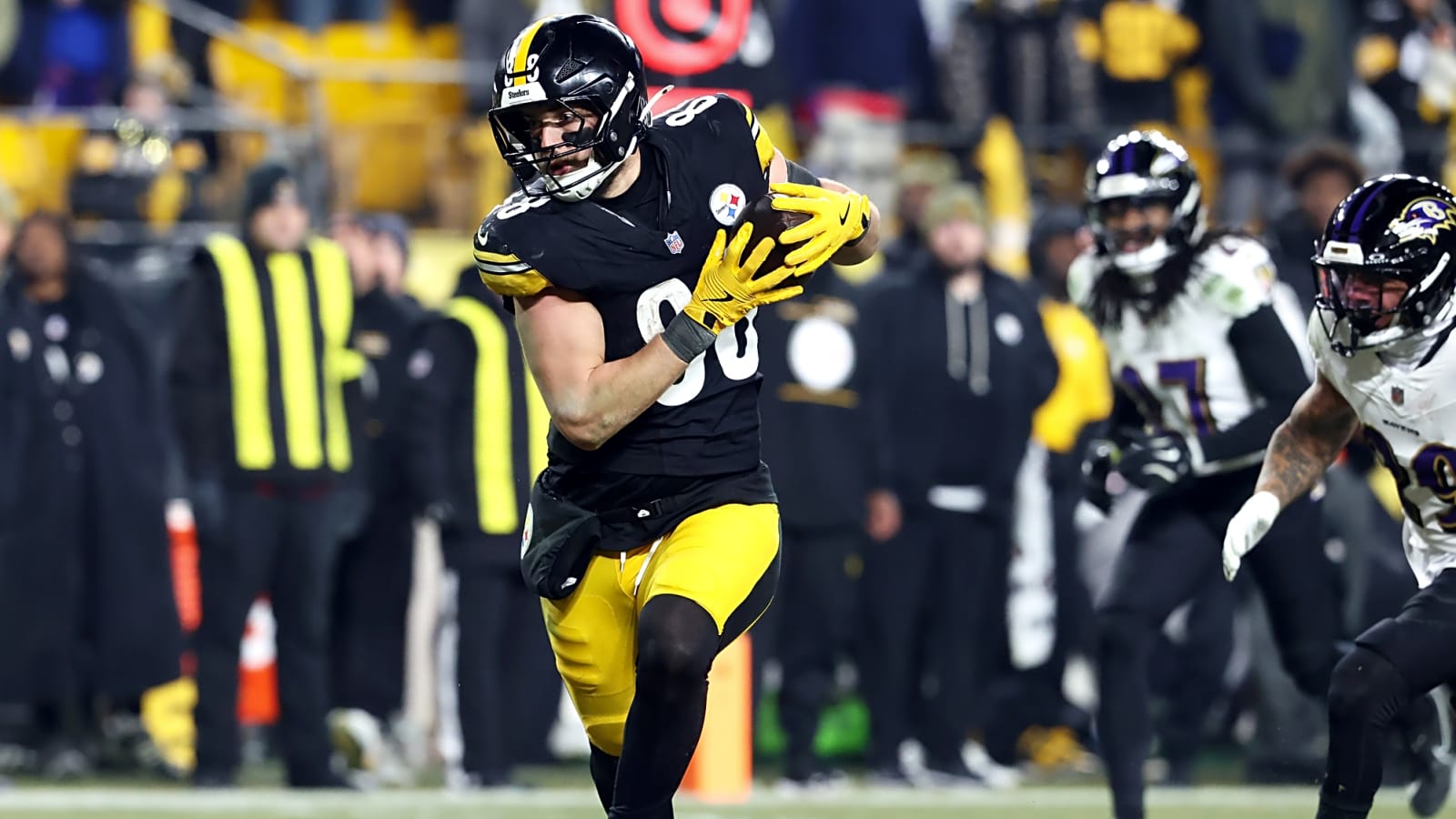
Steel City Underground presents it’s ‘Upon Review’ series of Pittsburgh Steelers positional group grades for the 2025 NFL season with statistical analysis and performance reviews.
The Pittsburgh Steelers leaned on a crowded tight end corps in 2025 with mixed results, featuring flashes of playmaking, role confusion and an injured key contributor late in the season. As the Steelers finished 10-7 and atop the AFC North, their tight ends combined for 1,206 all-purpose yards and eight receiving touchdowns, but the inconsistent distribution of targets and roles left evaluators with more questions than answers.
Pat Freiermuth
Leading the group statistically was Pat Freiermuth, whose season was marked by peaks and valleys. Freiermuth started all 17 games and finished with 41 receptions for 486 yards and four touchdowns, averaging 11.9 yards per catch, the highest among the Steelers’ primary tight ends. His contributions were vital in several key wins, including a standout prime-time performance against the Cincinnati Bengals where he hauled in multiple scores and over 100 yards. Yet, despite those moments, Freiermuth’s overall impact fell short of expectations for a player coming off a lucrative contract and known for consistent production in previous seasons.
Freiermuth’s yards and red-zone usage were solid, and his efficiency remained respectable, but the offensive scheme set in place by offensive coordinator Arthur Smith often limited his involvement — especially in early games — for reasons head coach Mike Tomlin described in October as schematic rather than performance-based.
Freiermuth’s B- grade, as a result, is skewed. We took into account his output in previous seasons and his late-season reemergence. Why Freiermuth was given a high-dollar extension and used the way he was – too little in our opinion – really threw off the fact that, had he been given more opportunities in a less TE-heavy scheme (paired with multiple other TEs) he would likely have been graded much higher.
Good stuff from Pat Freiermuth in his relative lack of usage in the Steelers offense this season
pic.twitter.com/BPAnlGNuZw
— Chris Adamski (@C_AdamskiTrib) January 13, 2026
Jonnu Smith
Behind Freiermuth in targets was Jonnu Smith, a veteran acquisition brought in to diversify Pittsburgh’s scheme. Smith finished with 38 receptions for 292 yards and two touchdowns, ranking second among the group in catches. His presence helped bridge moments when the passing attack sputtered, though his numbers didn’t approach the production he posted earlier in his career with other clubs.
Smith didn’t always appear to be on the same page with quarterback Aaron Rodgers and that led to some busted routes or drops. His moderate production kept the position relevant without elevating it.
Grade: C
Darnell Washington
Emerging as an intriguing piece was Darnell Washington, whose season showcased a blend of size, efficiency and sporadic scoring. Washington appeared in 16 games, totaling 31 receptions for 364 yards and one touchdown, with an average of 11.7 yards per reception. Although he did not play every snap – and ultimately landed on injured reserve late in the year due to a broken arm -Washington’s combination of contested-catch ability and red-zone blocking offered a dimension the Steelers lacked in previous seasons.
BIG DARNELL WINS THE ANGRY RUNS SCEPTER
Watch @gmfb on NFLN |
: https://t.co/8oQDFfgwG7 pic.twitter.com/0kuTq2SORk
— Pittsburgh Steelers (@steelers) November 18, 2025
As one of the most exciting players on offense to watch, Washington showed the most natural progression, blending physicality with production. His injury late in the year tempers the outlook – but his statistical efficiency suggests his best football could still be ahead.
Grade: B
Connor Heyward
Heyward played a more limited role, both as a tight end and fullback hybrid. He finished with three receptions for 21 yards and one touchdown, also contributing as a short-yardage runner with 15 carries for 43 yards and two rushing scores. Heyward’s value was more situational – goal-line bruiser and puzzle piece – than central to the passing game. He stepped in for Aaron Rodgers in some short-yardage plays, as well. But, due to limited opportunities, he also graded low.
Grade: C
Positional group analysis
Pittsburgh’s tight end group accounted for roughly one in every four passes completed, a reasonable share but one that lagged behind elite tight end corps across the league. On the positive side, the Steelers leveraged their size mismatches effectively at times, and tight ends were instrumental in key third-down conversions. On the downside, inconsistent quarterback play – especially with Rodgers adjusting to new weapons – limited how often tight ends were prioritized in pivotal moments.
In grading the unit overall, Pittsburgh’s tight ends were a group with individual strengths and flashes of impact, but not one that consistently elevated the offense or answered every question about role clarity and utilization.
Grade: B-
Related content:
More must-reads:
- Cardinals hiring of Sean McVay disciple Mike LaFleur as next HC may not yield immediate results in 2026
- Vikings' Justin Jefferson seems to shade J.J. McCarthy with Sam Darnold comments
- The 'Super Bowl host cities' quiz
Breaking News
Trending News








Customize Your Newsletter
 +
+




Get the latest news and rumors, customized to your favorite sports and teams. Emailed daily. Always free!
PRIVACY POLICY EDITORIAL POLICY CONTACT US
ABOUT YARDBARKER TERMS OF SERVICE


Use of this website (including any and all parts and
components) constitutes your acceptance of these
Terms of Service and Privacy Policy.
This site is for entertainment purposes only.
There is no gambling offered on this site.
Gambling Problem? Call 1-800-Gambler.
