
-

-


Follow Us
-

 On Facebook
 On Flipboard
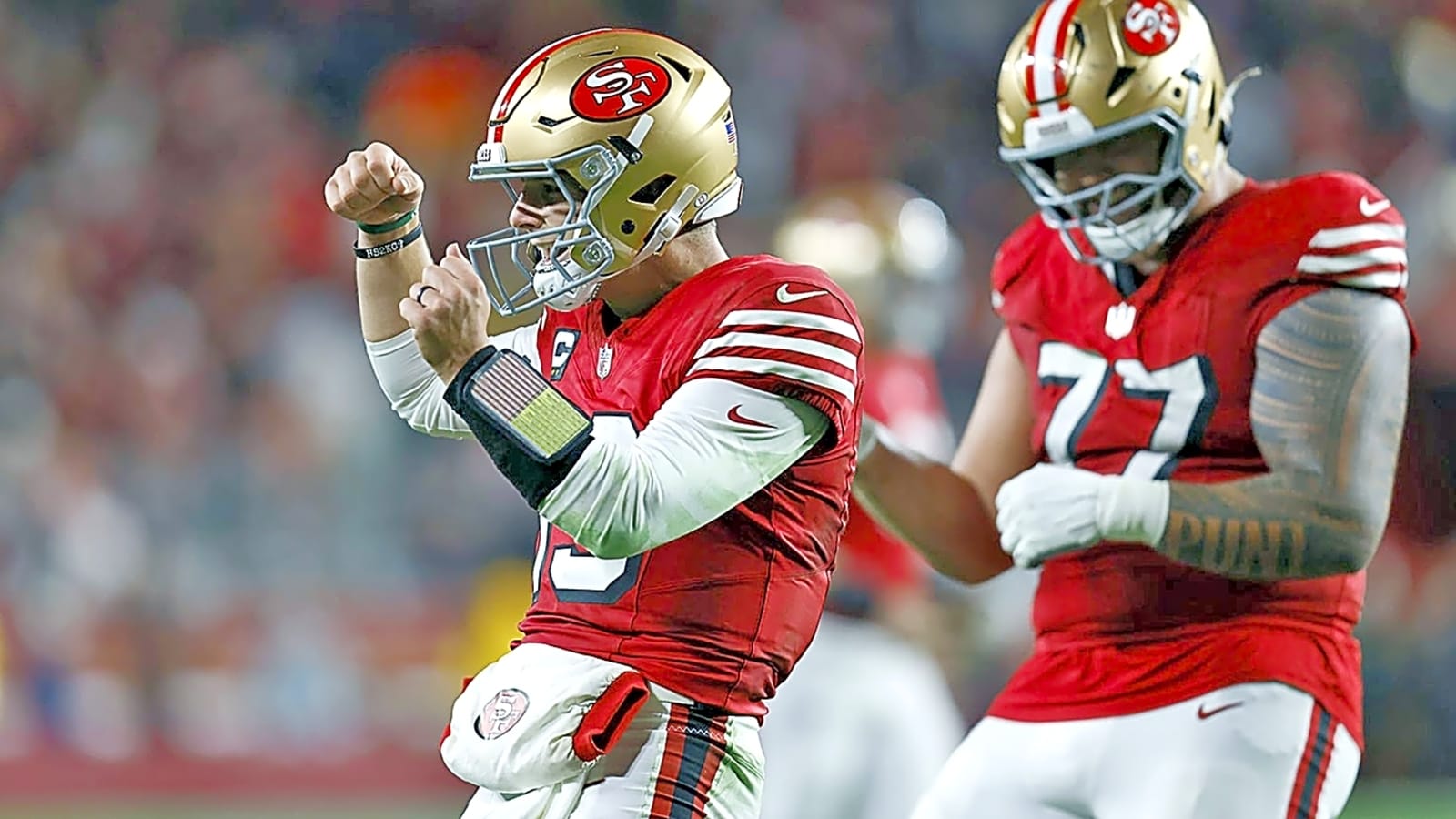
Pro Football Focus (PFF) has become the go-to grading source for everyone from print journalists to TV commentators to draft evaluators.
I was once under the impression it was meaningful, that it was useful.
Not anymore.
For the last few years, I have read articles that give the highest and lowest grades of that week's game. As a rabid 49ers fan, I have always seen those contests. I am, therefore, at least from a fan's point of view, very knowledgeable about who has had a good game and who has chumped it up.
Two things I have noticed about the PFF grades that are problems.
Number of snaps
I pay attention to the players who made a difference, and unless the circumstance is highly unusual, those are the players who have seen a lot of action. PFF will give the highest or lowest grades to people who barely played.
For instance, in Week 17 against the Bears, the lowest graded Niner was tight end Brayden Willis.
He played one snap. One. He is a pass catcher, but he was not even targeted. Often, Willis plays only on special teams or is brought in to block. What did he do wrong on that snap? Did he miss a block or tackle? And even if he did, how much did it impact the game?
In other words, who cares? Why is he even on a list?
In another example, in Week 13, back-up quarterback Mac Jones received a grade of 67. To PFF, that translates to average. Jones was given that grade based on four snaps.
And what were those snaps?
At the end of the game, he handed off twice, "rushed" for three yards for a first down, and then knelt down to end the game. How is that "average"? He did exactly what he was supposed to do, so why was his grade not much higher? Is it because his kneel-down counted as a one-yard loss and therefore he was credited with negative yardage? It is absurd.
And end-of-game kneel downs? In terms of performance, it doesn't get more meaningless than that.
Context
When I watch and judge someone's game as good or bad, I take context into account.
For instance, if a lineman stones the defender every snap except one in the second quarter on second and two, and the sack was for three yards, and his team made a first down anyway, it isn't a big deal. He had a very good game.
But if that single sack was late in the fourth, and the offense was driving for a field goal, and it was on third and nine and cost the team seven yards and took them out of field-goal range, he still only gave up one sack. He also might have cost them the game.
Who are the graders and what are their methods
One former player who hates PFF is retired superstar defensive tackle J.J. Watt.
He has several issues. First, the grades are determined by watching the TV broadcast, not the coaches' film. Watt said, "You can't watch film on the TV copy and create a grade." That makes sense. You need to be able to see all the angles and have a wider view to judge what happened accurately.
Watt also hates what is missing for the graders. Every play has a design. Every play has various responsibilities. Watt points out that it is necessary to know exactly what a player was supposed to do to grade fairly: "You can't break down a player's grade and know what they're supposed to do if you don't know their exact assignment."
Super-Bowl winning coach Bill Belichick gives an example of this: "You see a play on film and a receiver goes uncovered down the field. So you know it's probably one of two guys' mistakes, so you don't know which guy it is. A lot of times the announcer will say, '[This guy] should've taken him,' or, '[That guy] should have taken him.' And I'm looking at the play saying, it could have been either guy, depending on what the call was."
Watt also said he has heard from reliable sources (meaning people who actually experienced it)
that Uber drivers have told their rides that they break down PFF film as a side gig.
I have opinions on who played well or poorly, but I do not break down film.
The final word
You are better off watching the games and judging for yourself. There are various statistics in a simple box score that give a reasonable sense of how someone played. To me, if a quarterback completed 65% of his passes, threw two touchdowns and no interceptions, he probably had a solid game. If he threw one pick, I look at when it happened. On the second drive, which didn't lead to points for the other team, it wasn't significant. If it was on a game-tying drive and the corner picked him off at the eight-yard line, it cost his team the game.
If a running back averages seven yards per carry on 11 carries, you should look at what his longest run was. If it was fifteen yards, he must have had a lot in that seven-yard range or a number of them that were close to that fifteen average. That would be impressive. But if his longest was 51, that means the rest were for 26. That's 2.6 yards per carry for the others, which is atrocious.
Ultimately, there is no perfect way to judge a performance—or it is different from person to person. But one thing I know is that Pro Football Focus is not the way to go.
More must-reads:
- Ravens reporter seems to confirm major Zay Flowers contract update
- Will Howard gets bad news amid Steelers' development of Drew Allar
- The 'Game-winning-drives record by team' quiz
Breaking News
Trending News




Customize Your Newsletter
 +
+




Get the latest news and rumors, customized to your favorite sports and teams. Emailed daily. Always free!
PRIVACY POLICY COOKIE POLICY CONTACT US
ABOUT YARDBARKER TERMS OF SERVICE


By using this site, you agree to our Terms of Service and Privacy Policy.
This site is for entertainment purposes only.
There is no gambling offered on this site.
Gambling Problem? Call 1-800-Gambler.
