
-


Follow Us

 On Facebook
 On Flipboard
 On Twitter

[Editor’s note: This article is from Athlon Sports’ 2025 “Year in Review” magazine, which celebrates the year’s champions and relives the biggest moments from across the world of sports. Order your copy online today, or pick one up at retail racks and newsstands nationwide.]
The Florida Panthers spent most of their existence as the butt of the joke. The empty seats, the losing seasons and the general lack of impact on the NHL had plenty of fans calling on the league to move the franchise out of South Beach and into a more traditional hockey market.
At the time, you couldn’t blame them — the Panthers made the postseason just three times between 1997 and 2019, and they went 25 years between winning a round in the Stanley Cup Playoffs. Those days, and that sentiment, feel like a million miles away now.
That’s because the Panthers have won back-to-back Stanley Cups, with the 2024–25 triumph solidifying Florida’s spot among the elite franchises — not just in hockey, but across all sports in the current era. What was once a punchline has become a powerhouse, a franchise that’s redefined what hockey success can look like in South Florida.
As often happens in sports, when the focus shifted from the celebrations to the new season, skeptics began to question whether the Panthers would have the same motivation after going to consecutive Stanley Cup Finals, winning one of them. Florida wasted no time answering those questions, compiling an 11-3-1 record through their first 15 games and showing there would be no Stanley Cup hangover in Sunrise.
Just when it looked like Florida had found its footing and was being penciled in as the heavyweight in the Eastern Conference, the hockey gods began to meddle. Matthew Tkachuk, the team’s heart and soul, went down with an injury while playing for Team USA during the 4 Nations Face-Off. It was unclear how long Tkachuk would be out — or if he’d even make it back in time for the Stanley Cup Playoffs.
The injury seemed to take some of the wind out of Florida’s sails, and the Cats wrapped up the regular season on a middling 13-10-1 run. However, there was a silver lining.
With Tkachuk sidelined, the Panthers suddenly had plenty of cap room to work with at the trade deadline, and general manager Bill Zito, as he’s known to do, made use of it by pulling off two huge splashes — acquiring Seth Jones from the Blackhawks and Brad Marchand from the Bruins. Both deals were stunners, with very few people connecting the dots between those players and the Panthers until right before the trades were consummated.
The reaction across the league, aside from surprise, was doubt. Jones had struggled playing big minutes on a terrible Blackhawks team, while Marchand, pushing 37, looked a step behind his usual pace. The Panthers chose to trust that, in the right environment, both players would rediscover their form — and they did.
Due to their sluggish finish and questions about the health of key players, the Panthers were underdogs against the Tampa Bay Lightning in Round 1 of the Stanley Cup Playoffs. But give this team a chip on its shoulder at your own risk — the Cats quickly reminded everyone they were still the same bullies who steamrolled through the playoffs a year ago.
They made quick work of the Lightning, losing only one game in the best-of-seven, with Tkachuk gutting it out through injury. Even more encouraging was how seamlessly Marchand fit on the third line with Anton Lundell and Eetu Luostarinen, while Jones played a massive role anchoring the blueline.
Round 2 against Toronto brought an entirely different challenge. The Maple Leafs took the first two games on home ice and led 3–1 in Game 3 before the Panthers mounted a vintage comeback, capped by Marchand’s overtime winner. Florida took the next two — including a dominant Game 5 that ended with Maple Leafs fans throwing jerseys on the ice — but dropped Game 6, setting up a do-or-die Game 7 in Toronto.
The entire hockey world stopped for this showdown, pitting the league’s most tortured market against the defending champs. Unfortunately for the casuals, it was one-way traffic: The Panthers dominated from start to finish, earning a 6–1 win, the same score as Game 5.
As thrilling as Round 2 had been, the Eastern Conference Finals against Carolina were far less dramatic. The Panthers stormed out to a 3–0 series lead and closed it out in five games, once again looking like a team of destiny.
The 2024–25 Stanley Cup Final was a rematch from the previous year, and while the Panthers and Oilers split the first four games (three of which went to overtime), Florida began to assert itself with a 6–1 blowout in Game 3.
From there, the Cats outscored Connor McDavid and the Oilers 20–9, culminating in a 5–1 win on home ice in Game 6. Sam Reinhart tallied four of the five goals, capping an unforgettable run.
When it came time for the traditional passing of the Stanley Cup, captain Aleksander Barkov did something surprising and wonderful. Typically, the Cup is handed to the team’s longest-serving player or MVP — logical choices like Reinhart, Sam Bennett, Tkachuk or Aaron Ekblad. But these Panthers are different, which is why Barkov sought out journeyman defenseman Nate Schmidt.
Schmidt had played the most games (742) of any Panther without winning the Cup and had come agonizingly close before. After playing 200 games for the Capitals from 2013 to 2017, Schmidt was selected by Vegas in the Expansion Draft — only to face his former team in the 2018 Stanley Cup Final, where Washington prevailed.
“It’s surreal,” Schmidt said after the game. “I don’t really know what to feel; laugh, cry, slide on the ice with my belly out. I don’t know. It’s just amazing.”
Schmidt began a Cup relay among players who hadn’t been on Florida’s roster during the previous season’s championship run. It eventually ended with a pass from Jaycob Megna — who played just eight regular-season games — to third-string goaltender Evan Cormier, who spent the entire 2024–25 campaign with the Savannah Ghost Pirates of the ECHL and never appeared in an NHL game.
And yet, it was Cormier who passed the Cup to starting goaltender Sergei Bobrovsky.
Analysts will spend years dissecting how Florida built a juggernaut — the trades, the culture, the talent. But the essence of the Panthers’ rise can’t be captured by numbers or narratives.
To truly understand why they are special, just watch Cormier hand the Stanley Cup to Bobrovsky, the goaltender who made it all possible.
NHL Season in Review
In a league that had started to become predictable, the 2024–25 NHL season belonged to the unexpected.
It was a year when a goaltender claimed the spotlight, rookies arrived ready to rewrite the future and a smooth-skating defenseman turned himself into one of the league’s most dynamic goal scorers.
From Connor Hellebuyck’s historic MVP run in Winnipeg to Cale Makar’s goal-scoring symphony in Colorado, from Brandon Hagel’s emergence in Tampa Bay to the new generation raising the bar for debutantes, the 2024-25 NHL season stretched the league’s imagination of what greatness could be.
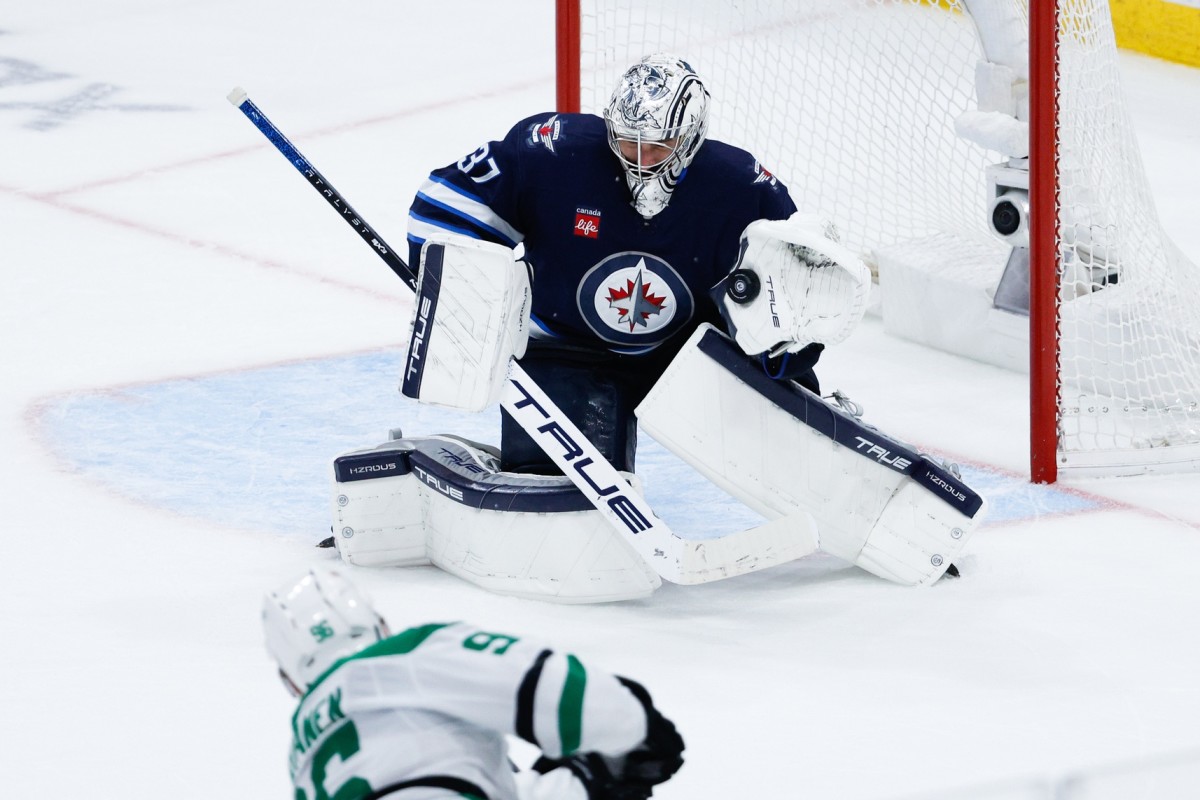
Player of the Year: Connor Hellebuyck, Winnipeg
Connor Hellebuyck had long been one of hockey’s most respected goalies, but in 2024–25, he became something rarer: the league’s most indispensable player. The Winnipeg Jets’ netminder didn’t just put up prolific numbers; he provided a platform for his team to enjoy its most successful season in history.
The Jets won the Presidents’ Trophy with 116 points, and they did it the old-fashioned way. Winnipeg allowed just 190 goals all season, 13 fewer than the next best team, and Hellebuyck did the heavy lifting.
The Michigan native won 47 games, posted a .925 save percentage and, according to MoneyPuck, stopped 39.6 goals above expected.
In an era where scoring is up, save percentages are down and players are taught to shoot to score rather than to just get pucks on net, Hellebuyck’s performance was a throwback — reminiscent of Patrick Roy and Dominik Hašek in their primes.
By season’s end, there was no question who the league’s MVP was. The Jets were not the most explosive team, nor the deepest, but they had the game’s ultimate equalizer in net.
When the league handed Hellebuyck the Hart Trophy — making him the first goaltender since Carey Price in 2015 to win MVP — it wasn’t just because it was time for a netminder to be recognized. It was an acknowledgment that Hellebuyck had almost singlehandedly pushed Winnipeg to its greatest season ever.
Breakout Performer: Brandon Hagel, Tampa Bay
Brandon Hagel had long been known as a pesky winger with some scoring touch, but in 2024–25, he became something entirely different. Hagel emerged as a legitimate star in Tampa Bay, and his breakout might have drawn more attention if not for teammate Nikita Kucherov leading the league in scoring.
Hagel hit a pair of milestones — 35 goals and 90 points — but more importantly, his evolution into a bona fide top-line threat reshaped the Lightning’s outlook after many predicted a step back following the departure of key veterans, including Steven Stamkos.
The gritty winger still did the dirty work in corners and around the crease, but he also developed into a playmaker, finding chemistry with Brayden Point, Kucherov and Jake Guentzel. His brilliance opened up space for Kucherov, forcing opponents to pick their poison rather than simply shadow Tampa’s superstar.
Hockey fans love to debate who the league’s most underrated player is. For years it was Frans Nielsen, then Aleksander Barkov, then Roman Josi. Now that title belongs to Brandon Hagel.

Rookies of the Year: Macklin Celebrini, San Jose; Lane Hutson, Montreal
After watching Nathan MacKinnon, Connor McDavid, Jack Eichel, Auston Matthews and Leon Draisaitl redefine the NHL landscape in the 2010s, it was time for a new generation of stars to stake their claim. And if this crop of debutantes is any indication, the league’s future is in remarkable hands.
No. 1 overall pick Macklin Celebrini entered the league with the poise of a 10-year veteran and the skill set of a franchise cornerstone. His 63 points in 70 games were impressive, but perhaps more telling was how he responded to adversity after suffering an injury in his NHL debut.
Many expected it to slow his progress; instead, it sharpened him. Celebrini quickly evolved into a silky playmaker and a responsible two-way forward, making his linemates better on every shift.
The point total stood out, but his vision, defensive reads and ability to dictate pace suggested he could be the player to take the torch from Sidney Crosby as the game’s next superstar.
Given how strong Celebrini’s season was, it took something extraordinary for another rookie to rival him. Enter Lane Hutson, Montreal’s miniature marvel. Generously listed at 5-foot-10, Hutson’s size made him a risky second-round pick in 2022, but the only real risk turned out to be passing on him.
Hutson posted 66 points while helping lead Montreal to a surprising playoff berth. In a year full of surprises, few stories felt more joyful than watching a diminutive defenseman electrify the Bell Centre once again.
Most Inspiring Performance: Zach Werenski, Columbus
Not all spellbinding efforts get recognized at the end of a season, which is why we wanted to tip our cap to Zach Werenski’s inspired play in Columbus.
The Blue Jackets were hit by tragedy before the season when Johnny Gaudreau and his brother, Matthew, were killed by a drunk driver at the end of August. Columbus dedicated the entire season to its fallen teammate, and it was a fitting tribute given how close the Jackets came to making a shocking playoff appearance in the 2023-24 campaign.
Under Werenski’s leadership, Columbus finished with 89 points and missed the final wild-card spot by a single game. He was the unquestioned MVP for the Jackets, authoring one of the season’s quiet masterpieces.
Playing in a small market on a non-playoff team, Werenski didn’t get the attention he deserved for a campaign that saw him post 82 points while averaging nearly 27 minutes a night.
Most Remarkable Accomplishment: Cale Makar, Colorado
Makar had already established himself as the most dazzling blueliner of his generation, but he crossed another frontier in 2024–25 by becoming the first defenseman since Mike Green in 2008–09 — and just the second since 1992–93 — to score 30 goals in a single season.
What made Makar’s feat so breathtaking wasn’t just the benchmark he hit but how he hit it. He’s not the classic wind-it-up-and-fire offensive defenseman, but rather a modern hybrid who thrives on skating, pace and creativity.
Long known as a playmaker, Makar has now added a new dimension — he’s become one of the league’s most dangerous goal scorers.
More must-reads:
- Team USA would be setting itself up for Olympic failure if Stars' Jason Robertson is left off roster
- Sidney Crosby breaks longtime Penguins franchise record
- The 'NFL's active 300-yard passers' quiz








Customize Your Newsletter
 +
+



Get the latest news and rumors, customized to your favorite sports and teams. Emailed daily. Always free!
PRIVACY POLICY EDITORIAL POLICY CONTACT US
ABOUT YARDBARKER TERMS OF SERVICE


Use of this website (including any and all parts and
components) constitutes your acceptance of these
Terms of Service and Privacy Policy.
This site is for entertainment purposes only.
There is no gambling offered on this site.
Gambling Problem? Call 1-800-Gambler.
