
-

-


Follow Us
-

 On Facebook
 On Flipboard


We are now midway through the NCAA men’s college hockey season, and the Columbus Blue Jackets‘ 10 collegiate prospects have had mixed results. A few players have produced early, while others are still looking to get going heading into the second half.
The Blue Jackets currently have more NCAA prospects than in any junior or overseas league. The NCAA continues to be a strong developmental path, especially now with Canadian Hockey League (CHL) players and even ECHL/American Hockey League (AHL) players entering the mix.
Their top two NCAA prospects are not performing at the level expected of high first-round picks. It is also somewhat concerning that the organization does not have a single prospect representing them at the 2026 World Junior Championship, which is typically a strong indicator of high-end talent in the system.
Still, the organization has plenty of big, physical defensemen and several future depth forwards in the collegiate ranks. In short, it is a solid prospect pool within the NCAA, but they do not seem to have that true star-level prospect at the moment.
Below is a breakdown of each collegiate prospect.
Cayden Lindstrom, C, Michigan State
General manager Don Waddell’s first-round pick at fourth overall in 2024 has not quite lived up to the hype yet. He has continued to struggle with injuries. Last season, Lindstrom did not play at all in the regular season with the Medicine Hat Tigers of the Western Hockey League (WHL) after suffering a back injury.
It was a long road to recovery, taking around 18 months, which is a long time for a young prospect who is still catching up. He returned for four games in the WHL playoffs and recorded four points, scoring two goals and adding two assists. He returned briefly during the WHL Playoffs and dressed for a handful of games as Medicine Hat went on to win the WHL title.
Those injuries have lingered into the beginning of his freshman year at Michigan State. He began this season in the lineup but missed about three weeks in November. He is not putting up the numbers expected of a fourth-overall pick, with three points on one goal and two assists in 11 games so far for 0.27 points per game.
When he has been in the lineup, he has centered the Spartans’ third line with Gavin O’Connell on his left and Vancouver Canucks draft pick Anthony Romani on his right. He is averaging 14:28 of ice time per game and does have one game-winning goal, which came in a big win over then top-ranked Boston University in October. He jumped onto a breakaway off a stretch pass from O’Connell, used his speed, and sniped it home.
P1 | 15:12 | MSU 3 – BU 1
— Michigan State Hockey (@MSU_Hockey) October 17, 2025
Cayden Lindstrom goes five-hole for his first collegiate goal! What a find by Gavin O'Connell! pic.twitter.com/MqoE5KUfXv
This kind of goal is a clear flash of his potential, but he has not been able to bring that level consistently from night to night.
Although the consistent scoring has not been there, and his start to the season did not earn him a spot on the Team Canada 2026 World Junior roster, he has been impressive in the faceoff circle. He has won 77 draws so far, a 53.8% success rate, which is the third most on the team despite playing five fewer games than most forwards. He has taken 143 total draws and is clearly trusted by the coaching staff.
With several teammates away at the World Juniors, including Porter Martone, Ryker Lee, and Shane Vansaghi, Lindstrom may see more ice time in the Great Lakes Invitational (GLI; Dec. 28-29).
Looking at the situation, it seems like the injuries are always going to be a concern, given how often they have resurfaced with Lindstrom. It is easy for fans to look at this pick and say they should have taken Ivan Demidov, who went fifth overall in that draft, and at this moment, that is a more than reasonable take. However, I am not ruling out Lindstrom whatsoever. The NCAA is physical, hard, and heavy defensively, and sometimes freshmen just don’t put up the same offensive numbers they would in many junior leagues.
We will see if his role and ice time increase at Michigan State over time. If he can get back to being more of a power forward and play physically, especially at 6-foot-3, 220 pounds, he can still live up to being that high-level player. He has the potential to jump into a dynamic top six at Michigan State, who are currently ranked third in the country, and eventually become NHL-ready. All I ask is to hold off on ruling him out just yet.
William Whitelaw, RW, Western Michigan
William Whitelaw has been the most impressive forward collegiate prospect in the Blue Jackets system this season, if not one of the most impressive overall, given how quickly he is improving. He was drafted in the third round of the 2023 NHL Draft at 66th overall by Jarmo Kekäläinen.
The 20-year-old is now in his third season of college hockey and has already spent time at three different schools. As a freshman at Wisconsin, he recorded 17 points in 37 games. He then transferred to the University of Michigan, where he put up 18 points in 35 games. After the 2024-25 season, he transferred again to Western Michigan, which has turned out to be the best move of his career.
He joined the defending national champions in what I consider the best conference in college hockey, the National Collegiate Hockey Conference (NCHC). Western Michigan is 10-6-0 and ranked seventh in the country, a strong start by their standards and one that has them pushing for another NCAA Tournament berth.
I wrote a full profile on Whitelaw earlier this season and interviewed him in November. After a series sweep of Miami, he explained why he came to Kalamazoo.
“Coming here was a no-brainer. The way this staff develops guys, they make everyone better, they harp on the details, that is how you end up playing in the NHL. That is ultimately why I came here. And, obviously, to win a national championship.”
Whitelaw has been playing on the Broncos’ speedy top line at right wing, skating alongside center Owen Michaels and left wing Ty Henricks. Henricks was bumped up to that line about a month into the season, and since then, the trio has developed strong chemistry as a hard forechecking and quick, dynamic unit. Whitelaw has seen a jump in ice time this season, averaging 17:40 per game.
He is tied for the team lead with 15 points on nine goals and six assists in 16 games, tied with Grant Slukynsky, and is producing 0.94 points per game. He also leads the team with 76 shots on goal, has three game-winning goals, and has scored once on the power play and once shorthanded. Whitelaw is also an important piece of the top power play unit and one of the most aggressive shooters on it. His wrist shot is one of the best on the team, and he is not afraid to let it go when he has space.
Whitelaw is working on becoming active in all three zones, and for a smaller forward, he backchecks well. He uses his speed and quick stick lifts to disrupt opponents. He told me he wants to improve his 200-foot game and be more consistent in all areas, and so far, he has been quite successful at that through the midpoint of the season.
He is a smaller forward at 5-foot-9, 185 pounds, and performing like this in a tough checking conference like the NCHC is impressive. At this pace, he will likely earn himself an entry-level contract (ELC) after the season.
Jérémy Loranger, RW, Nebraska-Omaha
There was plenty of discussion about Jérémy Loranger across the Twitter world this summer when it came to models and projections. He was drafted 198th overall in the seventh round of the 2025 NHL Draft, and the Blue Jackets are hoping he can be a steal after they traded up to get him. He was the MVP of the Sherwood Park Crusaders in the British Columbia Hockey League (BCHL), putting up a massive 119 points on 48 goals and 71 assists in 62 games, counting both the regular season and playoffs.
The BCHL is a step down from the CHL or the United States Hockey League (USHL), but it is still an upper mid-tier junior league, and he was absolutely dominant in it.
He joined Nebraska-Omaha of the NCHC this season and has put up six points on two goals and four assists in 10 games. The Mavericks are off to a decent start at 7-11-0 overall and sit near the bottom of the NCHC, but they are still a dangerous team. The 18-year-old has spent time on the third line of late at right wing alongside center Samuel Huo and left wing Trevor Wong.
He is producing 0.60 points per game while averaging 12:06 of ice time per game and has one power-play goal. He returned from injury on Dec. 12 in North Dakota after missing time since early November. He is also one of only two NHL draft picks on the Mavericks roster, with the other being Brett Hylant, a 2023 seventh-round pick of the Washington Capitals.
Loranger scored the first goal of his collegiate career last weekend on the road at Augustana in a 4-1 Saturday night win. He scored twice in that game, a big performance that helped Nebraska Omaha earn the series split. His first collegiate goal came on the power play while skating on the top unit with leading scorer Luke Woodworth and one of their best defensemen, Griffin Ludtke.
He is not afraid to go to the net front and be physical despite being 5-foot-10 and 170 pounds. His second goal at Augustana showed that, as he drove the net hard and finished the play.
NOT ONE, BUT TWO
— Omaha Hockey (@OmahaHKY) December 21, 2025#ForThe402 pic.twitter.com/tM6ixxnzqb
He has been disciplined so far with no penalties this season. I’d like to see him develop more defensively, but he is a gritty, hard-working prospect with the potential to become a late-round steal for the Blue Jackets.
James Fisher, RW, Northeastern
James Fisher, a 2022 seventh-round pick, is having a decent season in his limited role for Northeastern in Hockey East. The Huskies are 10-6-0 overall and ranked 13th in the country. Fisher plays a depth role and has put up three points so far on two goals and one assist while averaging 7:35 of ice time per game.
The 21-year-old sophomore appeared in 24 of Northeastern’s 37 games last season and recorded two points. He has some good size at 6-foot-2 and 195 pounds and had a strong two-goal weekend against Boston College in late October, scoring in each game.
In his current role, he plays on the fourth line at right wing alongside center Andy Moore and left wing Griffin Erdman, and the trio has combined for 11 points this season. Fisher seems to be limited in terms of opportunity in a tough conference like Hockey East, and while there is still time for him to develop as the season goes on, it is hard to see an ELC coming with this level of production.
Jackson Smith, LD, Penn State
Jackson Smith, the 14th overall pick by the Blue Jackets in the 2025 NHL Draft, is having a solid season on a good Penn State team. The Nittany Lions are 11-5-0 overall and 4-4-0 in Big Ten play, ranked ninth in the country.
Smith leads all Penn State defensemen with nine points on three goals and six assists, averaging 0.64 points per game. He also averages 21:39 of ice time per game and carries a heavy workload as the left defenseman on the top pairing with veteran right defenseman Jarod Crespo, who has over 100 NCAA games played.
Smith plays an important role on the top power-play unit, and all three of his goals have come on the man advantage, including one game-winner. His skating continues to stand out, and his offensive instincts are elite. He gets pucks through from the blue line, has a heavy slap shot, an accurate wrist shot, and can make plays with the puck for a defenseman his size.
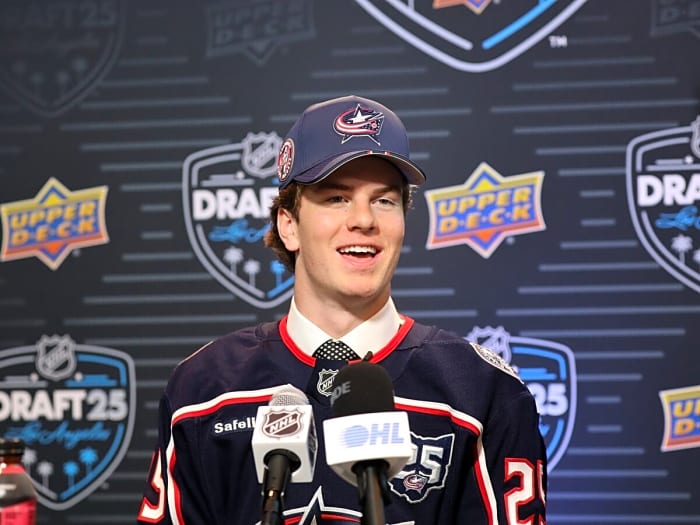
Defensively, he still needs some development. He has blocked 10 shots and is minus-1 on the season, but also has accumulated 14 penalty minutes in 14 games, all minor penalties (seven). Decision-making will improve with experience, especially considering he is an 18-year-old freshman.
Smith was cut from Team Canada’s World Junior roster after attending camp and having one tough outing in the preliminary games. That contributed to the Blue Jackets having no prospects at the World Juniors this year. It is not ideal, but he is still developing in a tough conference like the Big Ten.
While he is not putting up the wild numbers some top-15 picks do, the NCAA can be difficult for freshmen. I have confidence he will become an NHL-ready defenseman in a few seasons with continued development at Penn State and with his natural ability at his size.
Malte Vass, LD, Boston University
Malte Vass, a 2025 third-round pick at 76th overall, has had a limited role at Boston University of the Hockey East so far this season. The Terriers are 9-8-1 overall and ranked 19th in the country. Vass has recorded three points, all assists, and is averaging 0.23 points per game while playing 7:37 per night. He has been on the left side of the third defensive pairing alongside right defenseman Carter Amico, a Philadelphia Flyers draft pick.
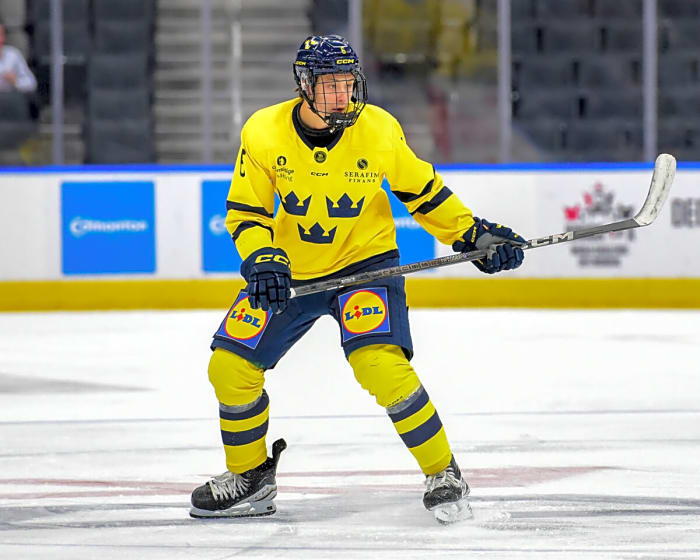
Vass is minus-3 on the season, has registered only four shots on goal, and has blocked 10 shots in 13 games. He is a defensive defenseman and plays a physical, heavy style at 6-foot-3, 193 pounds. The 18-year-old Swede will need more time to develop, especially in a tough conference like Hockey East, but the tools are there for him to grow into a reliable shutdown presence.
Andrew Strathmann, LD, North Dakota
Andrew Strathmann, a 2023 fourth-round pick, has moved around North Dakota’s defensive core this season and has played on multiple pairings on the left side. The sophomore defenseman is plus-8 on the season but has only one point, an assist, through 16 games. He has played with EJ Emery and Sam Laurila at different points, and with a full lineup, it appears he is settling into the third defensive pairing with Emery. Strathmann is averaging 11:59 of ice time per game.
The 5-foot-11, 190-pound 20-year-old is reliable and smart with the puck. He has room to grow offensively on a dynamic North Dakota team that is 14-4-0 and ranked fourth in the country. His defensive game is his strongest area, with 17 blocked shots this season, and he makes good decisions and breaks pucks out well. He should continue to develop in the NCHC, one of the toughest conferences in college hockey.
Luke Ashton, LD, Cornell
Luke Ashton, a 2024 sixth-round pick at 165th overall, is a massive presence on Cornell’s blue line in the ECAC. He stands at 6-foot-5, 235 pounds and spent last season at Minnesota State, where he recorded 13 points in 38 games on an NCAA Tournament team. They nearly upset Western Michigan in the opening round of their regional, but lost in overtime.
The 20-year-old sophomore defenseman averages 19:26 of ice time per game, a strong workload for a player his size, and typically plays on the second defensive pairing with right defenseman George Fegaras.
Ashton is physical but also smart and disciplined. He has taken only one penalty this season, a single minor, and has blocked 10 shots. He has three assists for three points and has appeared in all 11 games for the Big Red, while being plus-6 on the season. Cornell is 7-4-0 and ranked 17th in the country, and Ashton will continue developing on a team with a chance to reach the NCAA Tournament for a fourth straight season.
Tanner Henricks, RD, St. Cloud State
Tanner Henricks, a 2024 fourth-round pick at 101st overall, suffered an unfortunate injury in early November in a fall after a high hit from his own brother, Ty Henricks of Western Michigan. He was ruled out for roughly three months and is targeting a return late this season. Henricks likely would have been in the mix for the USA World Junior roster had he not been injured. He played in the World Junior Summer Showcase this past summer and was trending in that direction before the freak injury.
Before going down, Henricks played six games and recorded four points on one goal and three assists. He averaged 16:02 of ice time per game and produced 0.67 points per game. He was playing on the right side of the top pairing with left defenseman Cooper Wylie.
The 6-foot-4, 205-pound 19-year-old is a two-way defenseman who had seven blocked shots in those six games. He breaks pucks out well, skates at a high level, and can make plays. He scored his first collegiate goal on the road at Bemidji State in early October and already shows strong instincts on when to pinch vs when to stay home. He also saw time on the power play before the injury.
Henricks has the makings of a strong middle-round pick who could reach the NHL one day. He will need more time to develop after missing most of his freshman season, but his size, mobility, and two-way talent make him a promising long-term prospect.
Melvin Strahl, G, Michigan State
Melvin Strahl, a 2023 fifth-round pick at 156th overall, has taken on a limited role at Michigan State this season as the backup to star netminder and Detroit Red Wings prospect Trey Augustine.
Strahl posted a 2.24 goals-against average (GAA) and a .903 save percentage (SV%) in 48 USHL games last season with the Youngstown Phantoms and set the franchise record for wins in a single season with a league-best 33-12-0-1 record. His postseason was rough and short-lived, though, as he finished with a 7.18 GAA and .706 SV% in two Clark Cup playoff games.
He has appeared in two games for Michigan State this season and is 2-0-0 with a 2.00 GAA and .927 SV%. He started on the road at Northern Michigan and made 22 saves on 24 shots, then earned another start at home against Colgate and stopped 29 of 31 shots.
Strahl has a lot of promise and is viewed as the future of Michigan State’s crease once Augustine goes pro, which is likely after this season. Strahl stands at 6-foot-3, 170 pounds, has solid size, and impressed at the Blue Jackets’ Development Camp this past summer. He could see a few more starts as the season progresses, but I need to see more at the college level before projecting his NHL or AHL future.
The second half of the NCAA season will be important for this entire group. The Blue Jackets will be looking for much-needed growth from players like Lindstrom, along with development from the rest of their collegiate prospects, as they close out the season. Many of these players are on strong teams that are tracking toward the NCAA Tournament, so several of them should be playing meaningful games in March, so stay tuned.
More must-reads:
- Winners, losers from Tuesday's Stanley Cup playoffs: Sabres' Zach Benson scores game-winner on his birthday
- Penguins' Kyle Dubas gives Evgeni Malkin update amid uncertainty
- The 'Active NBA double-double leaders' quiz
Breaking News
Trending News







Customize Your Newsletter
 +
+




Get the latest news and rumors, customized to your favorite sports and teams. Emailed daily. Always free!
PRIVACY POLICY COOKIE POLICY CONTACT US
ABOUT YARDBARKER TERMS OF SERVICE


By using this site, you agree to our Terms of Service and Privacy Policy.
This site is for entertainment purposes only.
There is no gambling offered on this site.
Gambling Problem? Call 1-800-Gambler.
