
-

-


Follow Us
-

 On Facebook
 On Flipboard


In the past two off-seasons, the Edmonton Oilers made significant attempts at upgrading their winger depth, adding Jeff Skinner and Viktor Arvidsson during the 2024 free agency and then Andrew Mangiapane in 2025. On paper, it seemed reasonable to think that at least one of those players could have found success on Connor McDavid or Leon Draisaitl’s wings.
But each of those signings ultimately failed to pan out for the Oilers. Skinner left in free agency after spending much of Edmonton’s 2025 playoff run as a healthy scratch, Arvidsson was moved to Boston in a cap‑clearing trade, and Mangiapane was dealt at the 2026 Trade Deadline.
There are several plausible explanations as to why these additions failed to materialize. Both Arvidsson and Mangiapane had an injury history, and Skinner was a poor defensive player who also failed to succeed with San Jose in 2025-26, so there are player-specific factors at play here. I also believe coaching was a huge reason; as I discussed in detail in an article a few weeks back, there was a general trend of Kris Knoblauch failing to get the most out of his forwards.
At the same time, it’s interesting to note Vasily Podkolzin’s success. Prior to his arrival in Edmonton, Podkolzin certainly didn’t have much positive experience in an NHL top-six; in fact, the season before he was traded, Podkolzin spent most of the year in the AHL. And yet, he wound up being substantially more useful to Edmonton than any of Skinner, Arvidsson and Mangiapane.
I believe there is another variable at play here, one that is often heavily underrated and undermentioned in much of public hockey discourse: chemistry.
In this article, I would like to dive deeper into the various lines that McDavid and Draisaitl have played on over the past few years, identify the common traits among the wingers who have succeeded, and outline what this should mean for Edmonton moving forward, both in terms of deployment by Edmonton’s next head coach – whoever it may be – and roster construction by management.
*All statistics via Natural Stat Trick, EvolvingHockey and AllThreeZones
What types of players succeed on Leon Draisaitl’s wing?
We’ll start with an analysis of Draisaitl’s wingers. I compiled every line that has logged at least 50 minutes at 5‑on‑5 over the past seven seasons with Draisaitl on it. Lines involving McDavid were removed as we’re specifically looking at Draisaitl’s second-line performance.
Then, I ranked those lines by goal share, which is the percent of on-ice goals that a line has controlled (e.g. if a line is on-ice for 3 goals for and 2 goals against, they have a 60 percent goal share, as they have controlled 3 of the 5 (60 percent) total goals on-ice). I also included expected goal share to identify whether results were driven by sustainable play or short‑term puck luck, which can be common in small sample sizes. Here are the results:
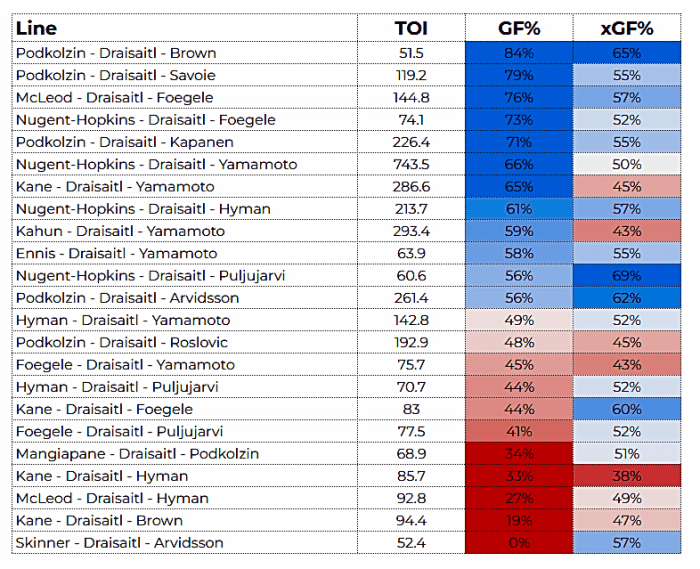
Before interpreting these results, it is important to note that some of these samples are rather small, and are thus prone to variance or noise. The goal of this exercise is not to produce a definitive ranking of every combination, but to identify a general trend in which wingers consistently helped Draisaitl drive play.
First, we can see a clear common denominator in three of the top-five lines here: Vasily Podkolzin.
Podkolzin has been Draisaitl’s most frequent 5‑on‑5 winger over the past two seasons, and the results justify that usage. As a duo, they have posted a 58 percent goal share and a 55 percent expected goal share. Without Podkolzin, Draisaitl’s numbers fall to 50 and 47 percent respectively. It seems incredibly clear that there is legitimately strong chemistry between Draisaitl and Podkolzin.
The other two lines in the top-five feature Warren Foegele, who left the team in free agency in 2024, but there seemed to be strong chemistry between Foegele and Draisaitl as well. Those two had an excellent 59 percent goal share and 54 percent expected goal share from 2021 through 2024 in a solid total sample size of 625 minutes.
Furthermore, the most commonly deployed second-line since 2019 is the line of Ryan Nugent-Hopkins, Leon Draisaitl, and Kailer Yamamoto, a line which was often called the “DRY” line. That line was fantastic in 2019-20, and many fans should recall that it almost single-handedly drove the team to a playoff spot that year during McDavid’s injury absence in February of 2020. In 743 minutes, they hold an outstanding 66 percent goal share.
Unfortunately, though it seemed that Yamamoto had immense potential in 2019-20, that season would turn out to be the peak of his tenure in Edmonton, as he sharply regressed in subsequent seasons, and it reflected in the “DRY” line’s declining expected goal share from 2020-21 through 2022-23. Nevertheless, their success in the season in which Draisaitl won the Hart Trophy is worth noting.
Now, what do Podkolzin, Foegele, and 2019-20 Yamamoto have in common, in addition to some of the other players that have appeared in those top lines, like Kasperi Kapanen, Matt Savoie and Ryan McLeod?
Each of them are very good forecheckers.
More specifically, each of those players are, to varying extents, agile and shifty players that are/were tenacious on the forecheck. They consistently and efficiently forced turnovers, disrupted opposing zone exits, and retrieved loose pucks. This, in turn, led to significantly increased time in the offensive zone and more time for Draisaitl with the puck on his stick, and the result was a line that would dominate goals and possession. This is something that even Draisaitl himself has seemed to note in regards to Podkolzin, who is quite notably Edmonton’s leader in forecheck pressures per 60 over the past two seasons per AllThreeZones.
“Podzy does a lot of things that a lot of people who don’t really understand hockey, they don’t see it,” said Draisaitl back in September. “He does a lot of work for me and it lets me have a lot of time with the puck and sets me up with great situations where I lack that in my game.”
One may argue that the exception to this is Zach Hyman, who is a very strong forechecker himself but has not had massive success with Draisaitl. Still, the RNH – Draisaitl – Hyman line does have strong results in the minutes they have played, and Hyman has spent massively more time with McDavid compared to Draisaitl, and so I don’t think it weakens this trend.
Conversely, it’s interesting and important to note that Draisaitl has seemed to find more success with these forecheckers, even those with unspectacular production totals, rather than scoring wingers.
For example, Draisaitl never found much success with Evander Kane. In fact, those two were awful defensively together. While the Kane – Draisaitl – Yamamoto did have a 65 percent goal share, their 45 percent expected goal share indicates it was a result of unsustainable puck luck, and the other lines where Draisaitl and Kane were paired together ranked below 45 percent.
Draisaitl also did not perform very well with Jeff Skinner (though the sample is not large here), and his results with Jack Roslovic this season are also mediocre. In fact, despite the fact that Roslovic is a proven 20+ goal scorer, Draisaitl and Roslovic as a duo were thoroughly out-chanced this season. Compare that to Kasperi Kapanen, for example, a player that has not scored 20 goals since 2018, and yet Kapanen was leaps and bounds better on Draisaitl’s right-wing.
The Podkolzin – Draisaitl – Kapanen line was perhaps the lone bright spot of Edmonton’s first-round loss to Anaheim. In the regular-season, they out-scored opponents 12 to 3, an 80 goal share. In the playoffs, they were up 6 to 0!
It’s also worth noting that players like Podkolzin and McLeod are fairly reliable in their own end. Compare this to Kane and Roslovic, who heavily struggle defensively and are both, interestingly, very poor at board battles.
All things considered, there seems to be significant evidence that Draisaitl is best when playing next to agile, defensively-responsible forecheckers that can get him the puck, even if their production is relatively unimpressive, compared to scoring wingers that can put the puck in the net but are one-dimensional otherwise.
What types of players succeed on Connor McDavid’s wing?
Let’s repeat the same process with Connor McDavid. Here are the results:

It’s a bit more difficult to decipher a clear-cut trend with McDavid’s line combinations compared to Draisaitl’s, as these results are more all over the place. Nevertheless, there are conclusions to be made.
We’ll start with the fact that McDavid and Hyman are clearly a fantastic duo. There are nine different line combinations of Hyman – McDavid – X above; seven of them have a goal share above 50 percent, and eight of them have an expected goal share above 50 percent. Overall, McDavid and Hyman’s results are simply elite. There is no duo better in the world at generating high-quality scoring chances at 5-on-5.
The most commonly deployed line with McDavid (no Draisaitl) over the past decade is Nugent-Hopkins – McDavid – Hyman. Now in the aggregate, their results of a 57 percent goal share and 63 percent expected goal share are very strong. But, if you look at their season-by-season results, it paints an interesting narrative.
In 2023-24, the RNH – McDavid – Hyman line was brilliant, possessing a 63 percent GF%, 65 xGF%. That line was simply unstoppable off the cycle that season. In 2024-25, they were at 55 GF% and 60 xGF%. Very good, but a noticeable decrease in goal share.
Then, in 2025-26, their xGF% remained at a strong 57 percent, but they dropped to a net negative in goal-share at 49 percent, being out-scored 23 to 24. This line still did a strong job at generating high-danger chances, but their ability to finish those chances saw a massive drop.
Some of this is due to the fact that Zach Hyman is not scoring at a 54-goal pace anymore. But, it seems to be more correlated with Nugent-Hopkins’ decline. Over the past two seasons, RNH’s 5-on-5 points per 60 rate ranks 334th; in fact, he had less 5v5 points than the likes of Nick Cousins and Jordan Martinook this year.
RNH and McDavid were a strong duo for several years, having had success with a variety of third wingers aside from just Hyman, even with the likes of Zack Kassian and Kailer Yamamoto a few years back. But, the unfortunate reality is that RNH is not producing at a top-six level anymore. If he can’t finish with McDavid and Hyman, as seen in the past two years, he seems much more suited to a 3C role over 1LW.
So, McDavid and Hyman can generate high-quality chances. That much is clear. But to optimize that line, I believe they need a scoring winger, someone that can consistently capitalize on those chances.
Compared to Draisaitl, it’s worth noting that McDavid has seemed to have much more success with the aforementioned one-dimensional scoring wingers. Kane – McDavid – Puljujarvi/Yamamoto had very good results in prior seasons. McDavid – Skinner also had excellent results in the limited minutes they played, which makes it all the more frustrating that Knoblauch did not deploy them more frequently in 2024-25. McDavid even had some solid results with James Neal in 2019-20 when Neal was scoring.
Still, preferably this scoring winger should not be entirely one-dimensional either, as while Kane – McDavid – Hyman had above-average finishing, they had below-average play-driving. So, the most important trait for the “optimal” winger for McDavid and Hyman seems to be someone that can finish chances, but this winger should also be able to generate off the cycle and not be a total liability in their own zone.
So, what does this all mean for Edmonton moving forward?
First, we can suggest more reasons as to why Skinner, Arvidsson and Mangiapane failed to meet expectations in Edmonton. Skinner had potential next to McDavid, but was never given ample opportunity by the coaching staff. Arvidsson was much more of a rush player than a forechecker, potentially explaining why he was never a spectacular fit with Draisaitl. Although the Podkolzin – Draisaitl – Arvidsson line had strong results, I believe Podkolzin deserves more credit, and the likes of Kapanen and Savoie – superior forecheckers to Arvidsson – outperformed him in that exact role. Finally, Mangiapane was neither an exceptional forechecker nor an efficient finisher at this stage of his career, largely contributing to the fact that he never found a consistent spot in the top-six.
Moving forward, I think it’s clear that the Oilers top-six should be centered around the duos of McDavid – Hyman and Draisaitl – Podkolzin. The main question should be who the third winger should be for each.
Matt Savoie is a strong candidate for either spot. His second‑half scoring surge and forechecking ability make him a versatile fit. He can support Draisaitl’s need for puck retrieval, but also has enough offensive touch to complement McDavid and Hyman.
Isaac Howard is another option, though his profile aligns more naturally with McDavid. Howard’s primary weapon is his shot, and while detailed forechecking data is not available for lower leagues, a snippet of Howard’s microstats (here) from the NCAA shows that Howard did not rank well in winning puck battles. It seems Howard is more optimal as McDavid’s winger. That would leave Savoie as Draisaitl’s RW alongside Podkolzin.
Of course, the Oilers could also re-sign Kapanen and see if Podkolzin – Draisaitl – Kapanen’s success can continue, which, as suggested in this article, could absolutely be possible. In this scenario, one of Howard and Savoie would be on McDavid’s wing, while the other could form a very strong third-line with RNH.
The Oilers could also go even more ambitious and pursue a much more high-end winger. For example, Jeff Marek recently brought up Jordan Kyrou of the St. Louis Blues as an option, and while any deal to acquire Kyrou would likely involve one of Howard and Savoie (plus more), Kyrou, with his combination of finishing and all-around talent, could be the perfect LW for McDavid.
All-in-all, the Oilers should be paying more attention to line chemistry and stylistic fit as they construct the 2026-27 Oilers roster. We’ll see how management decides to approach this.
More must-reads:
- Sidney Crosby passes Hall of Famer Joe Thornton on NHL all-time leaderboard
- Rick Tocchet blames Flyers' struggles on 'horny' defensemen
- The '2nd-most TD-passes by NFL team' quiz
Breaking News
Trending News


Customize Your Newsletter
 +
+




Get the latest news and rumors, customized to your favorite sports and teams. Emailed daily. Always free!
PRIVACY POLICY COOKIE POLICY CONTACT US
ABOUT YARDBARKER TERMS OF SERVICE


By using this site, you agree to our Terms of Service and Privacy Policy.
This site is for entertainment purposes only.
There is no gambling offered on this site.
Gambling Problem? Call 1-800-Gambler.
